
Whether in global coffee chains or the rapidly expanding food delivery sector, the molded fiber cup carrier (or drink carrier) is a high-demand protective packaging product. Unlike premium consumer electronics inserts that require an extremely smooth surface, a cup carrier’s primary function is to support, secure, and buffer multiple beverage cups during transport. Therefore, cup carriers are predominantly manufactured using the dry press or semi-dry press molded fiber process.
For investors planning a new production facility or expanding existing capacity, selecting the right cup carrier equipment requires making strategic trade-offs among three core factors: actual production capacity, dimensional precision (deformation control), and the optimal level of automation.
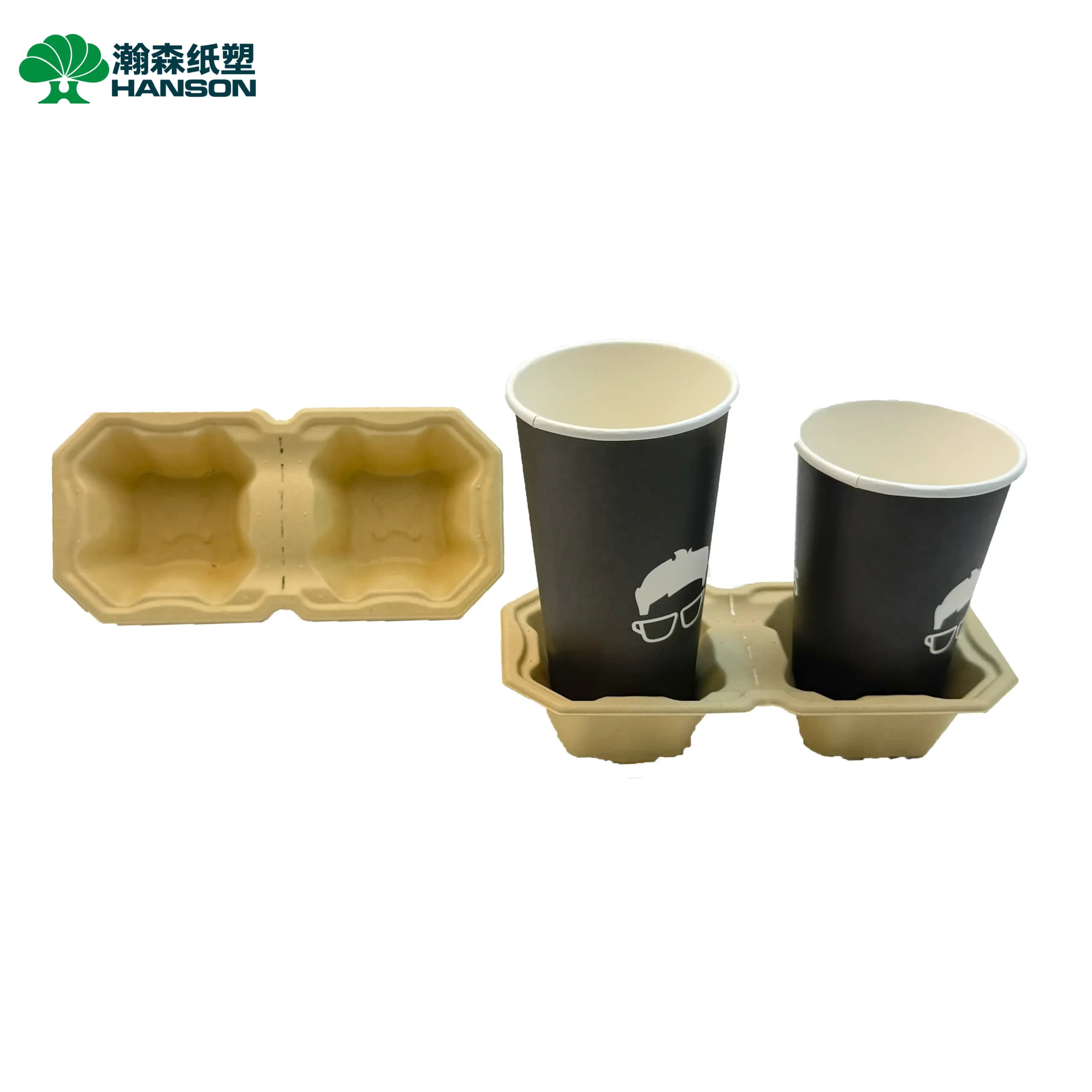
Capacity Planning: Moving Beyond Theoretical Cycle Times
A common mistake when evaluating cup carrier equipment is relying solely on the machine’s “theoretical cycle time” to calculate daily output. In reality, the production capacity of a pulp molding plant is the result of a complex, interconnected system.
-
Product Weight and Dewatering Load: Cup carriers are thick-wall protective products. A standard 4-cup carrier, for example, can weigh around 40 grams or more. Heavier products require more pulp slurry per cycle, which inherently carries more water into the subsequent stages, increasing the load on the dewatering and drying systems.
-
Mold Size and Cavity Layout: The physical size of the mold table (e.g., a large 1300 × 1300 mm platen) dictates how many cavities can be arranged per cycle, directly impacting the output volume per drop.
-
The Drying Bottleneck: In a traditional dry press process, even if the forming machine operates at a high speed, production will bottleneck if the wet preforms retain too much moisture and the drying tunnel cannot process them fast enough.
Therefore, true capacity must be evaluated by looking at the forming, dewatering, and drying stages as a unified system rather than isolated machine specs.
Controlling Precision and Deformation in Dry-Press Production
While a cup carrier does not require the micro-millimeter tolerances of a smartphone tray, it must maintain structural rigidity and precise cup-hole alignment to prevent beverages from spilling.
The most common quality issue in dry-press cup carrier production is drying deformation. When wet preforms with high moisture content enter a high-temperature tunnel oven, the rapid evaporation of water often causes the product to warp or shrink unpredictably.
To balance the high efficiency of the dry press process with dimensional stability, the cold pressing (pre-dewatering) process has become a critical technological upgrade. By introducing a servo-driven cold pressing station between the forming and drying stages, excess water is physically squeezed out while the product is still constrained by a mold. This significantly lowers the moisture content before drying, drastically reduces heat-induced deformation, and helps minimize mold scaling—ultimately extending mold maintenance cycles and improving overall line uptime. A final hot pressing station after drying ensures optimal flatness and stacking consistency.
The Value of Automation in Cup Carrier Production
Cup carriers are high-volume, cost-sensitive consumables. Relying on manual labor to transfer wet preforms or stack finished products is increasingly unsustainable due to labor costs and the need for consistent output.
In a modern automatic dry-press production line, automation is primarily about seamless process integration. For instance, employing truss manipulators to automatically transfer products across forming, cold pressing, drying, hot pressing, and stacking stations. This not only reduces headcount but, more importantly, eliminates the rhythm fluctuations caused by human fatigue, ensuring the equipment maintains a highly stable production cadence (uptime).
Hanson Pulp Molding’s Automatic Dry-Press Production Line
As a specialist in turnkey pulp molding solutions, Hanson Pulp Molding has developed an Automatic Dry-Press Pulp Molding Production Line specifically designed for high-volume protective packaging like cup carriers, egg cartons, and industrial inserts.
-
Innovative Process Flow: The line features a continuous workflow: Forming → Cold Pressing / Pre-Dewatering → Drying → Hot Pressing → Stacking, with all transfers handled by automated truss manipulators.
-
Capacity and Energy Performance: Taking a 40g 4-cup carrier as an example, this dry press line can achieve a standard capacity of approximately 18 tons per 23 hours under appropriate production conditions. Thanks to the efficient cold pressing stage, reference energy consumption sits at approximately 900 kWh/ton for electricity and 280 m³/ton for natural gas drying (actual figures depend on specific product and plant conditions).
-
High Uptime and Flexibility: Driven entirely by servo motors, the motion mechanisms ensure precise positioning and stability. The system accommodates large 1300 × 1300 mm molds with a quick-change design, making it highly suitable for both continuous mass production of cup carriers and frequent changeovers for various deep-cavity industrial protective inserts.
FAQ
Q: Should I use a wet press or dry press machine for cup carriers? A: Cup carriers function primarily as protective and support packaging, making the dry press or semi-dry press route the optimal choice. The dry press process offers better cost-efficiency and volume for thick-wall products, whereas wet pressing is generally reserved for premium packaging requiring extremely smooth surfaces.
Q: Why does the Hanson dry press line include a cold pressing (pre-dewatering) station? A: Introducing a cold pressing step before the tunnel dryer physically removes a significant amount of water from the wet preform. This reduces the energy load on the dryer, minimizes product warping during the drying phase, reduces mold scaling, and ultimately boosts the line’s overall operating stability.
Q: What is the exact daily capacity of a cup carrier machine? A: Capacity is strictly tied to the specific product design. For example, on the Hanson Pulp Molding automatic dry press line, producing a 40g 4-cup carrier yields approximately 18 tons per 23 hours. However, actual daily output will fluctuate based on the product weight, cavity layout, drying efficiency, and changeover frequency.
Conclusion
Choosing the right cup carrier equipment is not a simple matter of comparing the theoretical speeds of individual machines. The core of your decision should focus on how well the forming, pre-dewatering, drying, and hot pressing stages are integrated, and whether the automated transfer system can deliver true, sustainable uptime. By working backward from your product specifications and selecting a turnkey solution, you can build a stable, cost-effective manufacturing operation.
CTA
If you already have a product sample, 3D drawing, product dimensions, or target daily capacity for your cup carrier or protective packaging project, Hanson Pulp Molding can help evaluate the molding process, tooling, and complete automatic dry-press equipment configuration for your new plant.
WhatsApp: +86 15920604830
Email: linchuangcheng@hspulpmolding.com