
In a molded fiber factory project, completing the equipment installation does not mean you are ready for stable commercial production. During the acceptance phase, many investors focus solely on the “dry run cycle time” of the machine, overlooking the fact that molded fiber production is a comprehensive system comprising materials, equipment, tooling, and process control.
Particularly in high-quality wet-press foodservice packaging or premium industrial molded fiber packaging projects, the pulp molding mold (or tooling) is far more than a simple accessory. It directly dictates the forming quality, dewatering efficiency, and actual capacity of your production line. Therefore, the acceptance of pulp molding molds and equipment must be evaluated together based on real-world mass production standards.
Why Molded Fiber Tooling is More Than Just an Accessory
The fundamental logic of molded fiber production involves using a vacuum to draw fibers from the pulp slurry onto the mesh of a forming mold, followed by dewatering, transfer, and hot pressing (or drying). The pulp molding mold is actively involved in almost every critical step:
The forming mold determines the 3D structure of the product, while its mesh layout and drainage design influence fiber retention and forming uniformity. The hot press mold is responsible for heating, pressing, moisture venting, and surface finishing. If the mold design does not match the equipment’s operational cycle, vacuum system, or heat source configuration, the factory will inevitably face issues like product deformation, high moisture content, and poor yield, regardless of how advanced the main forming machine is.
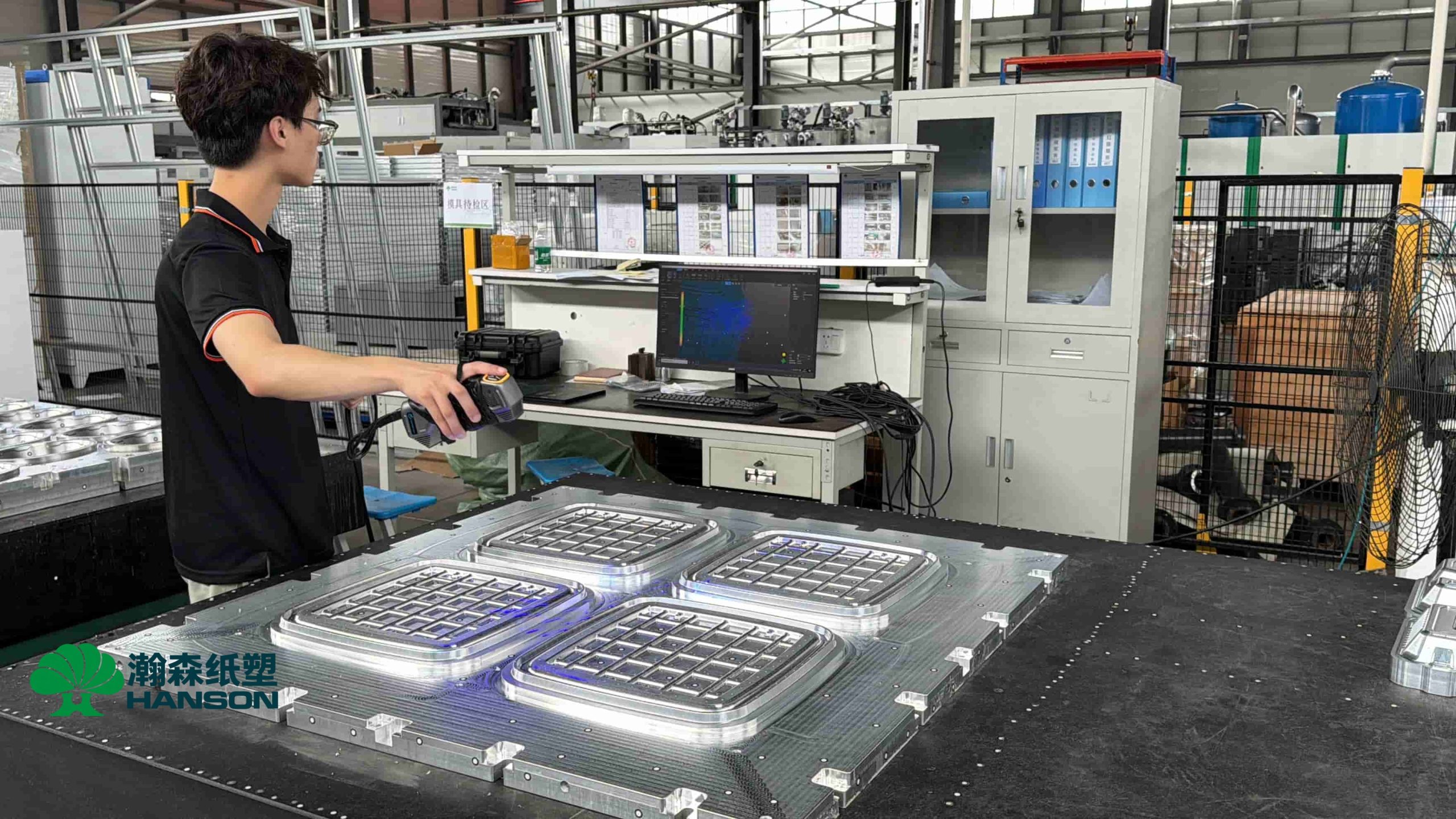
Core Acceptance Indicators for Pulp Molding Molds and Equipment
When professional buyers conduct equipment and tooling acceptance, they focus on several core indicators that directly impact profitability and scale:
1. Dimensional Accuracy and Surface Quality
This is the baseline for product delivery. During acceptance, it is vital to inspect the product’s performance after forming and hot pressing. For premium industrial packaging, the surface must be smooth, dense, and free of defects. Key dimensions should fall strictly within tolerances. Furthermore, by comparing products from different cavities in the same batch, you can evaluate whether the mold ensures uniform pulp slurry distribution across all areas.
2. Dewatering Efficiency of the Wet Preform
Removing water from fibers efficiently is a central challenge in molded fiber manufacturing. The dewatering efficiency of the mold affects not only production speed but also energy consumption. If a poorly designed mold leaves the wet preform with excess moisture content, it will increase the thermal load during the hot pressing stage. This leads to longer hot-pressing times, higher energy consumption, and an increased risk of product warping or uneven drying.
3. Mold-to-Equipment Coordination and Transfer Stability
Wet preforms are fragile and still retain significant moisture when they are transferred from the forming mold to the transfer tool or hot press mold. Acceptance must verify the in-machine mold transfer process. Are the molds positioned with high accuracy? Does the product demold cleanly without tearing or sticking? The parallelism and even force distribution of the equipment during clamping directly affect both mold lifespan and product integrity.
4. Actual Yield and Production Consistency
Theoretical cycle time should never be equated with actual daily production capacity. A valid acceptance test requires a continuous operational run under actual production conditions. It must account for variables like mold cleaning, process adjustments, and downtime. True production capacity is only meaningful when the yield rate and production consistency meet the required commercial standards.
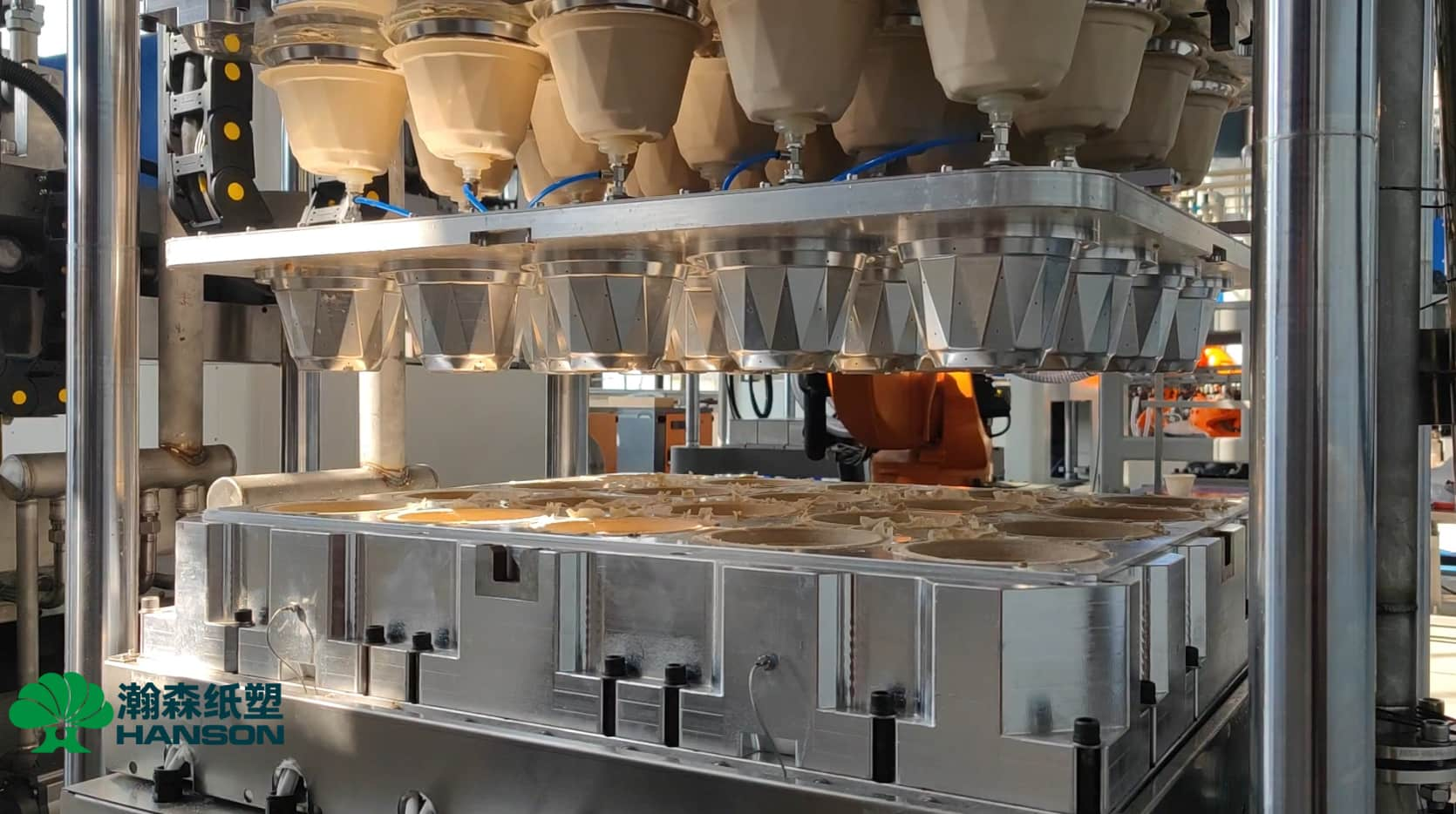
The Importance of Equipment, Tooling, and Process Synergy
Whether setting up a new production line or optimizing an existing factory, many perceived “equipment problems” are actually the result of mismatched molds and processes. For instance, product deformation is not always due to incorrect hot-pressing temperatures; it can often be traced back to inadequate moisture venting channels in the mold.
As a specialist in turnkey pulp molding solutions, Hanson Pulp Molding provides not only high-performance forming equipment but also comprehensive mold manufacturing and process development capabilities. Hanson Pulp Molding works closely with clients to synergize equipment, molds, and processes, and also offers old mold optimization and technical upgrades for existing production lines. By deeply understanding the relationship between the mold, the process, and the equipment, Hanson helps clients push their pulp molding projects from a concept to stable mass production.
FAQ
Can the same machine achieve the same production capacity with different molds? Not necessarily. Different molds change the number of cavities, product size, and unit weight. The drainage efficiency of the mold also affects forming and hot-pressing times. Therefore, the actual daily output can vary significantly when the same equipment runs different products.
If the product is too thin in certain areas or tears, is it an equipment vacuum issue or a mold problem? This is typically an issue of equipment and mold coordination. It could be caused by unreasonable mesh exhaust or slurry flow design in that specific area of the mold, or it might require optimization of the vacuum distribution and timing in the forming process. A joint evaluation is necessary.
Should new products be prototyped before ordering mass production molds and equipment? Yes. Prototyping helps validate the product structure, tooling design, surface finish, and process parameters before large-scale investment. This significantly reduces the risk of errors when transitioning to commercial production.
Conclusion
The acceptance of pulp molding molds and equipment is essentially a systemic evaluation of the production line’s capacity for mass production. By focusing on comprehensive indicators like forming quality, dewatering efficiency, transfer stability, and actual yield, investors can ensure that the equipment parameters and mold design work harmoniously to achieve efficient and stable commercial output.
If your molded fiber project is experiencing product deformation, subpar surface quality, dimensional fluctuations, or unstable production capacity, simply checking the equipment parameters is not enough. Hanson Pulp Molding can evaluate the issue by combining insights from the product, tooling, process, and equipment. Whether you need new mold development, old mold optimization, or complete process adjustments, we are here to help.
WhatsApp: +86 15920604830 Email: linchuangcheng@hspulpmolding.com