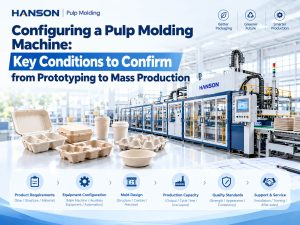
When planning a turnkey pulp molding plant or upgrading an existing production line, investors often grapple with a critical question: To what extent should we automate our pulp molding molds and forming equipment?
There is a common misconception that 100% automation is always the ultimate goal. In reality, the actual production capacity and profitability of a molded fiber project are not determined by the machine alone. They are heavily influenced by the synergy between the pulp molding mold (tooling), the equipment setup, and the manufacturing process. The appropriate level of automation must be evaluated based on your product portfolio, changeover frequency, and operational capabilities.
Why Tooling is the Core of Molded Fiber Automation
In any automated pulp molding machine, the mold is much more than just a shaping tool; it is the physical nexus where fluid dynamics, thermodynamics, and mechanical transfer intersect.
-
Demolding Reliability Dictates Uptime: Fully automated in-machine mold transfer or robotic unloading systems rely completely on stable demolding. If the draft angles or surface finishes of the tooling are poorly designed, wet preforms will stick to the mesh. This causes automated handling systems to fail, leading to frequent downtime and severely reducing the actual production capacity.
-
Dewatering Efficiency Drives Cycle Times: The moisture content of the wet preform directly impacts the subsequent hot pressing and drying stages. Well-designed tooling optimizes initial vacuum dewatering, meaning less water needs to be evaporated via thermal energy. This synergy significantly speeds up the automated hot-pressing cycle and reduces energy consumption.
-
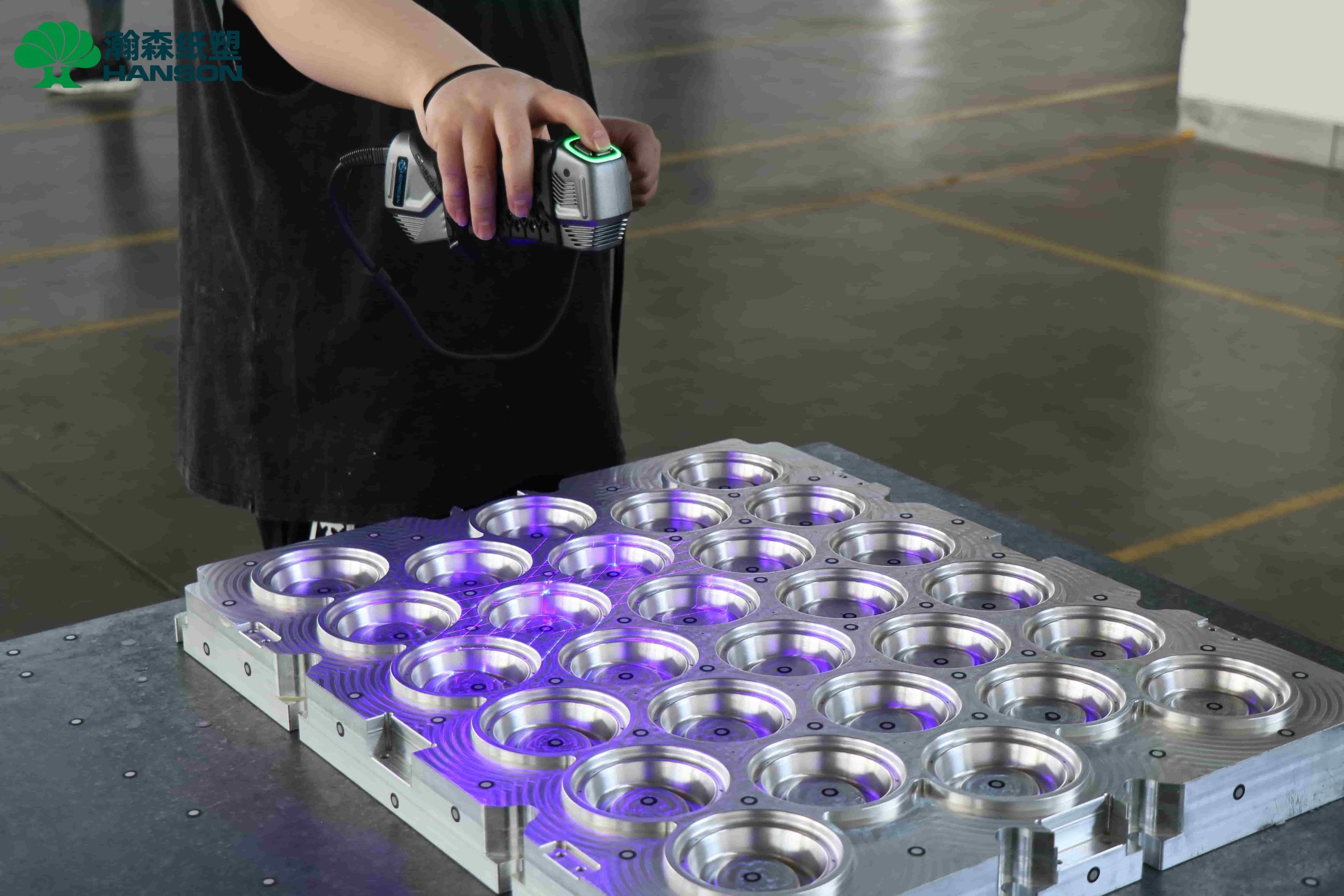
Dimensional Accuracy Enables Post-Processing: The precision of the forming and hot-press molds determines the dimensional stability of the final product. If parts suffer from warping or inconsistent shrinkage, downstream automation—such as servo-driven punch cutting, machine vision inspection, or automatic packaging—will struggle to operate smoothly.
3 Key Dimensions for Evaluating Your Automation Needs
Rather than simply choosing the machine with the highest theoretical speed, manufacturers should evaluate mold automation based on the following practical dimensions:
-
Product Changeover Frequency “Changeable molds” do not necessarily mean the line is suitable for frequent changeovers. Swapping a mold also requires re-calibrating pulp consistency, vacuum timing, hot-press temperatures, and trimming alignment. If your factory handles low-volume, high-mix orders, excessive automation may actually hurt your overall equipment effectiveness (OEE) due to prolonged setup and debugging times.
-
Post-Processing Automation Matching A production line is only as fast as its slowest bottleneck. If your forming tooling features a high number of cavities that output products rapidly, but your trimming, stacking, or laminating systems cannot keep pace, products will pile up. Tooling capacity must be perfectly synchronized with downstream automation capabilities.
-
Local Maintenance and Process Control Skills Highly automated lines demand skilled onsite engineers who understand how to fine-tune both the equipment and the pulp molding process. The level of automation should always match your project’s commercial model and your team’s technical readiness.
Hanson Pulp Molding: Synergizing Tooling, Process, and Equipment
As a specialist in turnkey pulp molding solutions, Hanson Pulp Molding understands that true B2B industrial reliability cannot be judged by a single machine specification.
We emphasize that forming equipment, tooling, and processes must be jointly designed and debugged around the final product. By integrating our deep knowledge of molds, processes, and equipment, we ensure seamless transitions from forming and dewatering to hot pressing and automatic trimming.
Whether providing custom tooling for new product development, optimizing existing molds to resolve demolding issues, or executing full turnkey setups, Hanson Pulp Molding connects every phase of the manufacturing process to help clients achieve stable commercial production.

FAQ
Does changing the mold on the same machine change the daily output? Yes. Different molds change the number of cavities, product weight, dewatering efficiency, and required hot-pressing time. Therefore, running different products on the same machine will result in varying actual production capacities.
Is changing a product as simple as swapping the mold? Not always. While physically swapping the tooling is required, operators usually also need to adjust pulp formulation, vacuum settings, hot-pressing temperatures, and downstream automation logic to ensure production consistency.
Is higher automation always better for pulp molding? No. The ideal automation level depends on your project scale, local labor costs, product changeover frequency, and technical maintenance capabilities. Automation should be matched to your specific commercial model.
Conclusion
Determining the right automation level for your pulp molding molds requires looking beyond theoretical machine speeds. It demands a holistic approach that aligns your product characteristics, tooling design, and process parameters with your overall production line. By ensuring seamless synergy between the mold and the equipment, manufacturers can maximize equipment uptime and secure long-term profitability.
If you already have a product sample, 3D drawing, product dimensions, or a target daily capacity, Hanson Pulp Molding can help evaluate the molding process, tooling design, and equipment configuration for your specific project.
WhatsApp: +86 15920604830 Email: linchuangcheng@hspulpmolding.com