Turnkey Pulp Molding Solutions
From Product Development to Stable Mass Production
Building a pulp molding factory is not simply a matter of purchasing several machines.
A complete molded fiber production system involves product design, raw material preparation, pulping, forming, hot pressing, mold engineering, trimming, coating or lamination, inspection, packaging, utilities, automation, operators and production management.
If these systems are designed separately, problems often appear after installation.
The pulping system may not match the forming equipment.The mold may not fully utilize machine performance.The post-processing system may become a bottleneck.Production capacity may fall below expectations.And when a problem occurs, responsibility may be divided among several suppliers.
This is why more manufacturers are looking beyond individual machines and choosing a turnkey pulp molding solution.
At Hanson Pulp Molding, we provide more than equipment.
We help customers build a complete pulp molding production system — from product concept and factory planning to installation, commissioning and stable mass production.
Why Are More Manufacturers Choosing Turnkey Pulp Molding Solutions?
In the early stage of the pulp molding industry, many factories purchased different systems from different suppliers.One company supplied the pulping system.Another supplied the forming machine.Another produced the molds.Other suppliers handled trimming, coating, inspection or packaging.This model can work, but it also creates significant coordination risks.
- Too Many Interfaces
A pulp molding factory is a connected production system.When each section is designed independently, technical interfaces can easily become unclear.
For example:
- Pulp preparation may not match forming requirements.
- Mold drainage design may not match machine vacuum conditions.
- Heating capacity may not match cycle time.
- Post-processing speed may not match upstream production.
- Factory layout may create unnecessary material handling.
- Utility capacity may be insufficient for future expansion.
These problems often do not appear during equipment purchasing.They appear after installation.And by that time, solving them may require additional investment, modification and production delays.
- Responsibility Can Become Unclear
When several independent suppliers are involved, another common problem appears:Who is responsible for the final production result?The equipment supplier may say the problem comes from the mold.The mold supplier may say the problem comes from the pulp.
The pulping supplier may say the forming parameters are incorrect.For the factory owner, the real concern is much simpler:Can the production line continuously produce qualified products at the expected capacity?
This is one of the main reasons more customers are choosing turnkey solutions.They do not only want to purchase machines.They want to purchase a complete production capability.
What Is Included in a Turnkey Pulp Molding Project?
A real turnkey project should cover much more than forming equipment.
At Hanson Pulp Molding, we summarize our complete service capability as a 6+1 Turnkey Service System.
-
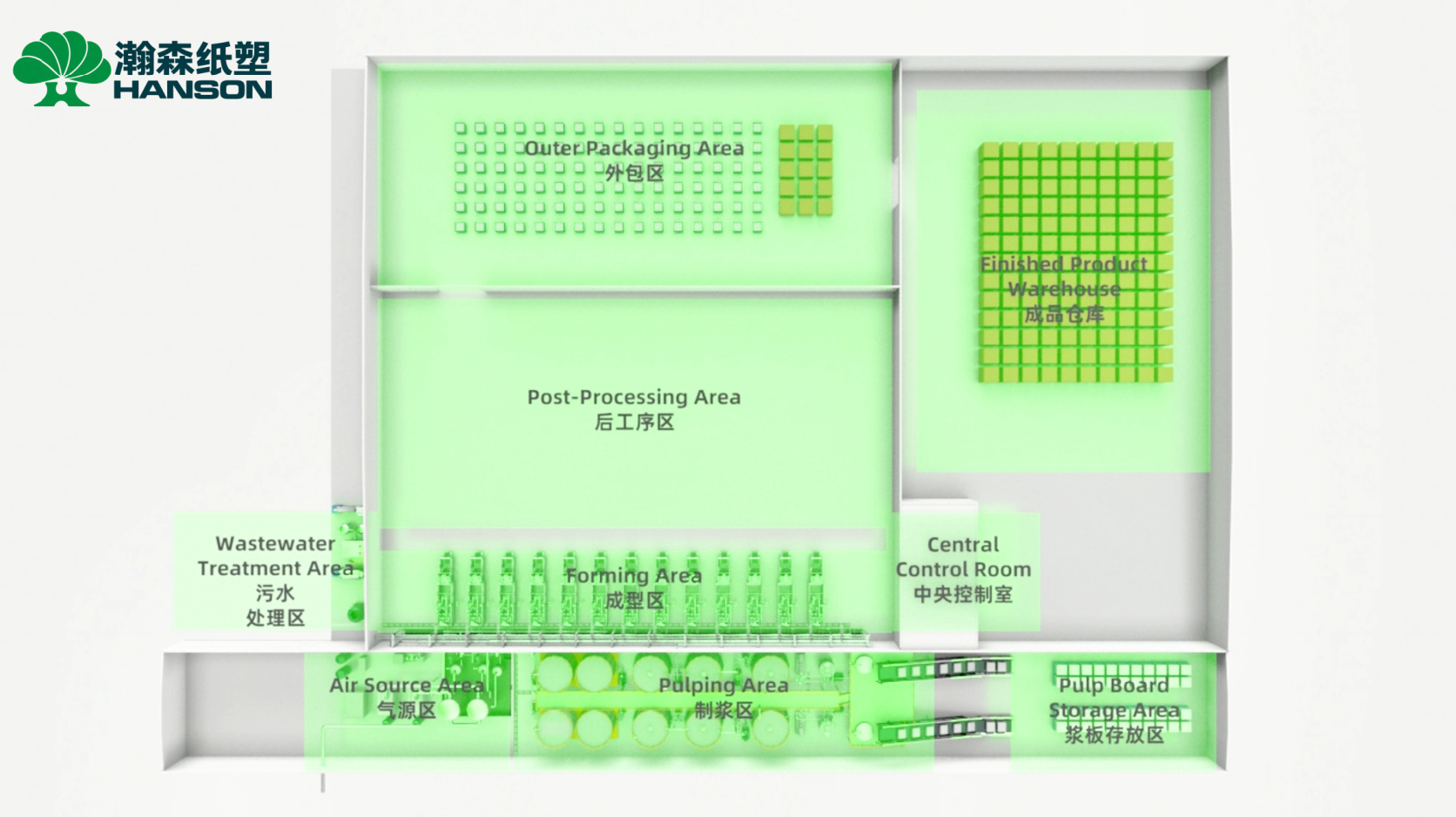
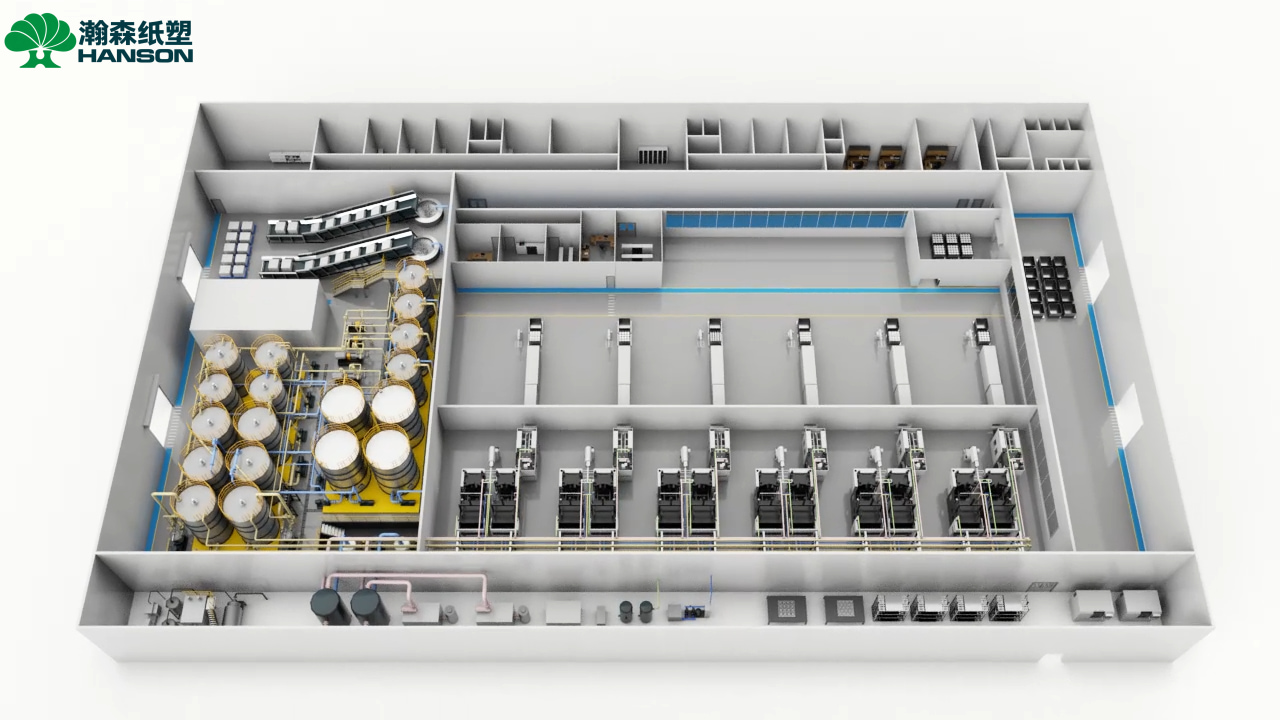
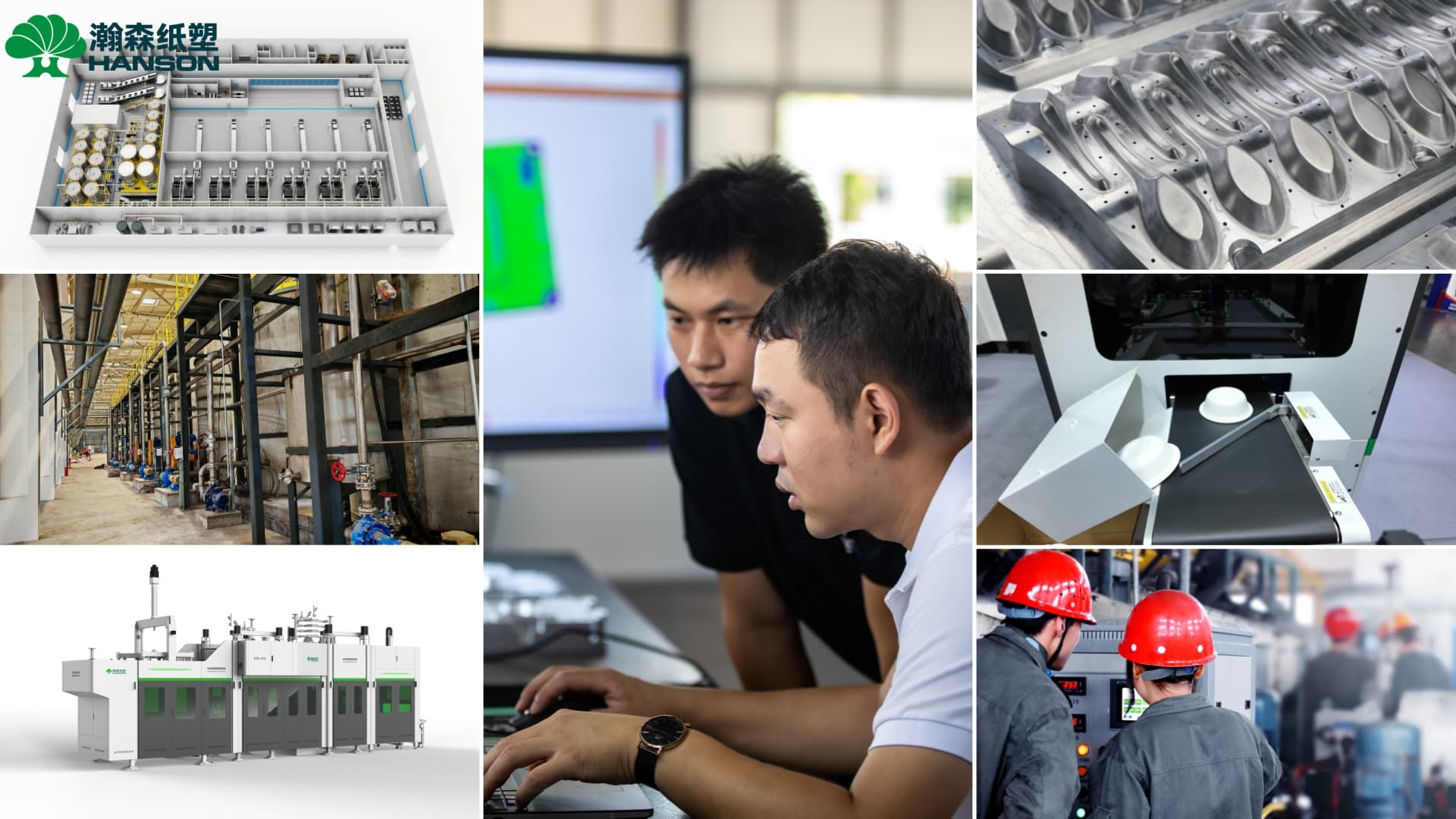
Complete Factory Planning
The project begins with the customer’s product and business objectives.
Before finalizing equipment, Hanson evaluates factors such as:
- Target products
- Planned production capacity
- Raw materials
- Wet-press or dry-press process
- Factory dimensions
- Utility conditions
- Automation level
- Post-processing requirements
- Future capacity expansion
Based on these conditions, our engineering team can participate in complete factory planning.
The scope can include:
- Production line layout
- Equipment positioning
- Pulping system planning
- Material flow
- Finished-product flow
- Water circulation
- Electrical systems
- Compressed air
- DCS systems
- MCC systems
- Maintenance areas
- Operator workflow
The objective is not simply to place machines inside a building.
The objective is to create an efficient production system.
-
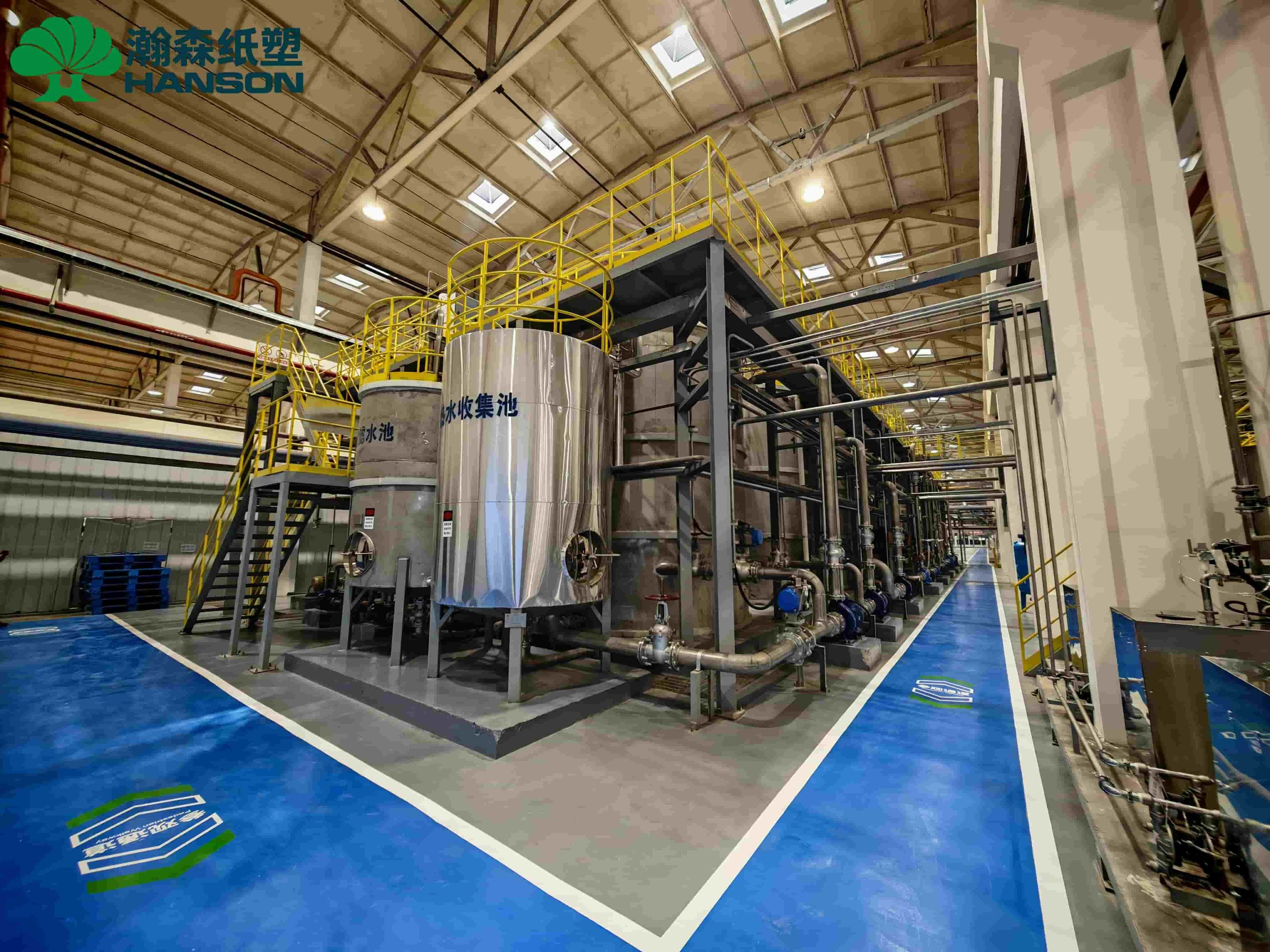
Pulping System Engineering
Pulping is the starting point of molded fiber production.Different products require different raw materials, pulp consistency, refining conditions, additives and circulation systems.For this reason, a pulping system should be designed according to the final product and production process.
Hanson can integrate:
- Raw material preparation
- Hydrapulping
- Refining
- Pulp storage
- Pulp mixing
- Additive preparation
- Process tanks
- Pumps
- Pipelines
- Water circulation
- Process control
The pulping system is coordinated with downstream forming equipment to create more stable operating conditions.
This is particularly important for factories producing high-quality wet-pressed molded fiber products, where pulp stability directly affects product consistency.
- Pulp Molding Equipment
The forming and hot-pressing system is the core of the production line.
Hanson develops equipment for multiple molded fiber applications, including:
- Molded fiber tableware
- Food containers
- Plates
- Bowls
- Trays
- Molded fiber lids
- Premium industrial packaging
- Electronics packaging
- Consumer product packaging
- Protective packaging

Different products require different equipment structures.
For this reason, Hanson does not recommend forcing every product onto the same machine platform.
Instead, equipment selection is based on:
- Product structure
- Product accuracy
- Product height
- Product weight
- Production capacity
- Automation requirements
- Mold configuration
- Process requirements
Depending on the production line, different processes can be integrated into one automated system.For example:
Forming → Hot Pressing → Trimming → Inspection → Stacking → Packaging
The objective is to reduce unnecessary manual handling and improve overall production efficiency.
-
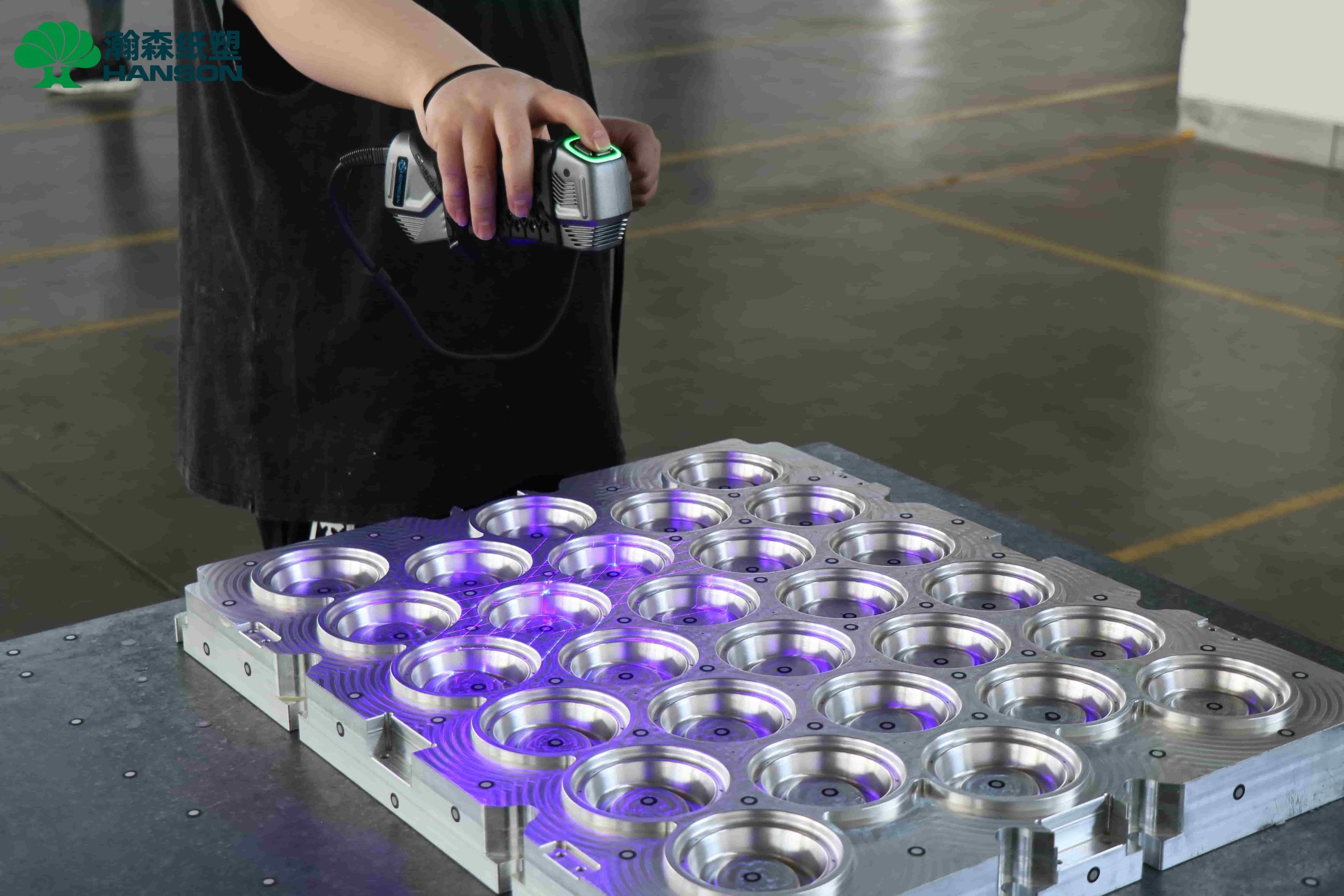
Mold Design and Manufacturing
In molded fiber production, the mold is not simply an accessory.
It directly affects:
- Forming quality
- Product weight
- Drainage efficiency
- Surface quality
- Cycle time
- Heating efficiency
- Product transfer
- Energy consumption
- Production stability
This is why Hanson combines equipment experience with mold engineering.
When designing a mold, our engineers consider not only the product drawing, but also the complete production process.
This includes:
- Product structure
- Fiber characteristics
- Forming conditions
- Vacuum distribution
- Drainage design
- Heating
- Product release
- Mold transfer
- Machine movement
- Cycle time
This is one of the key differences between designing a mold independently and designing a mold as part of an integrated production system.
At Hanson, the mold, equipment and process are developed to work together.
-
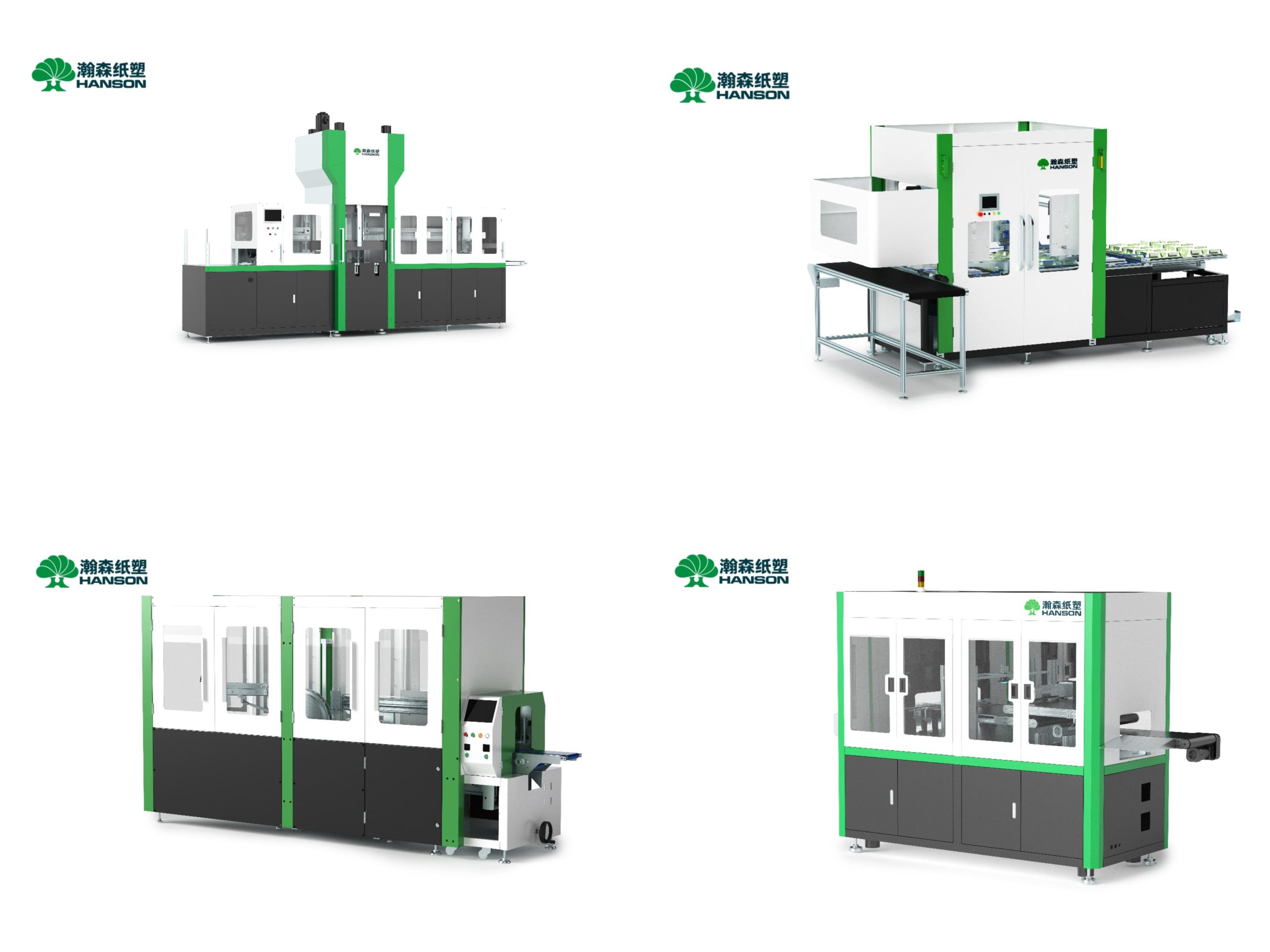
Post-Processing Automation
Many pulp molding products require additional processing after forming and hot pressing.
Depending on the product, this can include:
- Trimming
- Punching
- Lamination
- Coating
- Visual inspection
- Stacking
- Counting
- Packaging
If these processes are not properly matched with upstream production, they can quickly become bottlenecks.Hanson therefore develops and integrates post-processing equipment according to actual production requirements.
For highly automated projects, the entire production process can be connected from forming to finished-product packaging.The goal is to reduce manual transfer, improve consistency and lower dependence on labor.
-
Production and Technical Support
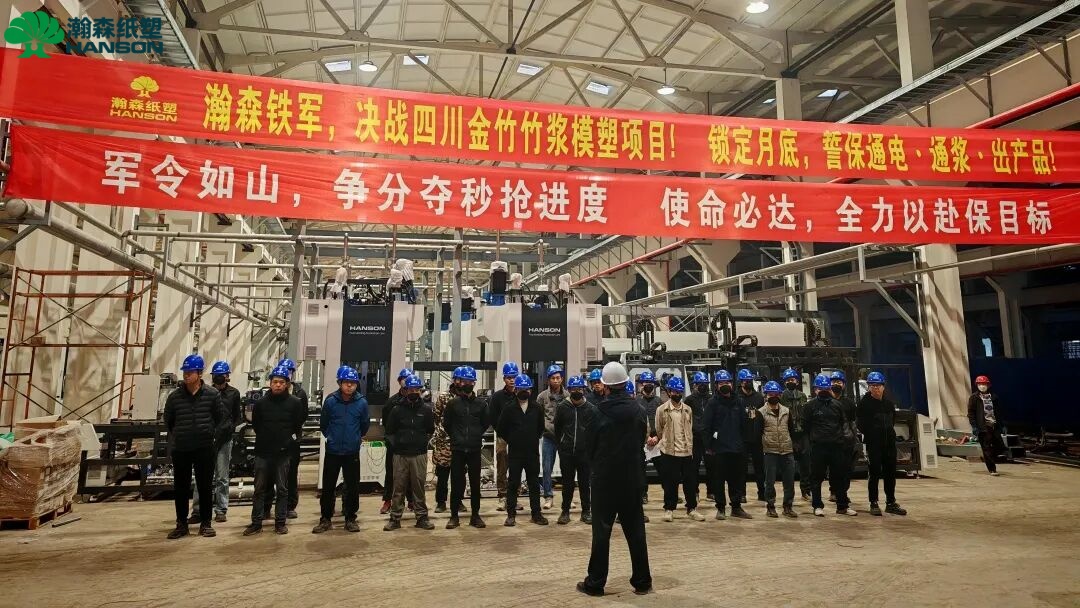
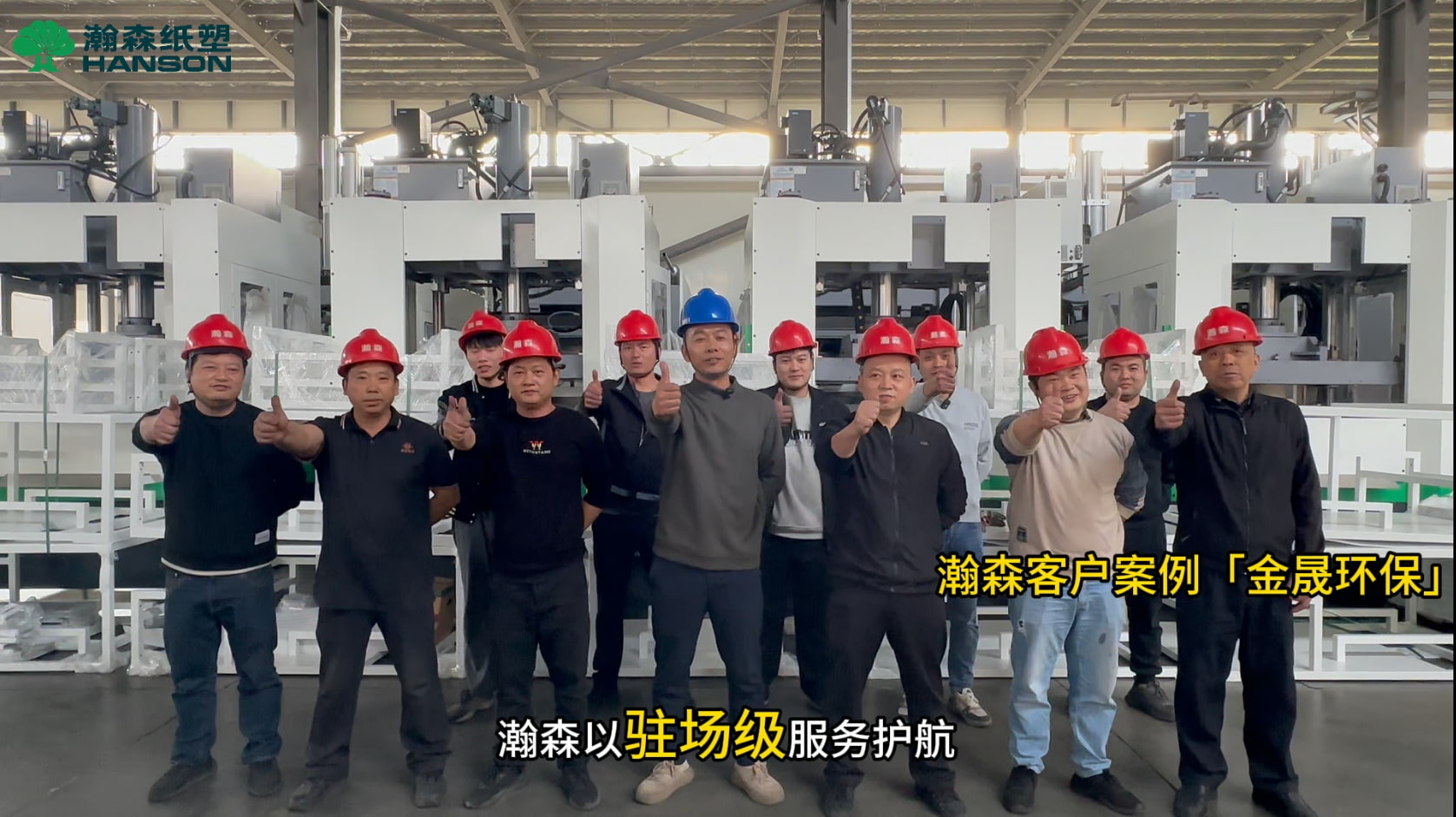
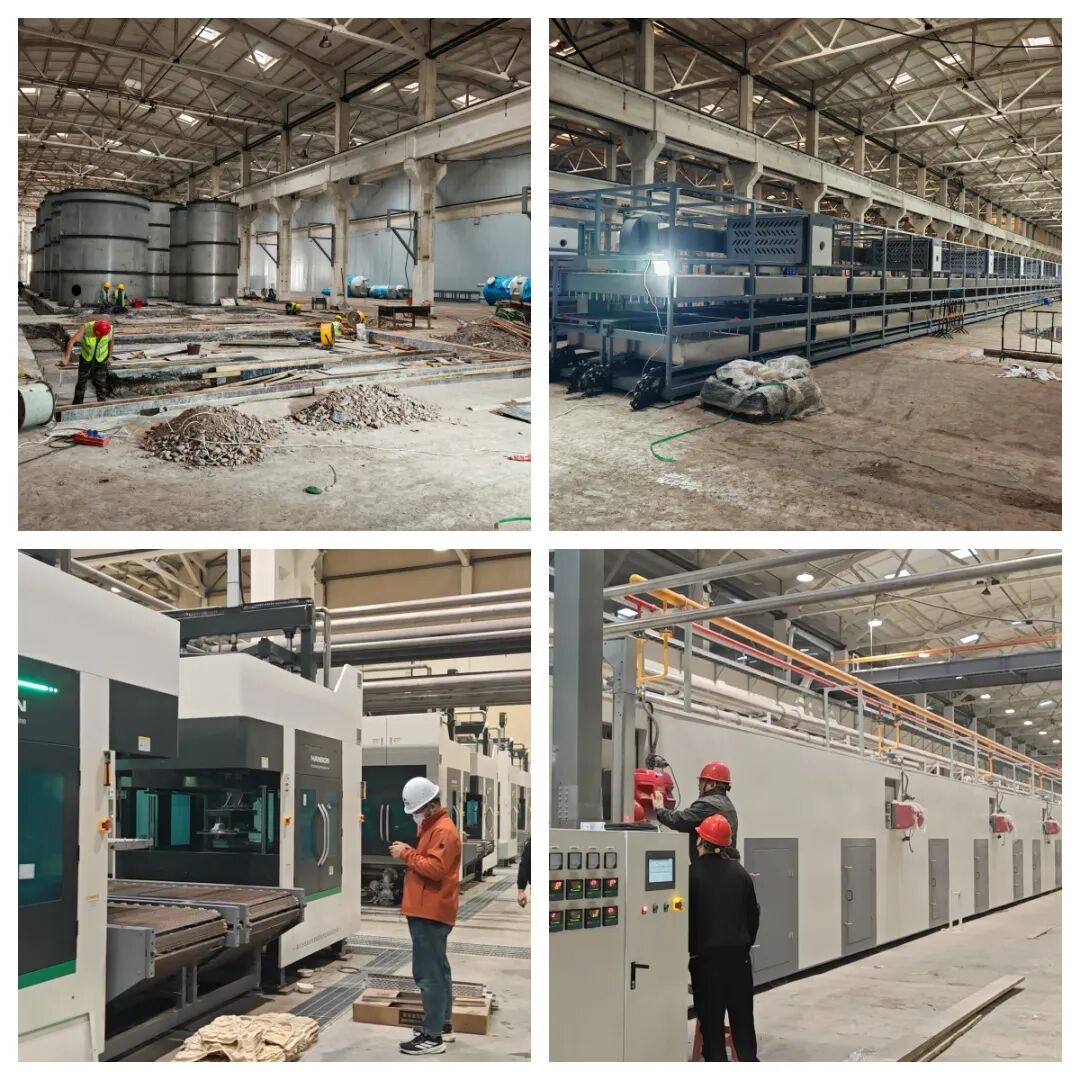
One of the biggest misunderstandings about turnkey projects is that the project ends when equipment installation is complete.In reality, this is often when the most important stage begins.
A factory must move through:
Installation → Commissioning → Trial Production → Process Optimization → Operator Training → Capacity Ramp-up → Stable Production
Hanson supports customers throughout this process.
Our technical services can include:
- Mechanical installation guidance
- Electrical commissioning
- Mold installation
- Mold adjustment
- Trial production
- Process parameter optimization
- Product quality adjustment
- Operator training
- Maintenance training
- Production management guidance
- Troubleshooting
- Capacity ramp-up
For turnkey projects, Hanson can provide up to six months of production support during the ramp-up stage.During this period, our team works with the customer’s production team to help establish a more stable production process and gradually transfer operational experience.
The objective is not simply:“The machine is running.”
The real objective is:“The factory can independently and continuously produce qualified products.”

+1. Product Definition, Design, Material Development and Sampling
Not every customer starts with a finalized product.
Some customers only have:
- A packaging concept
- A drawing
- A plastic product to be replaced
- A sample from the market
- A sustainability requirement
- A target application
In these cases, the project may begin before equipment selection.
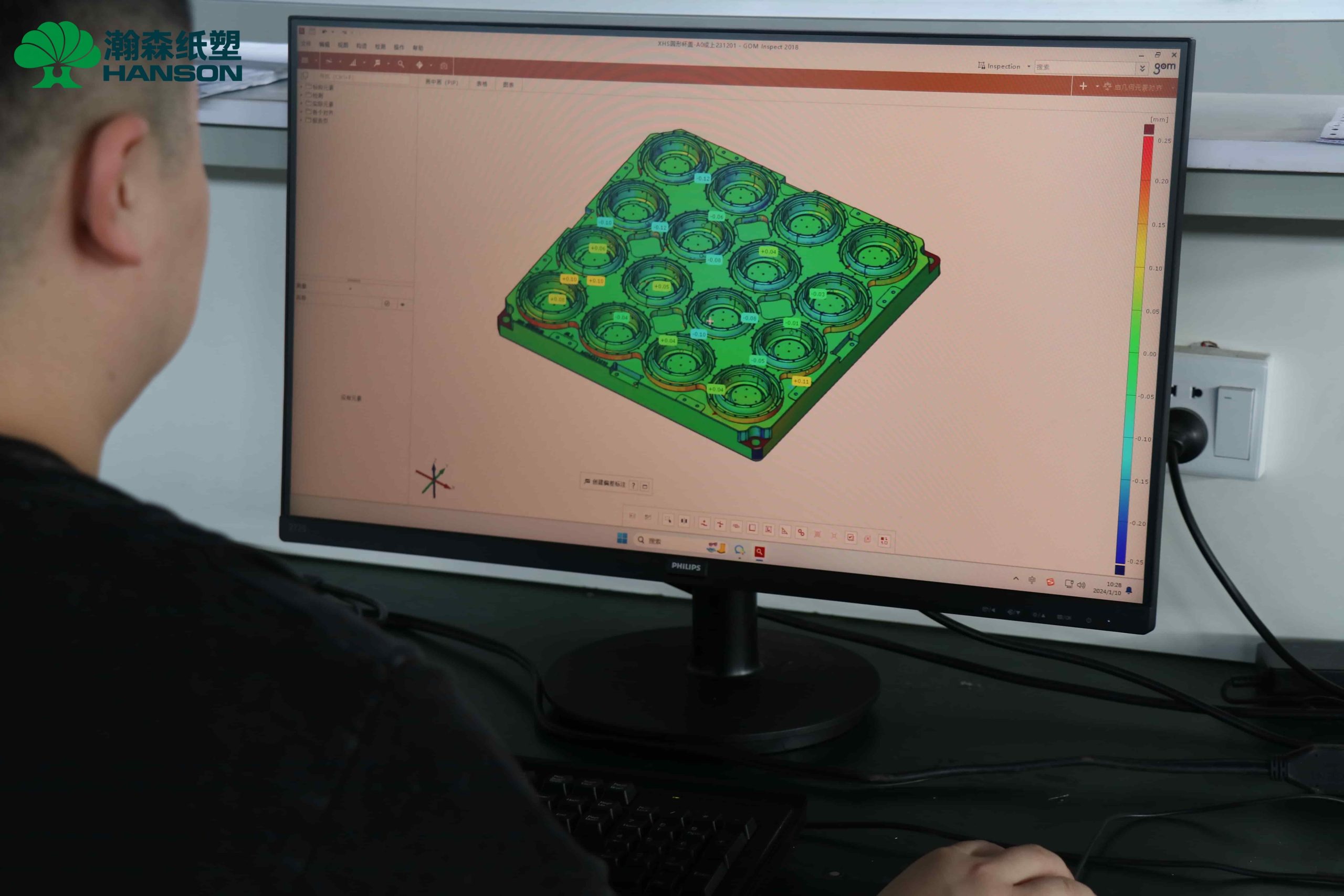
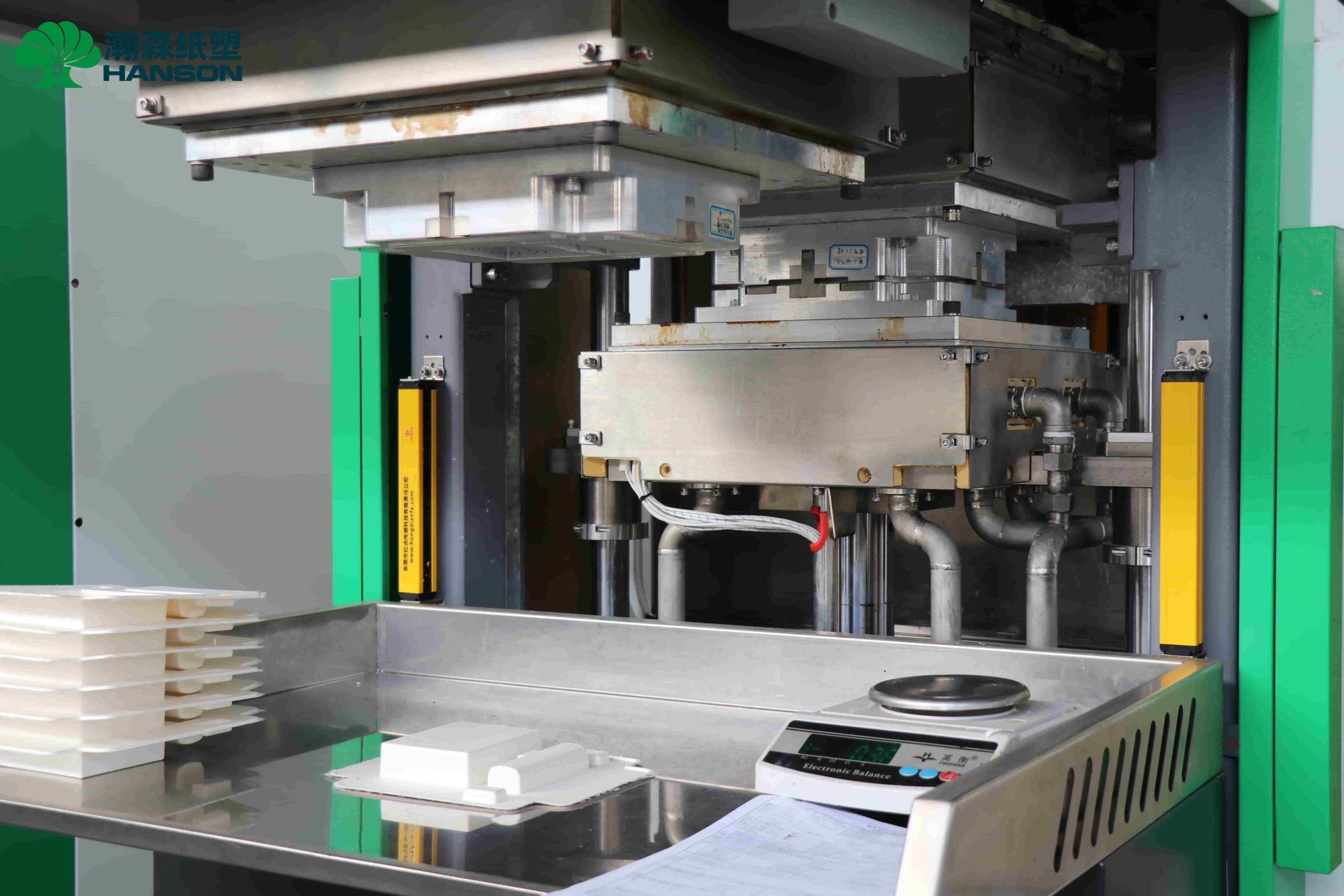
Hanson can participate in:
- Product definition
- Structural design
- Product feasibility analysis
- Raw material selection
- Fiber formulation testing
- Product sampling
- Prototype development
- Mold development
- Mass-production feasibility evaluation
This allows the product to be verified before customers commit to large-scale production equipment.
It also allows later equipment configuration to be based on real production requirements rather than assumptions.
What Makes a True Turnkey Pulp Molding Solution?
Not every supplier that sells multiple types of equipment is a true turnkey solution provider.
Buying the pulping system, forming machine and trimming machine from the same company does not automatically make a project turnkey.
A true turnkey supplier should be able to take responsibility for the complete production system.
We believe customers should evaluate several questions before choosing a turnkey partner.
Can the supplier start from the product?
The production line should be designed according to the product.
Not the other way around.
The supplier should understand:
Product → Process → Mold → Equipment → Automation → Factory
If equipment is selected before the product and process are fully understood, future modifications may become necessary.
Can the supplier design the entire production process?
A turnkey supplier should understand the relationship between:
- Pulping
- Forming
- Drying
- Hot pressing
- Mold design
- Trimming
- Surface treatment
- Inspection
- Packaging
These processes must work together as one system.
Can the supplier integrate molds and equipment?
In pulp molding, equipment performance cannot be separated from mold performance.
A supplier that understands machinery but not molds may struggle to solve certain production problems.
Likewise, a mold company that does not understand machine movement and process conditions may not optimize the complete cycle.
Can the supplier support commissioning and mass production?
Shipping equipment is not the final objective.
The supplier should have the engineering capability to participate in:
- Installation
- Commissioning
- Product trials
- Process optimization
- Staff training
- Production ramp-up
Is there one responsible project team?
A turnkey project requires clear responsibility.
Customers should know exactly who coordinates the project and who is responsible when technical interfaces need to be solved.
This is why Hanson uses a project manager responsibility system for major turnkey projects.
Turnkey Does Not Mean Supplying More Machines
There is an important distinction.
Turnkey does not mean supplying more machines.
It means taking responsibility for how the complete production system works together.
A real turnkey project should connect:
Product Development
↓
Process Design
↓
Factory Planning
↓
Pulping System
↓
Forming Equipment
↓
Mold Engineering
↓
Post-processing
↓
Installation
↓
Commissioning
↓
Training
↓
Mass Production
The value of turnkey engineering lies in reducing the gaps between each of these stages.
Why Can Hanson Deliver Complete Pulp Molding Turnkey Projects?
Turnkey projects require capabilities across multiple disciplines.
They cannot rely on a single machine or a single engineering team.
Hanson has built its turnkey capability around long-term experience in equipment, molds, process engineering and production service.
Today, Hanson has:
- 350+food packaging and tableware production line deliveries
- 150+premium industrial packaging project deliveries
- 500+core equipment units delivered
- 50–60R&D personnel
- 50+engineering and service personnel
- 50+patents
These capabilities support projects from individual machines to complete production facilities.
More importantly, Hanson combines several capabilities under one organization:
Equipment + Mold + Process + Automation + Engineering + Service
That integration is the foundation of our turnkey service.
Equipment Experience Matters
A turnkey solution is only as strong as its core production equipment.
Hanson has developed multiple equipment platforms for different pulp molding applications, including:
- Fully servo-controlled tableware machines
- Integrated forming and hot-pressing machines
- Premium industrial packaging equipment
- Automatic molded fiber lid production lines
- Sampling equipment
- Post-processing automation
Instead of pursuing one universal machine, Hanson develops equipment according to different product characteristics.
For example, molded fiber food packaging generally focuses more heavily on productivity and production efficiency.
Premium industrial packaging may require higher dimensional accuracy and greater flexibility for complex product structures.
This is why we believe:
Different applications require different production solutions.
Mold Experience Matters
Hanson’s turnkey capability is also supported by its mold engineering team.
The advantage is not simply that Hanson can manufacture molds.
More importantly, our mold engineers work with equipment and process engineers.
This allows us to incorporate years of machine experience into mold development.
When equipment, mold and process engineering are developed within one technical system, many potential problems can be identified earlier.
This reduces repeated adjustment after installation and helps shorten the path to stable production.
Service Capability Matters
For overseas customers especially, service capability is one of the most important factors when choosing a turnkey partner.
A production line may operate for many years.
Customers therefore need more than remote communication after installation.
Hanson has developed a growing service network covering multiple regions in China and overseas.
Our service presence includes locations such as:
Dongguan · Laibin · Yibin · Wuxi · Rayong · Jakarta · Vietnam · São Paulo · Dubai
This network supports installation, commissioning, technical service and faster response for international projects.
How Does Hanson Manage a Turnkey Project?
A large pulp molding project may involve dozens of technical interfaces.
Without clear project management, even good equipment can become difficult to coordinate.
Hanson therefore adopts a project manager responsibility system for major turnkey projects.
The project manager serves as the main coordination point between the customer and Hanson’s internal teams.
Depending on the project, these teams may include:
- Process engineers
- Mechanical engineers
- Electrical engineers
- Automation engineers
- Mold engineers
- Production engineers
- Installation engineers
- Service technicians
The project manager follows the project through key stages.
These can include:
Project Definition
↓
Technical Planning
↓
Factory Layout
↓
Equipment Configuration
↓
Engineering Design
↓
Manufacturing
↓
Installation
↓
Commissioning
↓
Trial Production
↓
Training
↓
Production Ramp-up
This creates clearer responsibility and reduces communication gaps between different technical departments.
Selected Hanson Turnkey Pulp Molding Projects
Turnkey capability is ultimately demonstrated through real projects.
Hanson has participated in a number of large and complex pulp molding projects in China and overseas.
Sichuan Jinzhu Project
The Sichuan Jinzhu project is backed by Wuliangye and represents one of Hanson’s important complete plant projects.
The project combines both dry-pressed and wet-pressed molded fiber production processes.
Compared with a conventional single-process factory, this creates greater complexity in:
- Production planning
- Equipment configuration
- Process coordination
- Automation
- Factory layout
- Commissioning
Hanson participated in the construction of the complete production system and provided continued technical support during production ramp-up.
The project is also an example of Hanson’s project manager responsibility system and production support model.
Hunan Lingao Project
Hunan Lingao is another representative large-scale project involving Hanson.
Its pulp molding production capacity is planned around approximately 35,000 tons of molded fiber tableware annually, combined with a broader upstream bamboo-based material industry chain.
Such projects require much more than individual forming machines.
They require coordination between raw materials, pulping, equipment, molds, utilities, automation and factory operations.
Hanson’s role reflects the type of integrated engineering capability required for large-scale pulp molding industrial projects.
BBCA Group Project
Hanson has also cooperated with BBCA Group on a project connecting agricultural fiber resources with pulp molding production.
The project reflects another important direction in the molded fiber industry:
Raw Material → Pulp → Molded Fiber Product
For customers developing an integrated fiber-based packaging industry chain, equipment selection is only one part of the overall challenge.
The production process must be planned from the characteristics of the raw material through to the final molded fiber product.
This requires deeper coordination between pulp preparation, product requirements and equipment design.
Overseas Project Experience
Turnkey projects become even more challenging when they are located overseas.
Differences in:
- Factory conditions
- Infrastructure
- Utilities
- Local technical teams
- Installation standards
- Spare-parts availability
- Language
- Production experience
can all affect project implementation.
Hanson’s overseas projects therefore place significant emphasis on engineering support, installation coordination and local service capability.
Our international project experience continues to strengthen our ability to support customers outside China from equipment delivery through commissioning and production.
From Equipment Delivery to Stable Production
For Hanson, delivering machines is not the end of a turnkey project.
A machine can be packed into a container and shipped.
But production capability cannot.
Production capability comes from combining:
- Equipment
- Molds
- Raw Materials
- Process
- Automation
- Operators
- Production Management
into one stable system.This is why Hanson focuses on the complete journey from product development to mass production.
Our goal is not only to help customers build a pulp molding factory.
Our goal is to help that factory work.
Who Is a Turnkey Pulp Molding Solution Suitable For?
A turnkey solution is particularly suitable for companies that are:
- Entering the pulp molding industry for the first time
- Building a new molded fiber factory
- Expanding existing production capacity
- Developing a new molded fiber product category
- Replacing plastic packaging with molded fiber
- Building an overseas production base
- Upgrading from semi-automatic to automated production
- Integrating pulp production with molded fiber manufacturing
For customers with limited pulp molding production experience, turnkey engineering can significantly reduce the number of technical interfaces that need to be managed internally.
For experienced manufacturers, turnkey integration can help improve project execution efficiency and shorten the time required for new capacity to reach stable production.
Frequently Asked Questions
What is a turnkey pulp molding solution?
A turnkey pulp molding solution is a complete production solution covering multiple stages such as product development, factory planning, pulping, forming equipment, molds, automation, installation, commissioning, training and production support.
Its purpose is to provide customers with a complete production system rather than separate machines.
Is a turnkey project the same as buying a complete production line?
Not necessarily.A supplier may provide several machines but still leave the customer responsible for integrating the process.
A true turnkey project requires engineering coordination between equipment, molds, process, utilities, automation and production.
Can Hanson help if we do not yet have a finalized product?
Yes.Hanson can participate from the product definition and sampling stage, including structural evaluation, material testing, mold development and production feasibility analysis.
Can Hanson support overseas installation?
Yes.Hanson provides overseas installation, commissioning and technical service support and continues to develop service capabilities in multiple international regions.
What happens after commissioning?
For turnkey projects, Hanson can continue supporting customers during the production ramp-up stage.This can include process optimization, operator training, troubleshooting and production guidance.For selected projects, support can continue for up to six months.
Planning a Pulp Molding Factory?
If you are planning a new pulp molding factory, upgrading an existing production line or developing a new molded fiber product, the first step should not simply be choosing a machine.
Start with the product. Then define the process. Then build the production system around it.
Tell Hanson:
- What product you want to manufacture
- Your target capacity
- Your preferred raw material
- Your factory location
- Your current project stage
Our engineering team can help evaluate the production process, equipment configuration and complete factory solution.
Hanson Pulp Molding
Turnkey Pulp Molding Solutions
From Product Development to Stable Mass Production
WhatsApp: +86 15920604830
Email: linchuangcheng@hspulpmolding.com