Molded Pulp Wine Insert Tooling: How to Balance Impact Protection and Shelf Appeal
Designing molded pulp wine insert tooling that protects heavy glass bottles while looking refined inside a gift box starts with two decisions: selecting the right molding process and building structural function directly into the mold geometry. Simply thickening the wall slows down cycle times without solving breakage or fit issues.
For molded fiber converters and packaging buyers, getting four mechanical features right—bottle retention, impact absorption, nesting efficiency, and smooth unpacking—determines whether a wine insert scales cleanly from prototype to mass production.
Selecting the Process Route: Wet-Press vs. Dry-Press
Before locking 3D part geometry, confirm whether the insert serves a retail gift box or a transit shipper. Each route sets distinct tooling boundaries:
-
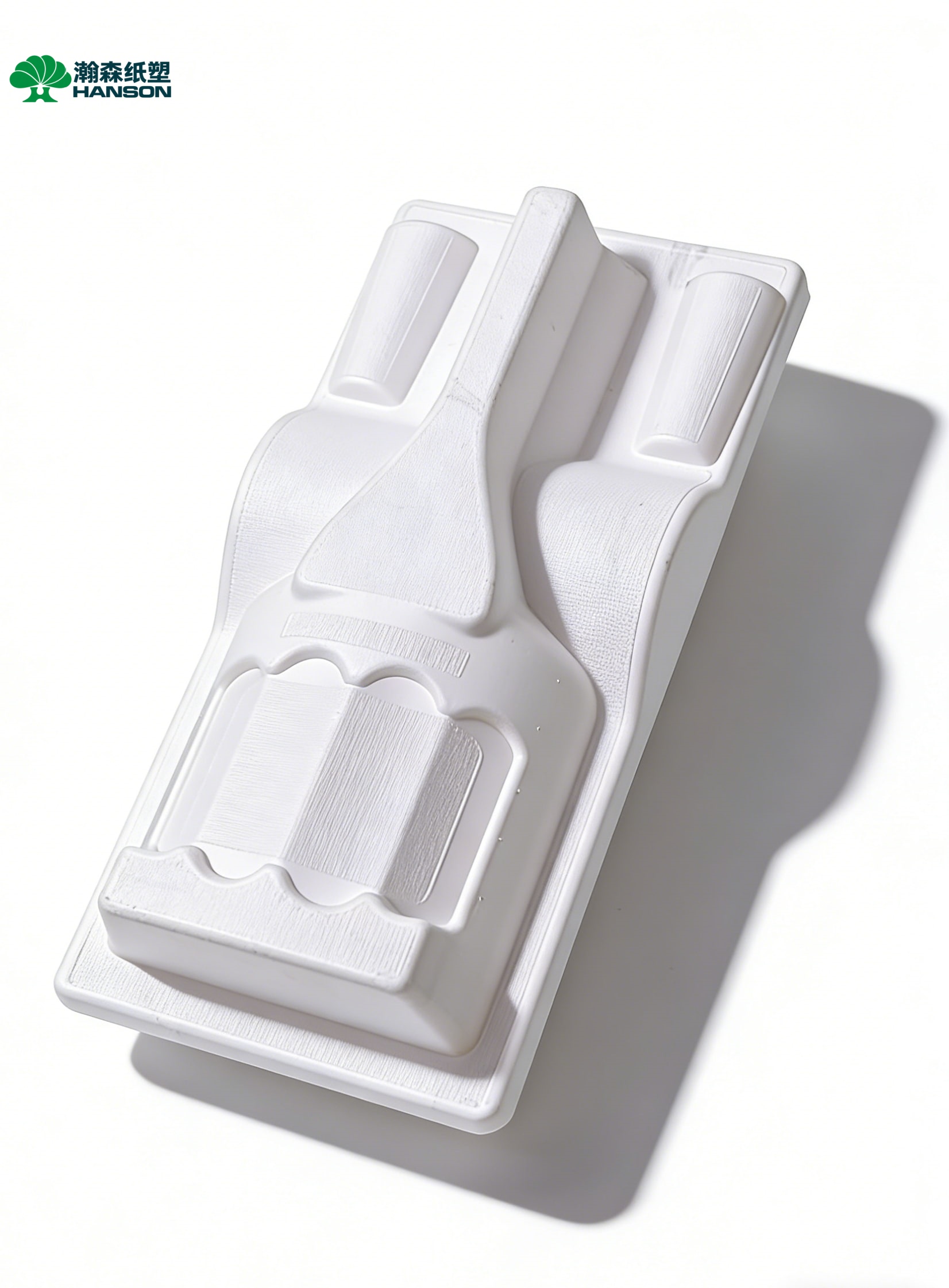
Wet-Press (Thermoformed Molded Fiber): Best for premium wine, spirits, and presentation boxes. Wet preforms move directly into heated pressing molds, producing smooth dual surfaces, crisp edges, tighter dimensional tolerances, and optional logo embossing. Tooling requires tight cavity matching, precise vacuum venting, and consistent surface finishing.
-
Dry-Press (Transfer Molded Pulp): Suited for multi-bottle e-commerce shippers and heavy-duty logistics trays. Parts run thicker with deep cushioning profiles and lower unit cost, but the non-forming side retains a rough screen texture that rarely meets luxury retail standards.
Do not transfer rough dry-press tolerances or injection-molding design assumptions into wet-press wine tooling. Fiber slurry behavior, vacuum dewatering, and hot-press shrinkage govern every radius and rib.
Four Structural Priorities for Wine Bottle Pulp Tray Design
1. Multi-Point Bottle Retention That Absorbs Glass Tolerances
Glass wine bottles vary slightly in outer diameter and height across production runs, and molded fiber shrinks slightly during hot-pressing. A zero-clearance cavity will either jam during packing or distort the outer carton. Reliable tooling uses three-zone positioning: a recessed base pocket to stop lateral sliding, a contoured shoulder cradle to carry axial shock, and controlled side ribs or neck locks that hold the bottle firmly while forgiving normal glass tolerances.
2. Impact-Absorbing Geometry Instead of Excessive Wall Thickness
Breakage during transit usually starts at the bottle heel or shoulder edge. Over-thickening the entire tray increases slurry suction time, traps steam during hot-pressing, and can trigger blistering or wall cracking. Instead, build protection through hollow cushioning feet, tapered crush ribs, and recessed air gaps that keep the bottle suspended away from the outer carton wall. Maintain generous fillet radii on internal corners so pulp fibers distribute evenly rather than thinning out over sharp edges.
3. Nesting Efficiency and Anti-Lock Denesting Features
Empty wine inserts consume significant freight volume if they cannot stack tightly. Tooling engineers must balance sufficient draft angles (scaled to cavity depth and fiber furnish) with dedicated denesting steps or stacking lugs. Without controlled spacing steps, tightly nested wet-press trays can vacuum-lock together, slowing down manual loading or jamming automated denesters on the bottling line. Exact draft angles and nesting pitch depend on bottle depth and fiber blend .
4. Ergonomic Packing and Effortless Unboxing
A tray that passes transit drop testing can still fail commercial adoption if line operators struggle to seat bottles or consumers have to pry the bottle out. Integrate three practical details into the mold layout early:
-
Symmetrical finger cutouts along the bottle waist or shoulder for a clean one-handed grip;
-
Mating alignment bosses and recesses on clamshell or top-and-bottom sets to speed up packing-line assembly;
-
Well-placed parting lines and clean edge-trimming allowances so flash does not snag the inner gift box liner.
Tooling Precision, Trial Runs, and Root-Cause Discipline
Consistent cosmetics and dimensional repeatability rely on disciplined mold fabrication. For high-appearance wine inserts, critical manufacturing steps—including rough machining, stress relief, finish machining, 3D scanning inspection, vacuum hole drilling, and precision wire mesh wrapping—work together to keep pulp deposition uniform and prevent hot-press witness marks.
With a dedicated tooling division, Hanson Pulp Molding’s mold and tooling services combine 10 senior designers, high-speed CNC machining (up to 24,000 RPM), and 3D scanning inspection, backed by 500 pulp molding molds manufactured to date. Depending on your production line setup, project execution follows clear pathways:
-
New tooling for Hanson equipment: Product development → complete tooling → in-house trial verification → mass production support.
-
New tooling for non-Hanson equipment: Product development → complete tooling → mass production support, built strictly to your press interface drawings (on-machine trial runs take place on your target line).
-
Existing molds on non-Hanson machines: Mold optimization and retrofitting → mass production support.
During initial mold trials, avoid blaming every defect solely on the tooling. Short shots, cracking, warping, sticking, or excess flash require structured troubleshooting across slurry consistency and fiber refining, press vacuum and hot-press temperature/pressure settings, post-trimming alignment, and finally mold screen condition and venting clearances. Always confirm final parameter adjustments through on-site trial validation.
Pre-Tooling Checklist Before Cutting Metal
Align these five inputs before approving mold design to prevent costly rework during sampling:
-
Physical Glass Bottle Samples (Multiple Units): Real samples capture glass dimensional variance and label recesses better than nominal CAD files alone.
-
Outer Box Internal Dimensions: Confirm exact inner tolerances for the rigid gift box or corrugated shipper, plus bottle count and orientation.
-
Process & Press Interface Specs: Specify wet-press or dry-press, platen dimensions, daylight/stroke limits, mounting bolt patterns, and vacuum/air port layouts.
-
Protection & Cosmetic Targets: Define drop-test protocols , fiber type (bagasse, bamboo, or wood pulp), color, surface finish, and embossing details.
-
Shipping Nesting & Packing Line Needs: Clarify target stack height per shipping carton and whether bottling plants use manual or automated denesting.
FAQ
Q1: Should molded fiber wine inserts always use wet-press tooling? Not always. Wet-press (thermoformed) tooling is the right choice when the insert goes inside a retail gift box that requires smooth dual surfaces, sharp contour definition, and tight outer-box fit. For bulk logistics or e-commerce shipping cartons where shock absorption and unit cost outweigh surface smoothness, dry-press tooling with deeper cushioning ribs often provides a better return on investment.
Q2: If wine inserts crack at the corners or fit loosely during trials, is the mold at fault? Not necessarily. Corner cracking can come from overly short fiber blends, uneven vacuum suction, rapid hot-press closing speeds, or excessive mold temperature—not just tight corner radii or blocked vent holes. Loose bottle fit may also reflect glass bottle batch tolerances or drying shrinkage. Troubleshoot slurry formulation, press parameters, equipment alignment, and post-trimming alongside mold clearances, and verify fixes on the production machine.
Q3: Can custom wine insert tooling be built for non-Hanson pulp molding machines? Yes. When supplying new tooling for non-Hanson equipment, Hanson Pulp Molding designs and manufactures the molds to match your machine’s platen size, mounting hole pattern, stroke, and vacuum/air interfaces, supported by 3D scanning inspection and mass production support. Because press mechanics vary across brands, trial molding and fine-tuning are validated directly on your plant’s corresponding production line.
Planning a new wine or spirits molded fiber insert? Share your bottle specifications, outer box dimensions, and press parameters with Hanson Pulp Molding for a pre-tooling design review and tooling quotation. Contact our international tooling team at [+86 15920604830].