When molded pulp products require enhanced waterproof, oil-proof, or barrier properties, lamination serves as a highly effective post-press solution. The process utilizes a thermal press mechanism to apply film onto molded pulp substrates, fulfilling specific functional requirements.
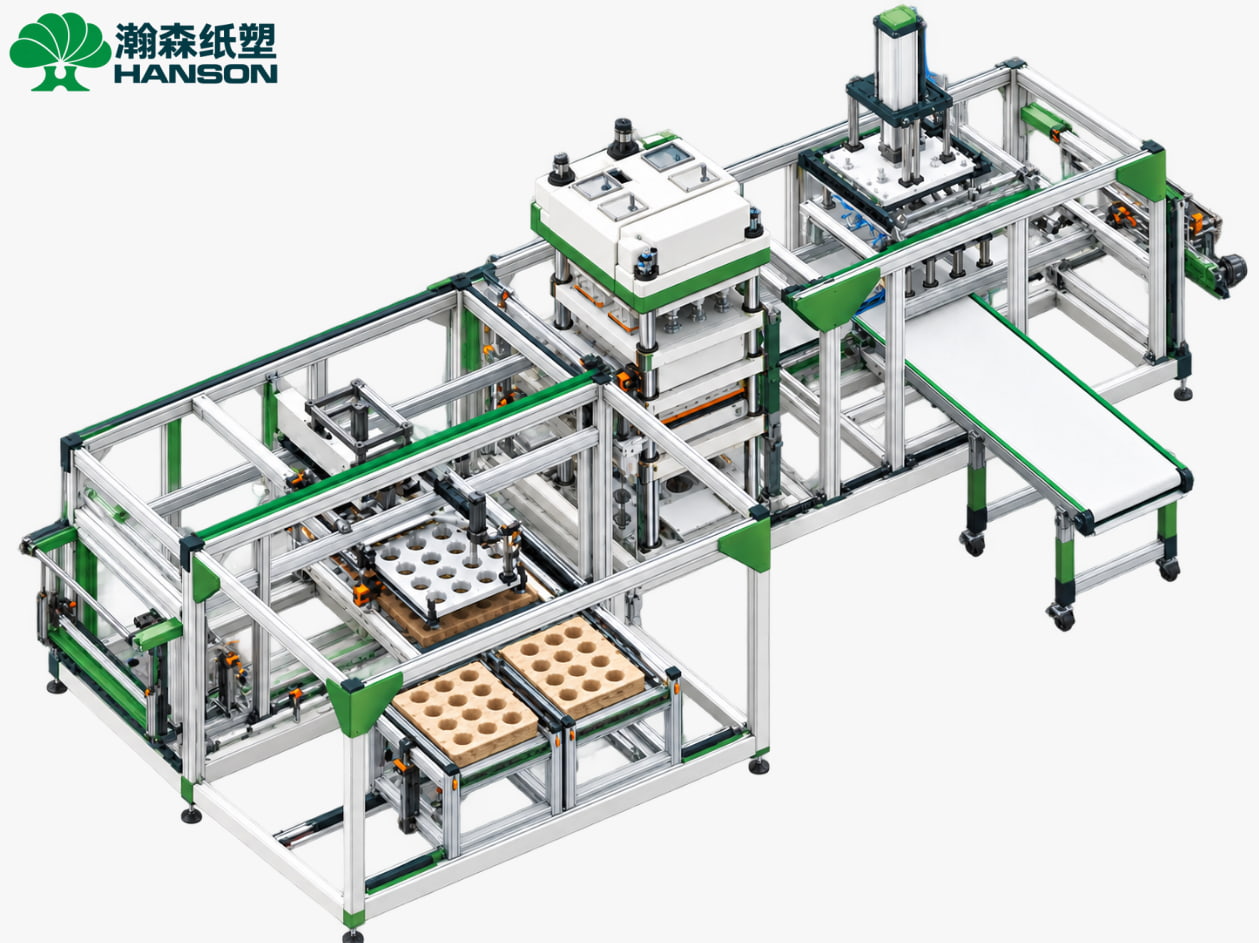
For buyers evaluating a pulp molding laminating machine, cycle time is often the first metric scrutinized. For instance, the Hanson Automatic Pulp Molding Laminating Line features a fast lamination cycle of 15s/mold. However, experienced manufacturers know that cycle time alone does not equal guaranteed daily output, as actual capacity is entirely product-dependent.
To accurately evaluate a molded fiber laminating line, decision-makers should look beyond standalone speed and consider the following crucial factors.
1. Mold Platen Size Determines Cavities Per Cycle A fast 15-second cycle is only truly productive if it yields a high number of units per press. Platen size dictates your cavitation. The Hanson Pulp Molding machine provides a robust mold platen size of 1100 × 1100 mm and accommodates a maximum product height of 80 mm. This expansive working area allows for more cavities per mold, maximizing the throughput of every single pressing cycle.
2. Seamless Process Integration Eliminates Bottlenecks Lamination is only one phase of the post-press workflow. If a machine laminates quickly but relies on disconnected manual trimming or stacking, the overall production rate plummets. A fully optimized system requires a continuous typical process: film unwinding, lamination, trimming, and product stacking. The Hanson laminating line features a synchronized setup where the trimming station delivers 80 tons of trimming force, ensuring that edge cutting keeps pace with the lamination speed without creating bottlenecks.
3. Servo-Driven Precision and Stability Consistent production relies on mechanical stability and precise pressure distribution. On the Hanson equipment, both the lamination station and trimming station are servo-driven. Controlled via a modern PLC + HMI control system, the servo motion ensures stable, coordinated operation and uniform platen pressure, which is critical for maintaining perfect parallel alignment during the thermal press cycle.
4. Film Versatility for Diverse Applications Barrier requirements vary significantly across different sustainable packaging orders. A reliable machine must adapt to different thermal and pressure profiles. Equipped with electric heating, this line is compatible with a wide range of films, including PE, PET, PLA, PBAT, PP, and EVOH, giving manufacturers the flexibility to handle diverse functional demands.
Evaluating Your Next Steps
True production capacity is the result of aligning equipment specifications with your specific product geometry and material needs.
If you are evaluating lamination for a molded pulp product, send Hanson Pulp Molding your product photos, dimensions, film requirements, and target performance. Our team can help evaluate the process and suitable equipment configuration.