For manufacturers operating existing molded pulp production lines, missing out on high-margin orders is a common frustration. When customers request heavy-grease food containers, high-barrier fresh food trays, or premium PFAS-free packaging, standard slurry additives and forming processes often reach their physical limits.
Instead of overhauling your entire wet-end and forming setup, the most cost-effective way to break through these product limitations is to upgrade your post-press capabilities. By adding a pulp molding laminating machine, you can unlock completely new applications and enter more demanding market sectors.
Here are the key product capabilities you can expand by integrating a lamination process:
1. Ultimate Physical Barrier Performance
Standard molded fiber products rely on chemical additives for water and oil resistance. However, for applications like hot soup bowls, durian packaging, or stringent PFAS-free food service requirements, chemicals may not guarantee 100% leak-proof performance over extended periods.
A pulp molding laminating machine applies a continuous film (such as PE, PET, PLA, PBAT, or PP) tightly to the surface of the molded fiber substrate through thermal pressing. This creates an absolute physical barrier, allowing you to confidently take on orders for heavy-grease and liquid-heavy packaging.
2. Heat-Sealable and MAP Packaging Compatibility
The ready-to-eat meal and fresh meat sectors require Modified Atmosphere Packaging (MAP), which means the packaging tray must be hermetically sealed with a top film.
Bare molded fiber has a porous surface that cannot form a reliable seal with top films. By utilizing a lamination line to apply a functional film (like EVOH for oxygen barrier) to the tray and its flange, the product becomes perfectly compatible with automated heat-sealing machines at food processing plants.
3. Enhanced Structural Integrity and Aesthetics
Lamination does more than protect against moisture; it mechanically reinforces the product. The bonded film significantly increases the burst strength, stiffness, and tear resistance of the molded pulp container. Furthermore, you can offer different surface finishes—such as glossy or matte—to meet the visual and tactile demands of high-end cosmetics or consumer electronics packaging.
How to Choose the Right Lamination Equipment
If you are evaluating the addition of this process, selecting an automated line is crucial to keeping labor costs down and maintaining consistent cycle times with your forming machines.
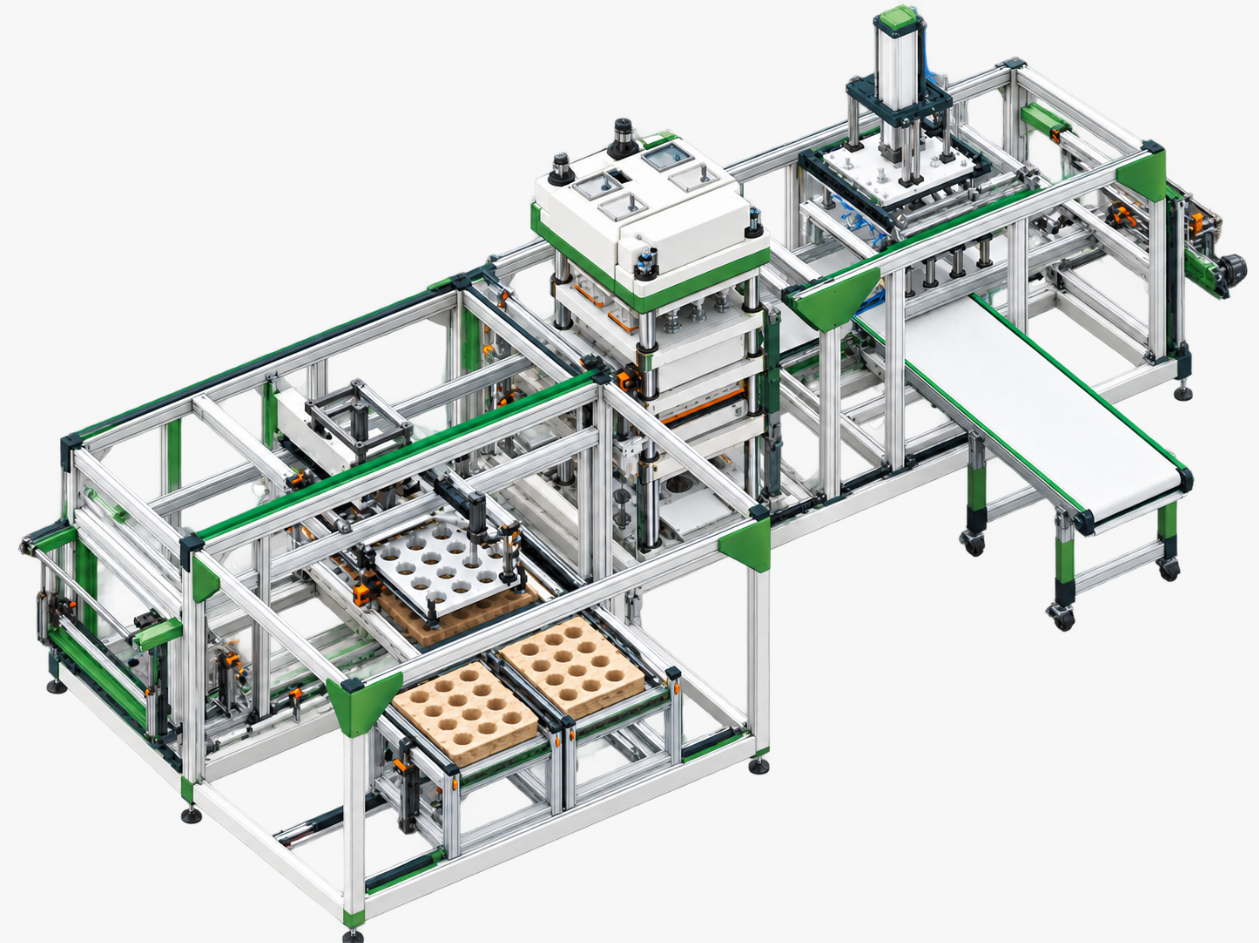
Taking the Hanson Pulp Molding Automatic Pulp Molding Laminating Line as an example, several key technical aspects ensure process stability:
-
Process Integration: The system seamlessly connects “Film unwinding → Lamination → Trimming → Product stacking.” This continuous flow eliminates intermediate manual handling and significantly boosts overall line efficiency.
-
Motion and Precision: Achieving a perfect, bubble-free lamination requires even pressure distribution. The Hanson Pulp Molding machine uses servo-driven lamination and trimming stations combined with a linkage structure for vertical up-and-down motion. This ensures precise motion control and maintains platen parallelism under pressure.
-
Capacity and Compatibility: A generous mold platen size of 1100 × 1100 mm and 80 tons of trimming force provide the versatility to handle multiple cavities per mold. With a lamination cycle of around 15 seconds per mold, the equipment can process products up to 80 mm in maximum height, accommodating a wide variety of deep-draw containers.
If you are evaluating lamination for a specific molded pulp product, send Hanson Pulp Molding your product photos, dimensions, film requirements, and target performance. Our team can help evaluate the process feasibility and recommend the suitable equipment configuration for your factory.