
When molded pulp products need to enter premium food packaging, modified atmosphere packaging (MAP), or sectors requiring stringent water and oil resistance, relying solely on the standard forming process often hits a performance bottleneck. While the industry has traditionally focused on the capacity of forming machines, post-processing operations—such as lamination, coating, and precision molds—are rapidly becoming the new growth drivers in the molded fiber equipment market.
For manufacturers evaluating production line upgrades or planning new projects, understanding the value of these post-processing technologies and selecting the right equipment is essential for securing high-value orders.
Why Post-Processing is the Key to Differentiation
The competitive landscape of molded pulp is shifting from sheer production volume to product functionality and surface aesthetics. Several realities are driving this trend:
-
The PFAS-Free Transition: Strict environmental regulations mandate PFAS-free solutions. Traditional in-pulp sizing additives often struggle to provide sufficient barrier properties against heavy grease and extreme temperatures without fluorine.
-
Sealing and Gas Barriers: Applications like fresh meat trays and ready-to-eat meals require heat-sealable lidding films and high gas barrier properties (e.g., against oxygen) to extend shelf life—functions standard molded pulp cannot achieve alone.
-
Premium Surface Finishes: Consumer electronics and high-end cosmetics demand zero-dust properties and flawless surface textures.
To address these market demands, manufacturers must explore post-processing solutions.
Lamination: The Core Solution for Functional Upgrades
When a product requires absolute liquid and grease resistance, heat-sealing capabilities, or gas barriers (using EVOH films, for instance), lamination is the most direct and effective process. By thermally bonding a film to the molded fiber substrate, the physical barrier properties are entirely transformed.
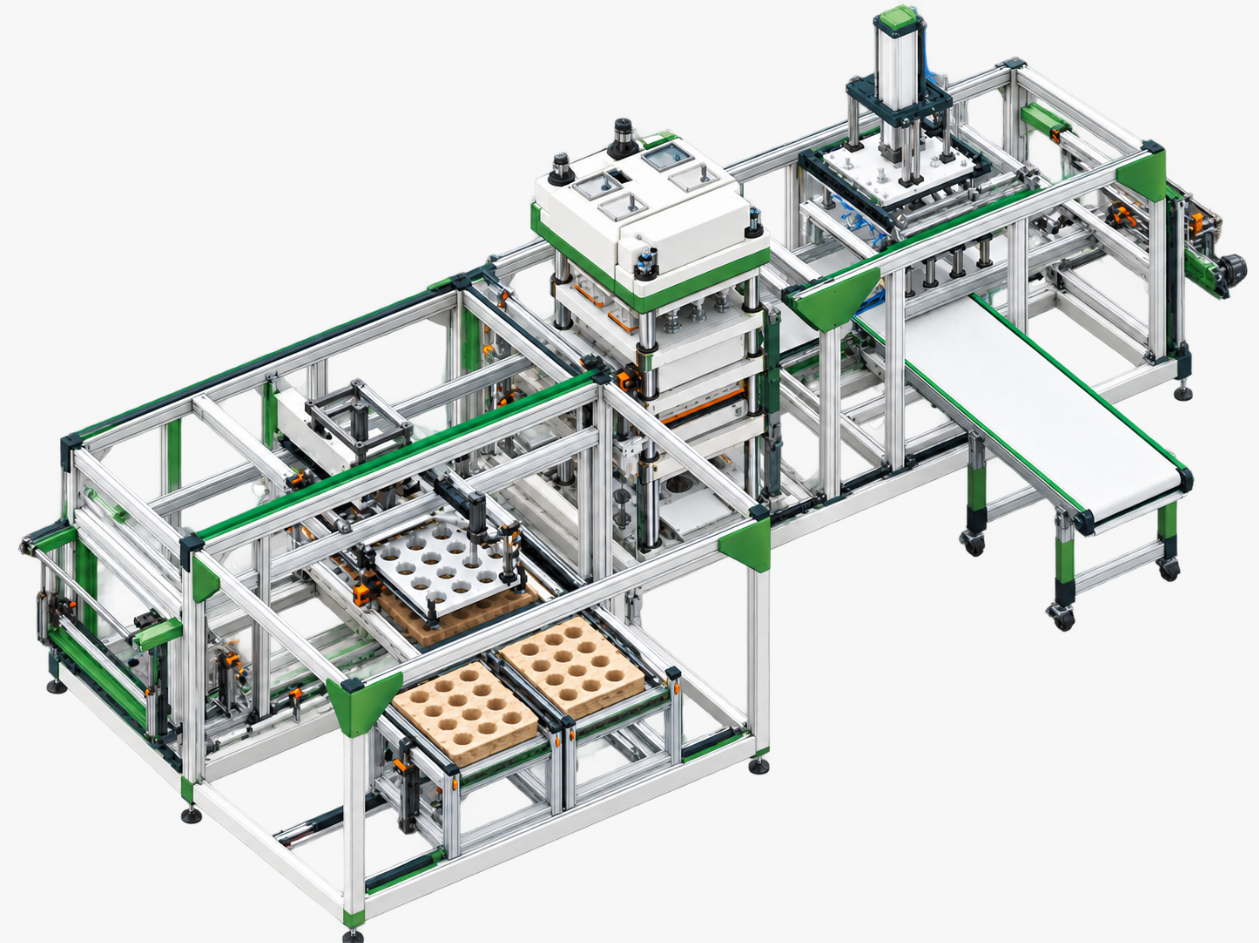
For companies ready to adopt this technology, selecting the right Pulp Molding Laminating Machine is a critical decision. Hanson Pulp Molding’s automatic laminating line is engineered specifically to meet these advanced post-processing needs:
-
Integrated Automation: The equipment seamlessly links the crucial steps: Film unwinding → Lamination → Trimming → Product stacking. This continuous process reduces manual material handling and significantly improves overall line efficiency.
-
Servo-Driven Stability: Both the lamination and trimming stations are servo-driven, ensuring precise and stable operation. The platen utilizes a direct up-and-down motion with a servo-toggle mechanism. This design provides uniform pressure distribution and maintains excellent platen flatness and parallelism, which is vital for consistent film adhesion.
-
Versatile Specifications: With a large mold platen size of 1100 × 1100 mm and a trimming force of 80 tons, the machine accommodates products up to 80 mm in height. The lamination cycle operates at approximately 15 seconds per mold (actual capacity is product-dependent). Furthermore, the system is compatible with a wide range of films, including PE, PET, PLA, PBAT, PP, and EVOH.
Coating and Molds: Additional Dimensions of Competitiveness
Beyond lamination, coating and tooling (molds) are crucial areas for capability upgrades:
-
Coating Technology: Ideal for products requiring specific barrier properties (like PFAS-free water and oil resistance) without a physical plastic or bioplastic film layer. This typically requires dedicated automated coating and drying lines.
-
Precision Molds: The quality of the mold dictates the dimensional accuracy of the product, which directly impacts post-processing success. High-precision molds ensure consistent draft angles and dimensions, reducing defect rates during subsequent lamination or trimming.
Evaluating Upgrades for Existing Production Lines
Adding a Pulp Molding Laminating Machine or coating line does not mean replacing existing forming equipment. Manufacturers should evaluate upgrades based on new project requirements:
-
Define the Goal: Is the objective to improve grease resistance or to enable film-sealing? If sealing or gas barrier is required, lamination is typically the preferred route.
-
Assess Mold Compatibility: Are the current product dimensions and designs suitable for thermo-lamination?
-
Synchronize Capacities: Ensure the throughput of the new post-processing equipment aligns seamlessly with the existing forming line output.
If you are evaluating lamination for a molded pulp product, send Hanson Pulp Molding your product photos, dimensions, film requirements, and target performance. Our team can help evaluate the process feasibility and recommend the suitable equipment configuration.