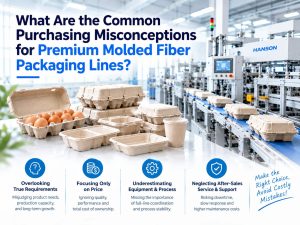
When investors and packaging manufacturers plan to enter the molded fiber market, one of the most frequently searched terms is “egg box machine.” The typical approach is to ask for the maximum capacity and the lowest price of the equipment. However, manufacturing a functional molded fiber egg carton is far more complex than producing a simple industrial cushion.
If you skip the critical steps of product definition and prototyping, jumping straight into large-scale equipment procurement can lead to severe production issues, such as deformed products, misaligned locking mechanisms, and unmet capacity targets.
Before configuring a complete dry-press pulp molding production line, you must first precisely define the product.
Egg Boxes vs. Egg Trays: Why Structural Design Matters
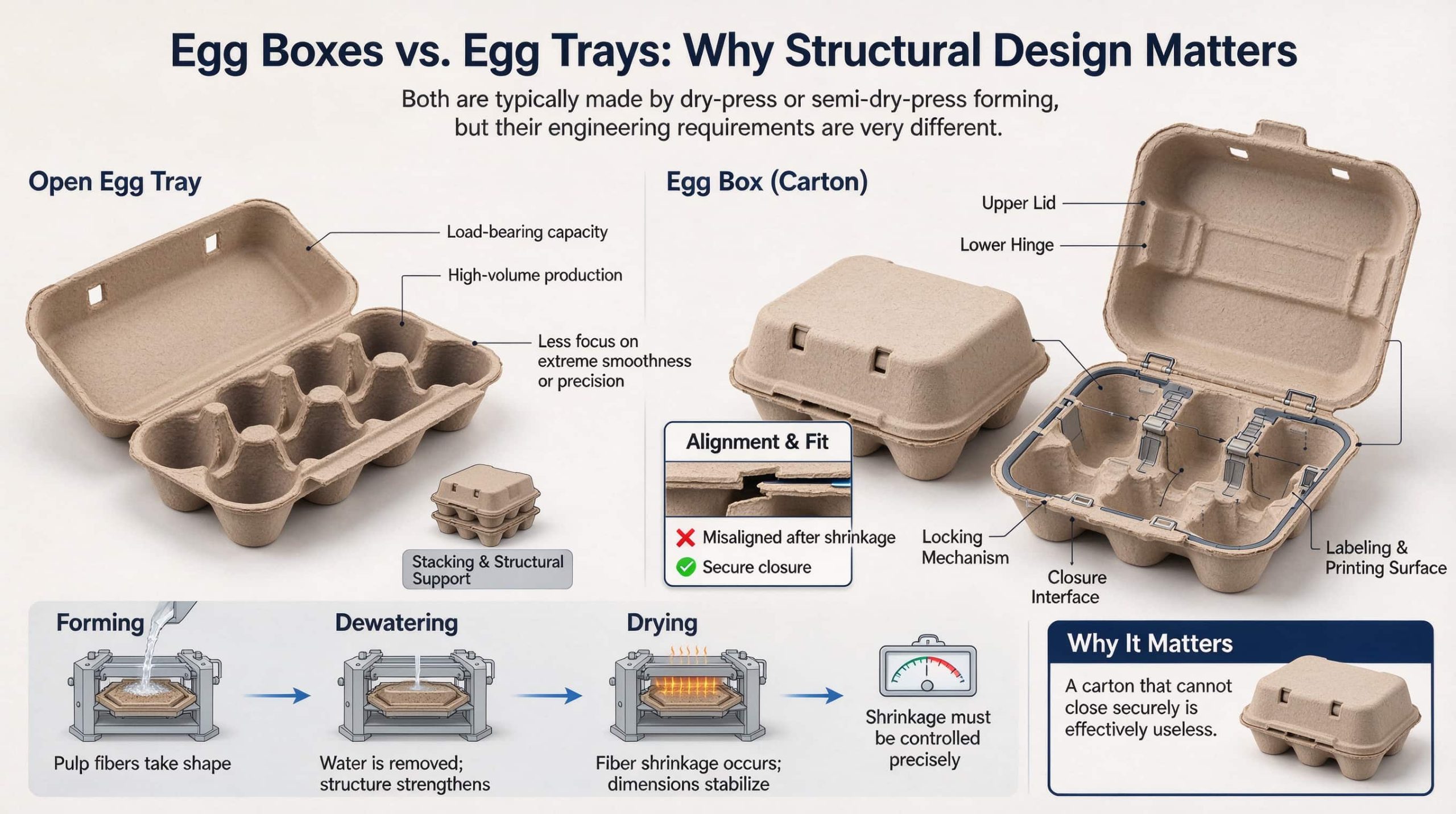
While both egg trays and egg boxes (cartons) are typically produced using a dry-press or semi-dry press process, their engineering requirements are significantly different.
An open egg tray prioritizes load-bearing capacity and high-volume production, with less emphasis on extreme surface smoothness or dimensional precision. Conversely, an egg box features upper and lower lids, hinges, locking mechanisms, and specific closure requirements, often coupled with labeling or printing needs.
During the forming, dewatering, and drying stages, plant fibers naturally shrink. If the hinge design is flawed or the shrinkage rate during drying is not strictly controlled, the upper and lower lids of the egg box will not align correctly. A carton that cannot close securely is effectively useless.
The Role of Prototyping in Molded Fiber Egg Box Production
For projects involving new structural designs, different fiber materials, or custom dimensions, creating mass-production tooling based solely on a 3D drawing is highly risky. Hanson Pulp Molding strongly recommends a standard project progression: Product Definition → Material R&D → Prototyping → Tooling Optimization → Process Validation → Mass Production Equipment.
Prototyping serves as an irreplaceable validation step:
-
Validating Forming and Demolding: Prototyping verifies whether the deep cavities and hinge structures can be easily demolded and if the wall thickness is uniform across the product.
-
Testing Shrinkage and Deformation: Because molded fiber wet preforms contain a large amount of water, drying causes shrinkage. Prototyping allows manufacturers to test the actual closure of the locking mechanisms after the product is fully dried.
-
Confirming Protective Strength: Small-batch samples can be subjected to compression and drop tests to ensure they provide adequate cushioning for fragile eggs during transport.
By utilizing specialized R&D equipment (such as the Hanson Pulp Molding ZAMS-6047 prototyping machine), manufacturers can determine the precise product weight, forming time, hot-pressing conditions, and mold layout restrictions. Only with this validated data can the actual output of a mass-production egg box machine be accurately calculated.
Configuring the Right Dry-Press Production Line for Egg Boxes
Once the product parameters are finalized, equipment selection shifts from comparing single machines to synchronizing an entire production system. As a specialist in turnkey pulp molding solutions, Hanson Pulp Molding configures automatic dry-press pulp molding production lines tailored for products like egg boxes and cup carriers.
In a typical automated setup, gantry manipulators handle the transfer of products between stations, seamlessly linking forming, drying, and hot-pressing:
-
Intelligent Pulp Preparation: The system is configured to handle specific fiber blends (such as recycled corrugated cardboard or waste paper), maintaining stable pulp consistency.
-
Forming and Cold Pressing (Pre-Dewatering): For egg boxes, the Hanson Pulp Molding dry-press line features a cold pressing station immediately after vacuum forming. This pre-dewatering step removes excess moisture before the wet preform enters the dryer. Not only does this reduce the thermal load and energy consumption during drying, but it also physically constrains the product, significantly reducing deformation and ensuring the dimensional accuracy of the hinges and locks.
-
Tunnel Drying: The pre-dewatered products pass through a double-layer tunnel oven. An optimized drying curve is vital for preventing warpage.
-
In-Line Hot Pressing: After drying, the egg boxes undergo hot pressing (using servo-driven, electrically heated molds) to achieve their final shape and smooth surface finish. Depending on the project, post-processing automation can be integrated for trimming or labeling.
Conclusion
The true capacity and quality of an egg box machine are not determined solely by its mechanical cycle time. They are the result of meticulous product definition, rigorous prototyping, and a well-engineered production line. By validating the product and process first, packaging manufacturers can eliminate guesswork, minimize investment risks, and ensure stable commercial production.
FAQ
1. Can I use the same machine for both egg trays and egg boxes? While both utilize dry-press or semi-dry press technology, egg boxes have stricter requirements for dimensional stability due to their lids and locking mechanisms. Egg box production lines often require more robust pre-dewatering (cold pressing) and precise hot-pressing stations to prevent deformation, which may not be necessary for basic open egg trays.
2. Why is cold pressing (pre-dewatering) important in a dry-press line? A cold pressing station mechanically removes moisture from the wet preform before it enters the drying oven. This lowers the energy required for thermal drying and, crucially, minimizes warpage, keeping complex structures like egg carton hinges accurate. It also reduces scale buildup on molds, extending maintenance cycles.
3. How is the actual daily capacity of an egg box machine calculated? Theoretical cycle times do not equal actual capacity. The true daily output depends on the individual product weight, the number of mold cavities, forming and dewatering times, drying line capacity, hot-pressing duration, and the overall equipment efficiency (yield rate and uptime).
CTA
If you already have a 3D drawing, a product sample, or a target daily capacity for your molded fiber egg boxes, we recommend starting with process validation and prototyping. Hanson Pulp Molding can evaluate your project from tooling design and pulp preparation to configuring the optimal automatic dry-press production line.
WhatsApp: +86 15920604830
Email: linchuangcheng@hspulpmolding.com