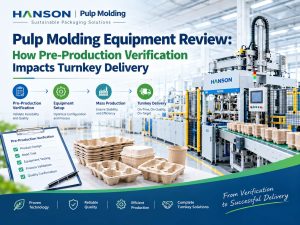
In many pulp molding projects, investors encounter a frustrating paradox: they create perfect molded fiber samples in the laboratory, but when they purchase large-scale pulp molding forming machines and build a full production line, they struggle with low yield rates, product deformation, and missed capacity targets.
Molded fiber manufacturing is a complex system, not a simple plug-and-play operation. From pulp formulation and tooling design to dewatering efficiency and hot pressing, every process variable directly affects the final product quality and the machine’s actual daily output. As a specialist in turnkey pulp molding solutions, Hanson Pulp Molding has reviewed numerous real-world delivery cases and concluded that successful commercial mass production relies entirely on the upfront synergy between the forming machine, the tooling, and the verified process parameters.
Based on actual industrial projects, this article breaks down how to align these three critical elements from the prototyping phase to stable mass production.
Phase 1: Prototyping and Process Validation
When developing a new product structure, utilizing special dimensions, or introducing novel plant fiber materials, moving directly to purchasing mass production pulp molding forming machines carries significant risk. A 3D drawing shows the physical design, but it cannot reveal whether the draft angles are sufficient for demolding, how efficiently the water will drain, or how much the fibers will shrink during drying. These factors must be validated through actual process testing.
Case Study: Shengquan’s “Verify First, Scale Later” Strategy When Shengquan needed to manufacture a special-sized diamond bowl, there was no mature forming machine solution readily available in the market for those specific dimensions. Instead of rushing to supply unverified large-scale equipment, Hanson Pulp Molding implemented a strict process synergy path:
-
Custom R&D and Pilot Production: Hanson conducted custom R&D and utilized its own facility to perform about 7 months of pilot production, thoroughly validating the forming, dewatering, and hot-pressing parameters for this unique product.
-
Prototyping Line: Shengquan’s Jinan facility then acquired a prototyping line to conduct small-scale commercial validation, ensuring all process metrics were stable.
-
Mass Production Configuration: Only after the sample and process were fully verified did Shengquan’s Daqing plant expand the partnership by deploying Hanson’s ZBG-1111 full-servo tableware forming machines for large-scale production.
By utilizing prototyping machines to lock in the optimal forming times and hot press temperatures, the client drastically reduced the troubleshooting time once the large-scale equipment was installed.
Phase 2: Synergy Between Tooling and the Forming Machine
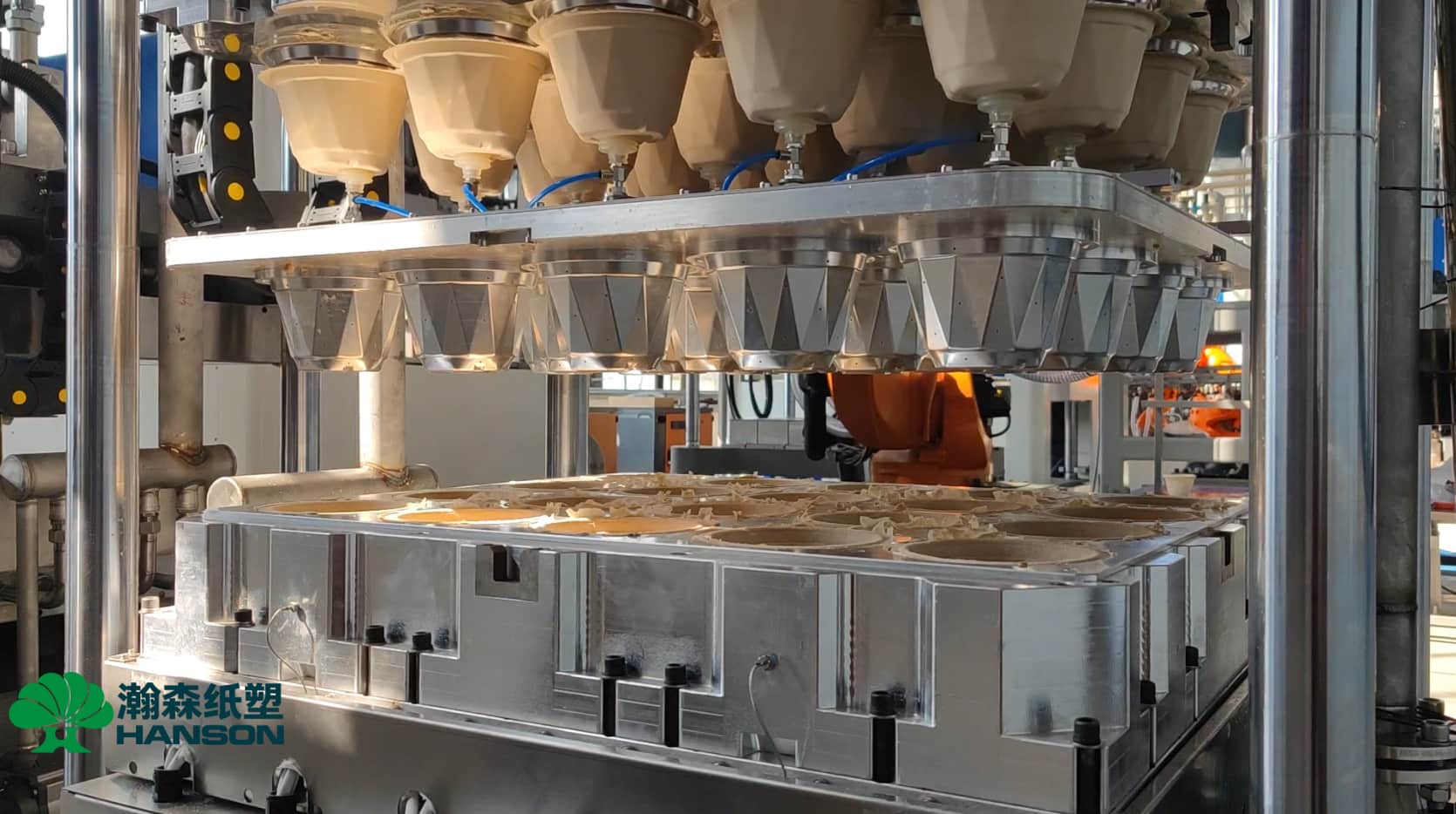
Many buyers mistakenly compare pulp molding forming machines based solely on their theoretical cycle times. In reality, the forming machine provides the necessary vacuum, pressure, and thermal environment, but the molded fiber tooling is what dictates dewatering efficiency and product consistency.
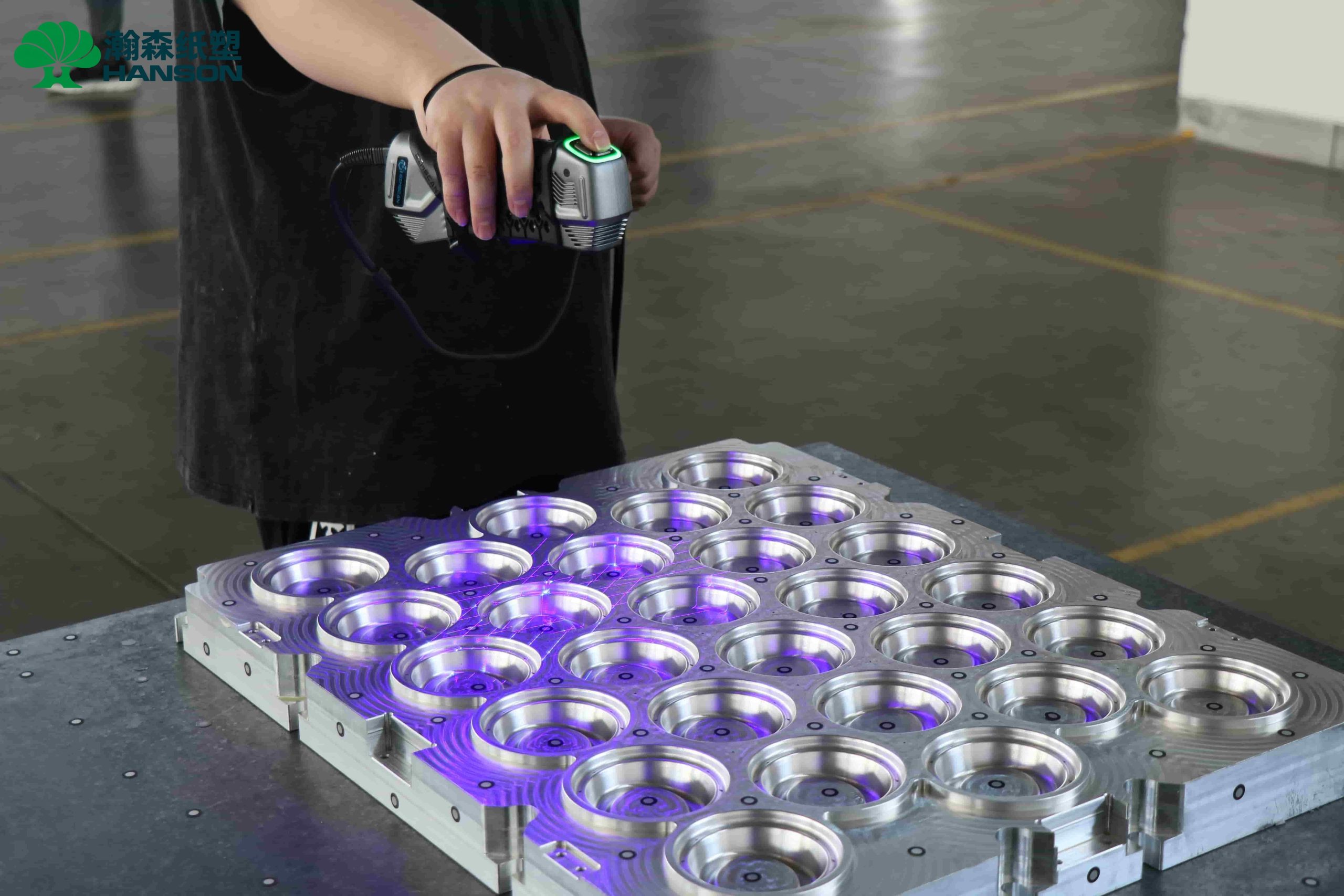
The wire mesh design on the forming mold determines fiber retention and drainage speed, while the exhaust venting in the hot press mold prevents surface blistering. If the mold design is poor, the wet preforms will carry excess moisture into the hot-pressing stage, forcing the forming machine to extend its heating cycle. This directly reduces daily capacity and drives up energy consumption per ton.
Hanson Pulp Molding advocates for the synchronized development of equipment and tooling. In premium industrial packaging projects for clients like Wangying and Xibao, where surface smoothness and dimensional accuracy are paramount, Hanson integrated the forming machine’s pressure control systems with the precision mold’s heat transfer structures. This synergy ensures that the equipment maintains exceptional product consistency even under heavy continuous loads.
Phase 3: Validating Stability in a Turnkey Plant Environment
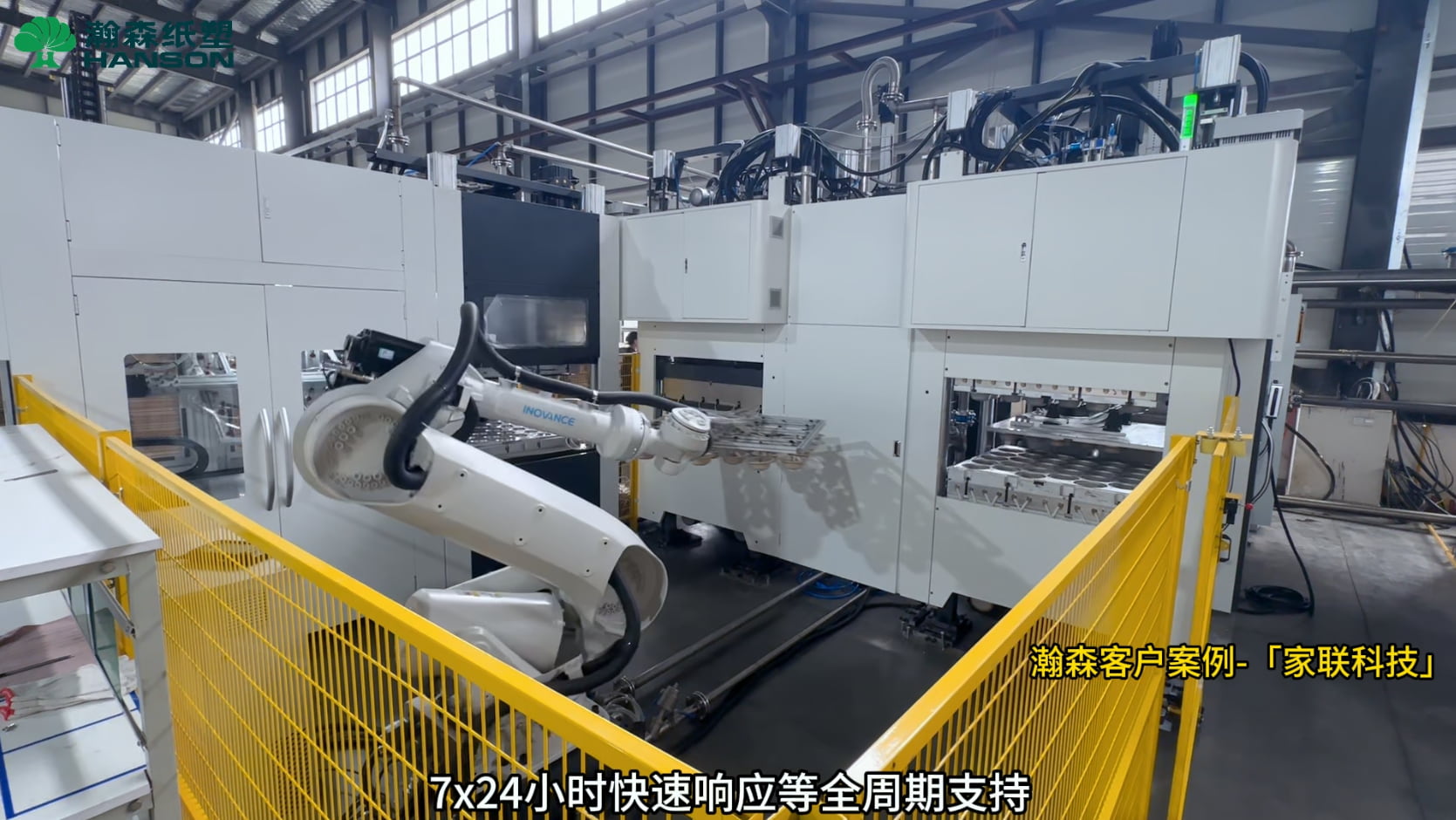
A pulp molding forming machine that performs well during empty-load testing does not automatically guarantee high uptime in a real factory environment. The stability of the pulp preparation system, the speed of post-processing trimming, and the consistency of the utility supply all impact the machine’s actual output.
Case Study: Jialian Technology’s Rigorous Mass Production Testing Before launching a massive overseas factory expansion, Jialian Technology did not rely solely on the theoretical parameters of the forming machines. Instead, they conducted approximately 4 months of rigorous real-world testing on Hanson Pulp Molding equipment. Over these 4 months, the machines were tested with actual pulp formulations, continuous heavy loads, and complete tooling sets to verify their true yield and stability. Having confirmed the synergy across all processes, Jialian Technology confidently purchased over 100 Hanson machines in the first phase for their production base in Thailand. This extensive pre-purchase stability testing provided a solid foundation for rapid installation and smooth production ramp-up overseas.
FAQ
1. Should I buy a mass production forming machine directly for a new product design? It is highly discouraged. For new structures or unverified materials, it is best to use a prototyping machine (such as the Hanson ZAMS-6047) for small-batch testing to verify demolding performance, wall thickness, and shrinkage. Once the tooling and process are validated, you can scale up to mass production machines, avoiding massive modification costs.
2. Why does the actual daily capacity change when I switch molds on the same forming machine? Because capacity is not dictated by the machine’s theoretical cycle time alone. Different molds change the product weight, the number of cavities, the drainage efficiency, and the required hot-pressing time. Slower dewatering or thicker products extend the forming and pressing cycles, which directly alters the daily output.
3. How does a turnkey pulp molding solution solve mass production issues? A turnkey solution is not just about assembling different machines; it involves reverse-engineering the plant based on the target product. Hanson’s 6+1 turnkey service system covers product development, plant planning, pulping systems, forming equipment, tooling, and post-processing, ensuring that interface friction between different production modules is eliminated before the equipment even arrives at the factory.
Conclusion
Transforming a perfect sample into a highly efficient production line requires more than just choosing a good pulp molding forming machine. It demands upfront process validation, precision tooling synergy, and rigorous stability testing in real-world conditions. Evaluating the product, the mold, and the machine as one unified manufacturing system is the most reliable path to securing your factory’s return on investment.
CTA
If you already have a product sample, 3D drawing, or a specific target daily capacity, Hanson Pulp Molding can help evaluate the most suitable pulp molding forming machine configuration, tooling design, and process layout. Whether you are in the prototyping phase or planning a large-scale turnkey plant, we are ready to support your project.
WhatsApp: +86 15920604830
Email: linchuangcheng@hspulpmolding.com