
When launching a new molded fiber packaging product, the trial run can sometimes be a battleground. If the product is defective upon mold installation, the equipment manufacturer might blame the tooling’s precision, while the tooling supplier might point to the machine’s uneven vacuum suction or poor piping. To avoid these disputes and ensure smooth project delivery, it is crucial to establish clear boundaries of responsibility between the equipment and mold manufacturers during the installation and debugging phase.
Whether for wet-press or dry-press processes, successful molded pulp tooling installation relies on accurate machine positioning, tooling quality inspection, and synchronized process parameters. Here is a practical breakdown of how the workload should be divided on the factory floor.
Equipment Manufacturer’s Scope: Providing a Stable Production Environment
The forming and hot-pressing machines are the foundational platforms for the molds. During installation, the equipment manufacturer is primarily responsible for the stability of the mechanical and pneumatic environment.
-
Machine Positioning and Platen Parallelism: The equipment technicians must ensure the precise positioning of the forming and hot-pressing stations. The parallelism of the upper and lower platens must meet factory tolerances. If the platens are misaligned, even the highest quality mold will suffer from uneven closure, causing flashing or cutting failures.
-
Vacuum Pipeline and Air Supply: Vacuum suction for forming and compressed air for part ejection are the lifeblood of pulp molding. The equipment manufacturer must guarantee the sealing of the vacuum pipeline, sufficient suction volume, and the stability of the air compressors. The mold only distributes the air holes; the volume and speed of the air/water flow are equipment responsibilities.
-
Heating and Temperature Control: For dry-press or thermoforming machines, the equipment must provide uniform heating to the platens and maintain temperature fluctuations within the specified process parameters.
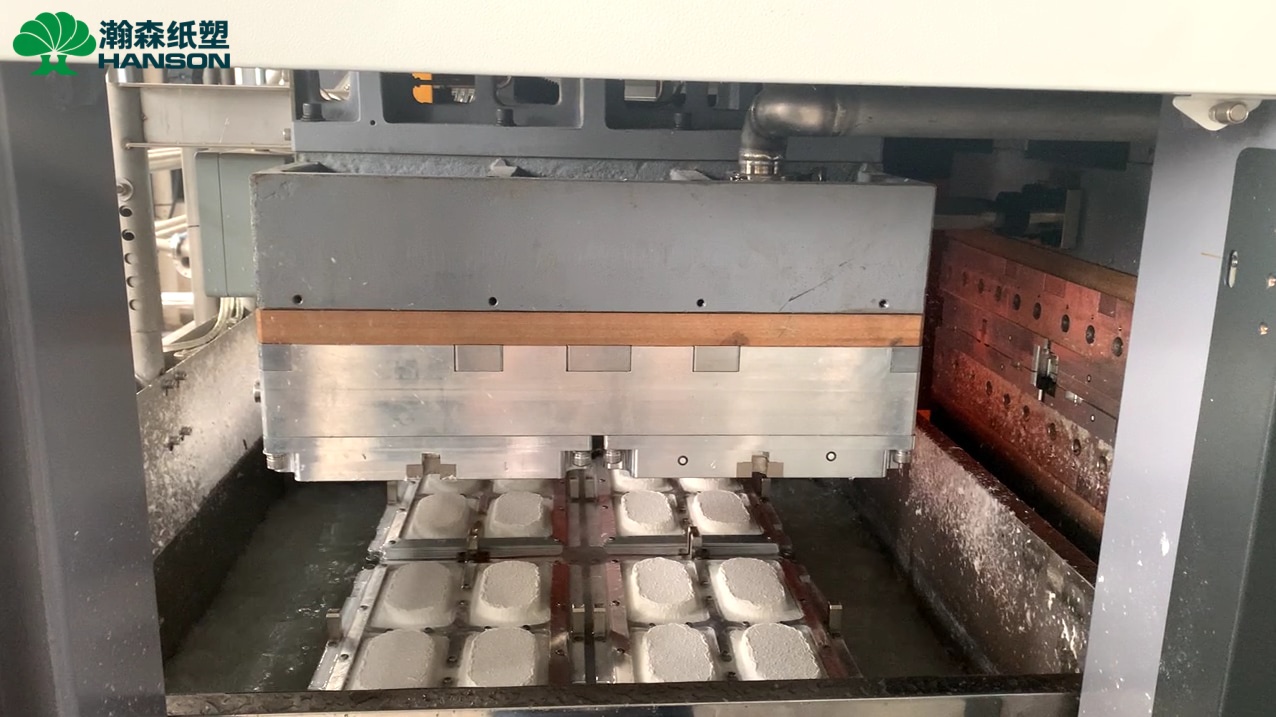
Tooling Manufacturer’s Scope: Tooling Integrity and Sample Sign-off
The mold determines the final geometry of the packaging. The tooling supplier’s duties on-site revolve around the physical condition of the mold and installation guidance.
-
Tooling Quality Inspection: Before shipment, the tooling supplier must complete dimensional checks (often via 3D scanning). During on-site installation, their engineers provide guidance to ensure proper alignment, preventing mechanical damage caused by forced clamping.
-
Mesh and Drainage Verification: The mold maker is responsible for verifying the tightness of the stainless steel mesh and the efficiency of the drainage holes. If the trial reveals localized blockages or water retention in the product, the tooling engineer must adjust the mesh or clear the drainage channels.
-
Sample Sign-off Responsibility: The sample sign-off is the ultimate validation of the mold. The tooling manufacturer is responsible for ensuring that the trial sample’s dimensions, weight, and aesthetics match the approved 3D drawings. Once the client signs off on the sample, the mold project delivery is officially completed.
Shared Responsibilities: Process Parameters and Troubleshooting
In a real-world setting, rigid division of labor isn’t always practical. Tuning the production line for optimal yield requires cooperation.
-
Tuning Process Parameters: The tooling manufacturer provides a baseline set of process parameters (e.g., recommended pulp consistency, suction time, pressing temperature, and vacuum degree). The equipment operator or factory technician then fine-tunes these variables based on the actual on-site pulp properties and pump efficiency.
-
Mass Production Support: If ejection issues occur, both parties must investigate together. They need to determine whether the issue stems from insufficient draft angles (tooling responsibility) or incorrect air-blow timing and pressure (equipment tuning).
Hanson Pulp Molding: Bridging the Gap in Commissioning
To minimize friction during mold installation, Hanson Pulp Molding leverages its extensive engineering experience—with over 500 pulp molding molds manufactured to date. We understand not only tooling but also the mechanical logic of mainstream molded fiber equipment. By utilizing high-speed CNC machining (up to 24,000 RPM) and rigorous 3D scanning, we eliminate tooling dimension errors before delivery. During on-site trials, our engineers can quickly identify whether an issue is caused by a vacuum pipeline fault or a process parameter mismatch, helping you achieve faster sample sign-offs and reliable mass production support.
-
FAQ 1: The mold doesn’t close tightly after installation. Is it the machine or the mold? Answer: First, run the machine without the mold and check the platen parallelism using a dial indicator. If the platens are parallel, apply red lead paste to the mold’s parting line and do a test close. If specific areas don’t touch, it’s a tooling precision issue. If the gap is entirely on one side, it’s likely an unlevel clamping mechanism on the equipment.
-
FAQ 2: During the trial, the product is thick on one side and thin on the other. Who should fix this? Answer: Troubleshoot step-by-step. Check the equipment first: Is the pulp vat level stable, and does the forming mold submerge evenly? Then check the mold: Are the drainage holes evenly distributed, or is the mesh locally blocked? Typically, adjust the machine’s vacuum distribution before modifying the mold’s water channels.
-
FAQ 3: After sample sign-off, what if the mold wears out too quickly during mass production? Answer: Sample sign-off confirms the dimensions and forming action. If rapid wear occurs later, check if the pulp contains excessive abrasive impurities (like sand) or if the machine’s clamping pressure is set too high. If both are normal, the mold’s material hardness or surface treatment may need to be evaluated.