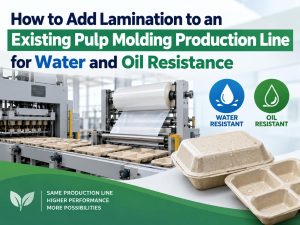
When molded fiber packaging needs enhanced barrier properties—such as advanced water and oil resistance—or a specific surface finish, relying solely on wet-end chemical additives is not always enough. Lamination has become an important post-press process to evaluate for products with strict functional requirements.
For manufacturers preparing to introduce this capability, a common question arises: What specific equipment is included in a complete pulp molding laminating production line? Is it a single standalone machine, or a complex system of multiple stations?
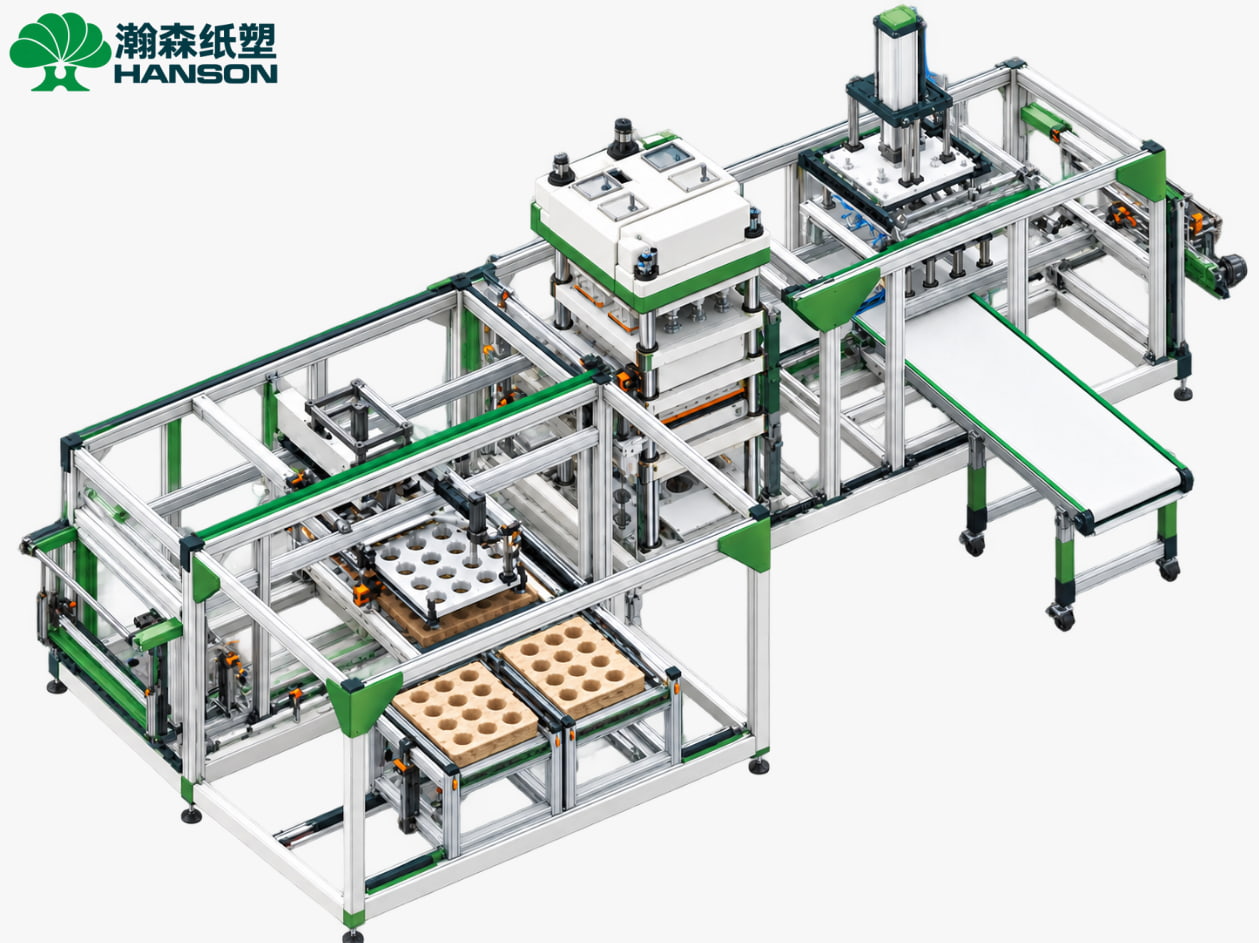
Modern, high-efficiency laminating equipment has evolved into a highly integrated system. Instead of disjointed standalone machines that require manual transfer of work-in-progress materials, advanced solutions connect key post-press steps automatically.Taking the Hanson Pulp Molding automatic laminating line as a prime example, a standard configuration typically consists of four core automated modules:
1. Film Unwinding Module
This is the starting point of the lamination process. This module ensures that the rolled film is unspooled evenly and fed accurately into the heat-pressing station. It is designed to accommodate various film types and thicknesses. The Hanson Pulp Molding line is compatible with a wide range of films, including PE, PET, PLA, PBAT, PP, and EVOH, to meet different product barrier requirements.
2. Core Lamination Station (Heat Pressing)
This is where the film is thermally bonded to the molded pulp substrate.
-
Motion Structure: To maintain stable lamination quality, the heat-press platen operates with a strictly vertical up-and-down motion, eliminating complex lateral movements. This reduces mechanical complexity and potential failure points.
-
Pressure Distribution: Utilizing a servo-driven linkage structure, the pressing force is distributed evenly, which is highly beneficial for maintaining platen flatness and parallelism. This is critical for large molds, such as the 1100 × 1100 mm mold platen equipped on Hanson machines.
-
Servo Control: The entire lamination station is servo-driven to ensure precise and coordinated action, achieving a lamination cycle time of 15s/mold (overall capacity is product-dependent).
3. In-line Trimming Station
After lamination, products typically have excess film around their edges. Hanson Pulp Molding utilizes a synchronized “lamination + trimming” configuration. The products are automatically transferred to a servo-driven trimming station that applies up to 80 tons of cutting force, capable of processing products with a maximum height of 80 mm. This seamless transition eliminates intermediate waiting times and manual transferring.
4. Product Stacking Module
After the edges are neatly trimmed, the finished products are automatically collected and stacked. This final module completes the automated post-press workflow, significantly reducing the labor required for material handling.
Conclusion
Managed by an intuitive PLC + HMI control system, a high-quality pulp molding laminating machine is essentially a fully automated micro-factory that integrates unwinding, laminating, trimming, and stacking.
If you are evaluating lamination for a molded pulp product, send Hanson Pulp Molding your product photos, dimensions, film requirements and target performance. Our team can help evaluate the process and suitable equipment configuration.