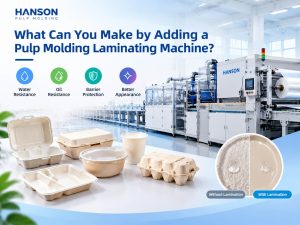
When molded fiber packaging requires enhanced water resistance, oil resistance, barrier properties, or specific surface finishes, lamination is a highly effective post-processing solution. However, adding this process can create new bottlenecks. If a factory relies on standalone machines—moving products manually from forming to lamination, then to trimming, and finally to stacking—the post-processing stage quickly becomes labor-intensive and prone to handling damage.
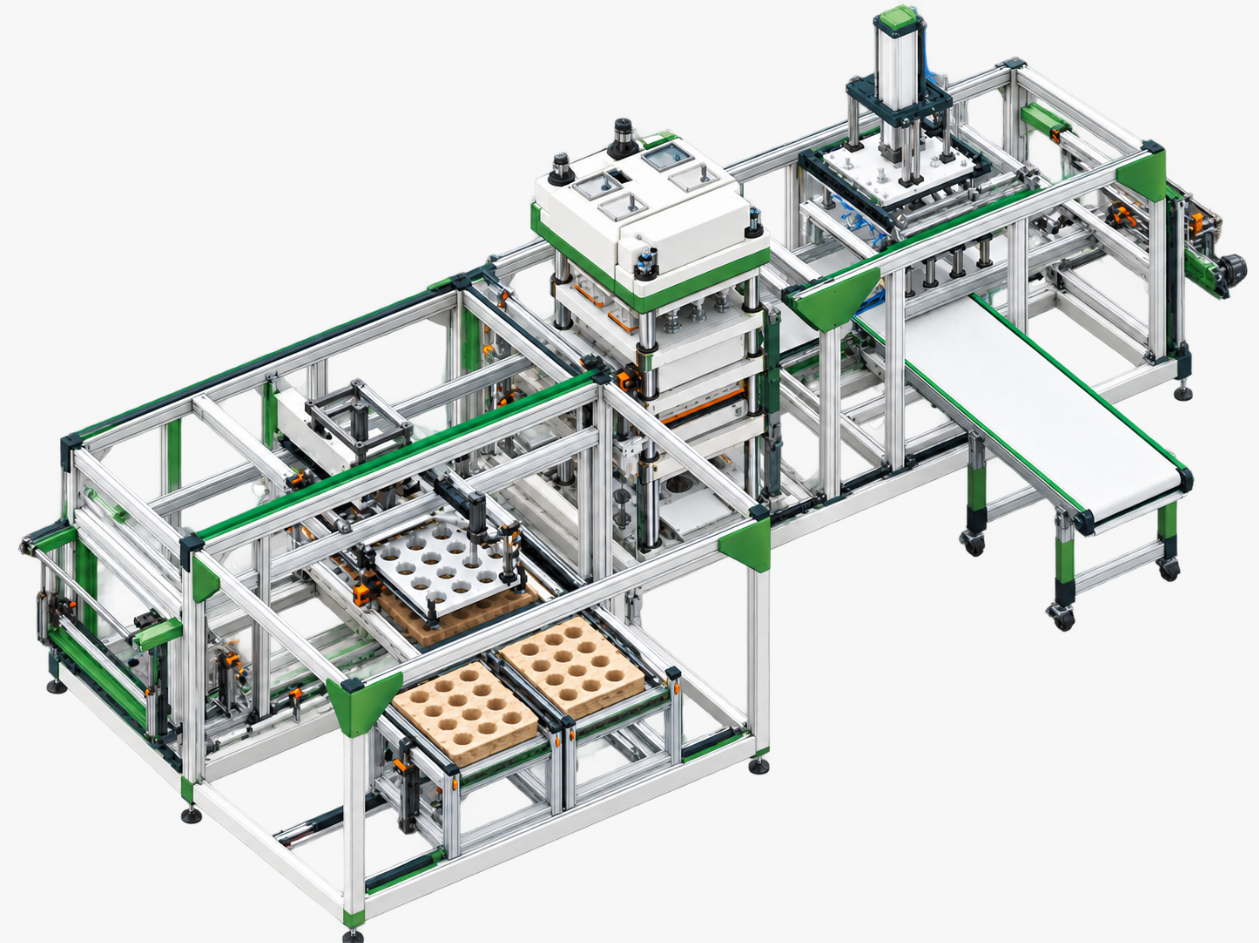
To address these challenges, integrating these post-processing steps into a single, fully automated production line has become a preferred approach for modern molded pulp manufacturers.
The Advantages of an Automated Lamination Line
1. Eliminating Intermediate Wait Times
When operating separate machines, the overall production capacity is often limited by the speed of manual loading, unloading, and transferring. An automated line synchronizes the entire workflow. By adopting a “one-lamination-one-trimming” configuration, the molded pulp products move seamlessly from the lamination station directly into the trimming station. This coordinated sequence eliminates intermediate staging, allowing the lamination cycle and trimming operations to match perfectly and improve overall line efficiency.
2. Reducing Labor and Product Damage
Molded pulp products, especially before final trimming, require careful handling. Manually transferring laminated products between machines increases the risk of scratches, contamination, and edge damage. An integrated line automatically transfers products from film unwinding through lamination, trimming, and product stacking. Minimizing human intervention helps maintain consistent quality and high hygiene standards, which is particularly crucial for food-grade packaging.
3. Optimized Motion and Stability
Both lamination and trimming require high precision and stable vertical pressing motions. In an automated setup, servo-controlled motion helps maintain stable and precise operation across all stations, ensuring that the entire line operates in perfect harmony without mechanical conflicts.
Equipment Selection for Automatic Lamination Lines
When evaluating an Automatic Pulp Molding Laminating Line, the focus should be on system integration and reliable mechanical design. Hanson Pulp Molding provides a comprehensive solution designed specifically for these requirements.
The Hanson automated line seamlessly integrates film unwinding, lamination, trimming, and product stacking. As detailed in the technical documentation (覆膜机设备简介V10_2026.01.15(1).doc), the machine features a large mold platen size of 1100 × 1100 mm and can accommodate a maximum product height of 80 mm. Both the lamination and trimming stations are servo-driven, with the trimming station providing 80 tons of force. The use of a servo-driven linkage structure ensures that the pressing force is distributed evenly, which is beneficial for maintaining platen flatness and parallelism.
The equipment is compatible with a wide range of films, including PE, PET, PLA, PBAT, PP, and EVOH. While the machine operates at a lamination cycle of 15 s/mold, the actual daily capacity is product-dependent, as it varies based on the cavity layout of the specific mold.
If you are evaluating lamination for a molded pulp product and want to optimize your post-processing efficiency, send Hanson Pulp Molding your product photos, dimensions, film requirements, and target performance. Our team can help evaluate the process and recommend the suitable automatic equipment configuration.