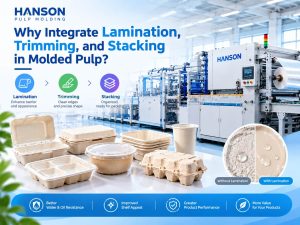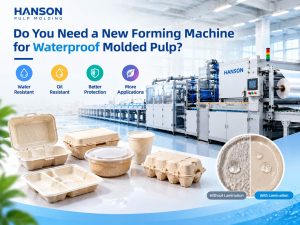
In the manufacturing of molded pulp packaging, the wet-end forming process is often highly automated. However, when products require enhanced water, oil, or barrier resistance, post-processing steps such as lamination and trimming are introduced. If these steps rely on standalone machines, they quickly become a bottleneck, requiring massive amounts of floor space and manual labor for loading, transferring, and stacking.
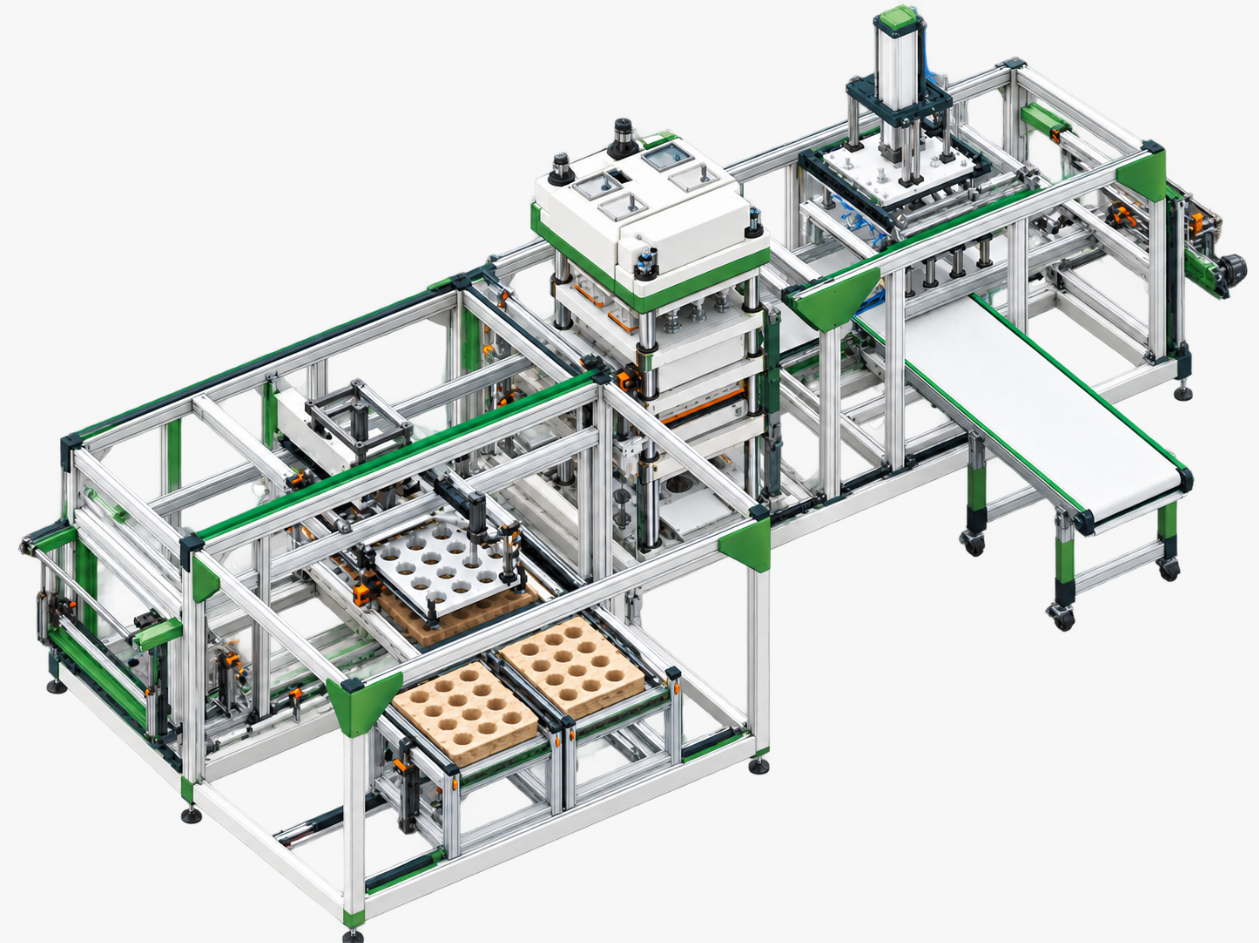
Whether you are designing a new facility or upgrading an existing production line, solving the labor issue in post-processing requires a strategic approach to automation.
Why Lamination and Trimming Should Be Automated First
In a conventional setup, a worker must manually load the molded fiber product into a lamination machine, wait for the thermal bonding, remove it, transport it to a trimming press, and then manually stack the finished goods. Every manual transfer adds to labor costs and slows down the overall production cycle.
The most effective way to reduce this labor dependency is to eliminate the intermediate manual handling. By integrating these disconnected steps into a continuous workflow—Film unwinding → Lamination → Trimming → Product stacking—manufacturers can significantly improve line efficiency.
How an Automatic Pulp Molding Laminating Machine Solves the Problem
To achieve seamless integration, the equipment must be designed for continuous operation rather than standalone tasks. The Automatic Pulp Molding Laminating Line developed by Hanson Pulp Molding focuses on stability and synchronized cycles to address these automation challenges:
1. Integrated Lamination and Trimming Configured to perform lamination and trimming sequentially, the production line eliminates the need for manual intervention between thermal bonding and edge cutting. Controlled by a PLC and HMI system, the stations coordinate perfectly to maintain a smooth, continuous production flow.
2. Full Servo Control for Precision Automation requires precise and reliable motion. Both the lamination and trimming stations on this equipment are servo-driven. This ensures stable operation, accurate positioning, and makes it easier to synchronize the mechanical movements, significantly simplifying operator adjustments.
3. Robust Platen and Linkage Structure The quality of the lamination depends heavily on the pressure and alignment of the thermal platen. The equipment features an up-and-down platen movement with no lateral motion, keeping the mechanical structure direct and reducing the risk of complex motion failures. Combined with a servo-driven linkage structure, it ensures even pressure distribution and maintains strict platen parallelism across the 1100 × 1100 mm mold area. The trimming station delivers 80 tons of force, accommodating products with a maximum height of up to 80 mm.
4. Versatile Film Compatibility An automated line must be flexible enough to handle diverse customer requests. This machine is compatible with a wide range of films, including PE, PET, PLA, PBAT, PP, and EVOH, allowing manufacturers to adapt to specific barrier requirements or environmental standards based on the material formulation.
Capacity and Equipment Selection
When planning for automation, production capacity is a primary concern. While the machine operates at a lamination cycle of 15 seconds per mold, it is important to note that actual capacity is product-dependent. The total output will vary based on product dimensions, mold layout, and the specific film used.
If you are evaluating lamination for a molded pulp product to reduce post-processing labor, send Hanson Pulp Molding your product photos, dimensions, film requirements, and target performance. Our team can help evaluate the process feasibility and recommend the most suitable equipment configuration for your facility.