When molded fiber packaging requires enhanced water, oil, gas barrier, or specific surface properties, the molding process alone may not be sufficient to meet the final application requirements. In such cases, lamination is a proven post-press solution worth evaluating.
For manufacturers looking to upgrade their production capabilities or meet strict client specifications, it is essential to understand what a pulp molding laminating machine is and the exact production challenges it addresses.
What is a Pulp Molding Laminating Machine?
A pulp molding laminating machine is designed to apply a polymer film onto the surface of molded pulp products. Using a thermo-compression process, the equipment securely bonds the film to the fiber substrate, significantly enhancing the product’s functional properties.
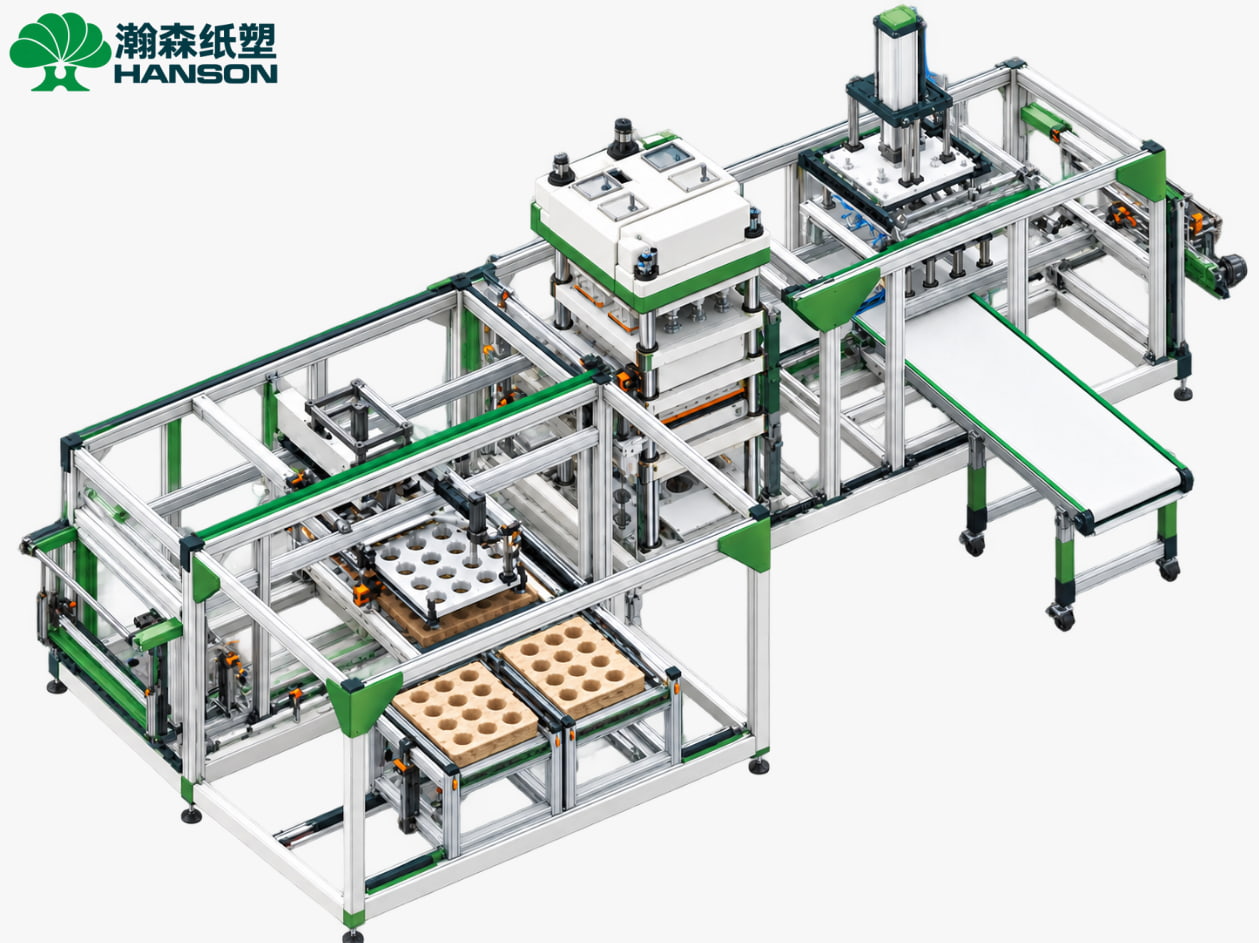
Modern lamination equipment operates as a fully integrated automated system rather than a standalone manual tool. The Automatic Pulp Molding Laminating Line from Hanson Pulp Molding, for example, integrates the entire post-press workflow: Film unwinding → Lamination → Trimming → Product stacking. This continuous process eliminates manual transfer between stations and ensures stable, high-speed output.
Key Challenges Solved by Lamination Lines
Adding a lamination process primarily solves performance and efficiency challenges for molded fiber manufacturers:
1. Strict Barrier Requirements Certain food service items (e.g., containers for hot soups or greasy foods) and specialized industrial packaging require zero leakage and high barrier performance. A laminating machine seamlessly applies films like PE, PET, or PP to create a dense physical barrier, solving the issue of liquid permeation that traditional chemical additives might not fully prevent.
2. Balancing Eco-Friendly Demands with Functionality As sustainability standards evolve, clients demand diverse material solutions. The Hanson Pulp Molding laminating line is compatible with a wide range of films, including eco-friendly options like PLA, PBAT, and EVOH. This versatility solves the challenge of meeting both rigorous performance criteria and specific environmental regulations with a single base material.
3. High Labor Costs and Workflow Inefficiencies Separating the lamination and trimming processes often requires significant manual labor for alignment and transfer, leading to bottlenecks and potential product damage. By combining a servo-driven lamination station (operating at a 15 s/mold cycle) and an 80-ton servo-driven trimming station, the equipment achieves an “in-line lamination and trimming” flow. This integration drastically reduces manual handling and synchronizes post-press efficiency.
What to Consider When Evaluating Equipment
When selecting a pulp molding laminating machine, it is crucial to look beyond just cycle speed. Stability and product compatibility are key factors for a successful project:
-
Motion Structure & Precision: Consistent pressure is vital for a smooth, wrinkle-free lamination. Equipment that utilizes a vertical up-and-down platen motion, combined with a servo-linkage structure, ensures uniform force distribution. This maintains platen flatness and parallelism, solving the issue of uneven film adhesion.
-
Product Compatibility: Production capacity is entirely product-dependent. You must evaluate your product’s dimensions against the machine’s specifications. For instance, an 1100 × 1100 mm mold platen size and a maximum product height allowance of 80 mm will determine your mold layout and ultimate output per cycle.
If you are evaluating lamination for a molded pulp product, send Hanson Pulp Molding your product photos, dimensions, film requirements, and target performance. Our team can help evaluate the process and recommend the suitable equipment configuration.