
When upgrading or establishing a new molded fiber factory, many investors focus heavily on fully automatic equipment to reduce labor costs and increase capacity. However, the success of an automated production line doesn’t just depend on the machine’s theoretical cycle time. The true bottleneck often lies in the pulp molding mold (molded fiber tooling) and how well it integrates with the equipment and the production process.
A pulp molding mold is not merely a consumable accessory. It is a core component that directly affects forming quality, dewatering efficiency, hot pressing results, and product consistency. So, to what extent should pulp molding mold automation be configured?
The Core Role of Molds in an Automated Pulp Molding Line
The essence of automation is continuous, stable production. If the mold design does not match the process requirements, even the most advanced automatic pulp molding machine will encounter frequent downtimes.
For example, during in-machine mold transfer, the wet preform—which still contains a high amount of moisture—must be accurately moved from the forming tool to the hot press mold. If the forming mold has poor dewatering efficiency, the wet preform will remain too wet and fragile, leading to deformation or breakage during transfer. Similarly, incorrect draft angles or uneven mesh drainage can cause the product to stick to the mold. Therefore, molds and equipment must be considered together; tooling design directly impacts forming, drying, and production stability.
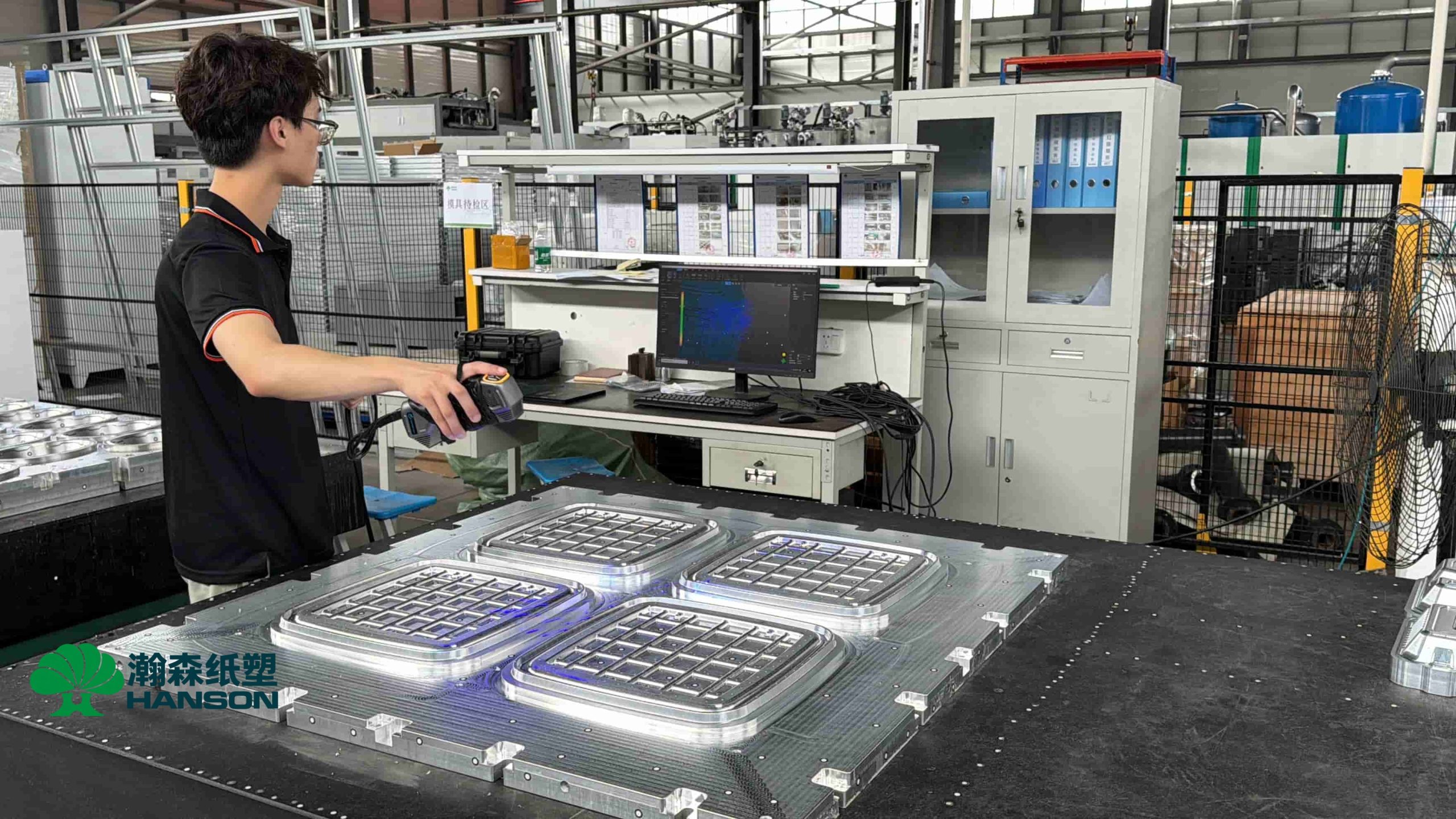
Key Factors for Configuring Pulp Molding Mold Automation
A reasonable automation configuration should match your project scale, product type, and overall line process. When evaluating molded fiber tooling, focus on these three dimensions:
1. Stability of In-Machine Mold Transfer
For premium industrial molded fiber packaging or high-capacity tableware, in-machine mold transfer is a critical automation step. The pulp molding mold requires exceptional precision to ensure that the wet preform is smoothly gripped and accurately positioned at high speeds. This demands robust structural design and highly precise distribution of vacuum and compressed air within the tooling.
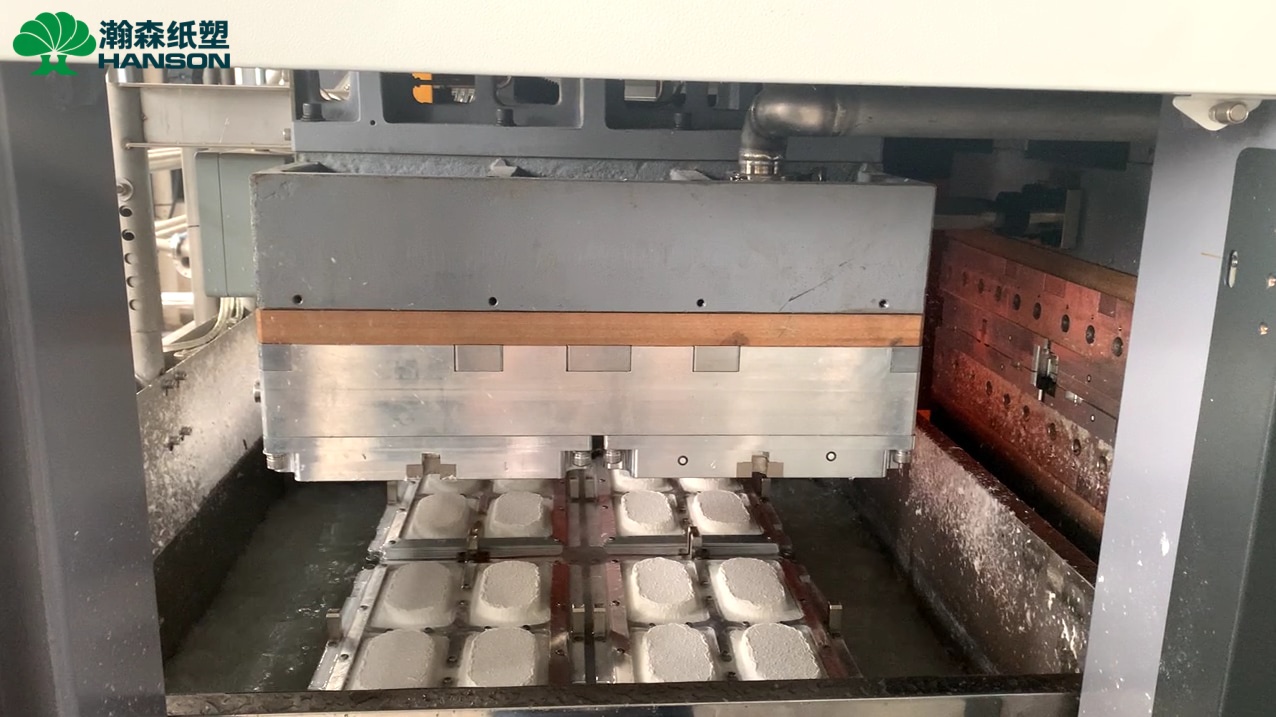
2. Matching Dewatering and Hot Pressing Efficiency
Production capacity is not solely determined by the machine; the mold’s dewatering capability is a massive variable. A well-configured mold can rapidly remove moisture during the forming stage, significantly reducing the energy required during the hot pressing phase. If the mold’s exhaust and drainage channels are inadequate for a high-speed automated cycle, products will suffer from localized wet spots or warpage, drastically lowering the yield rate.
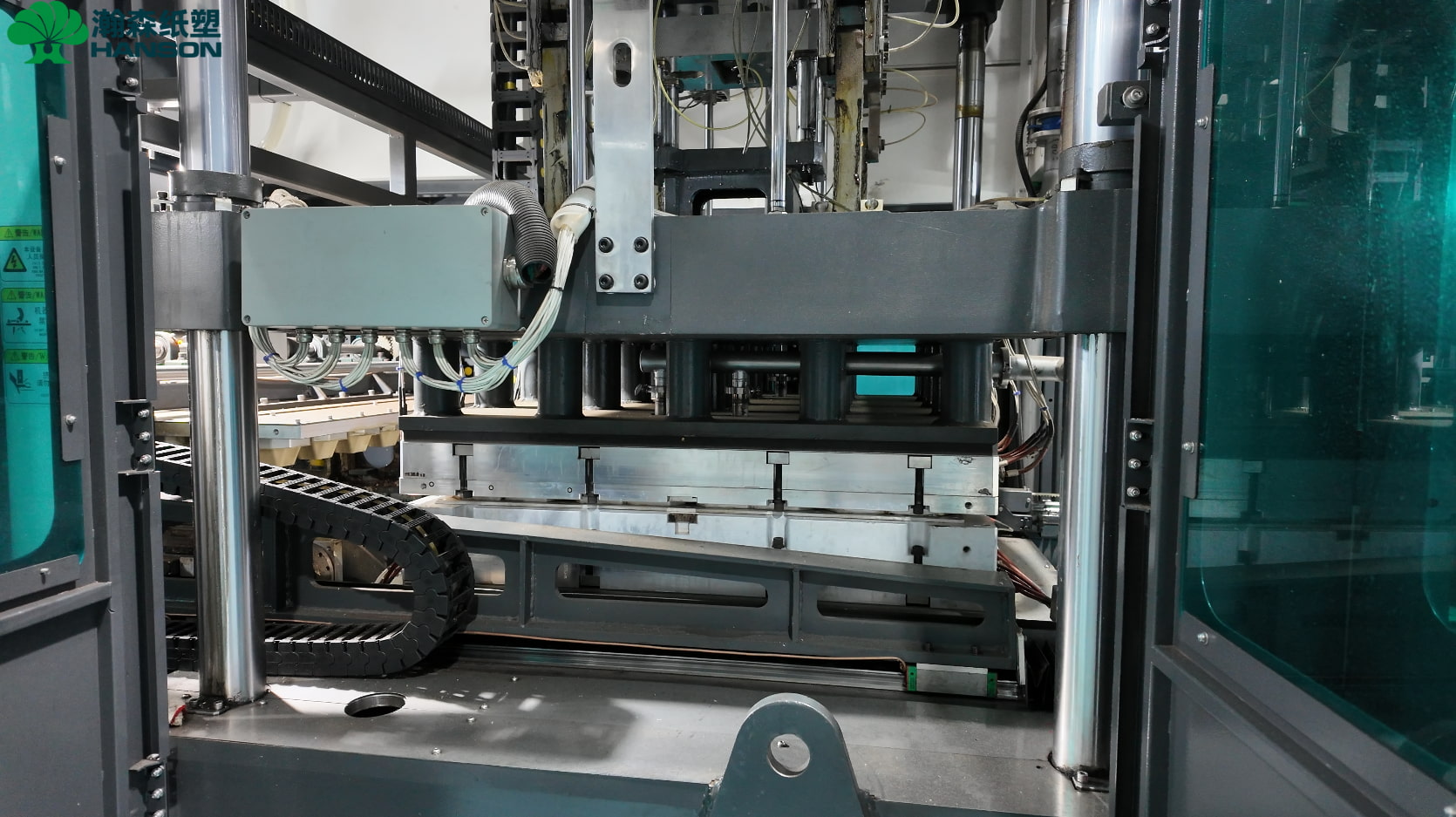
3. Integration with Post-Processing Automation
Modern pulp molding production lines often integrate post-processing automation, such as trimming, vision inspection, and stacking. The dimensional stability and trimming reference points established by the hot press mold directly determine whether downstream automated equipment (like a servo-driven punch cutting machine or vision inspection camera) can recognize and handle the product successfully. If tooling consistency is poor, the downstream automation will become the bottleneck of the entire plant.

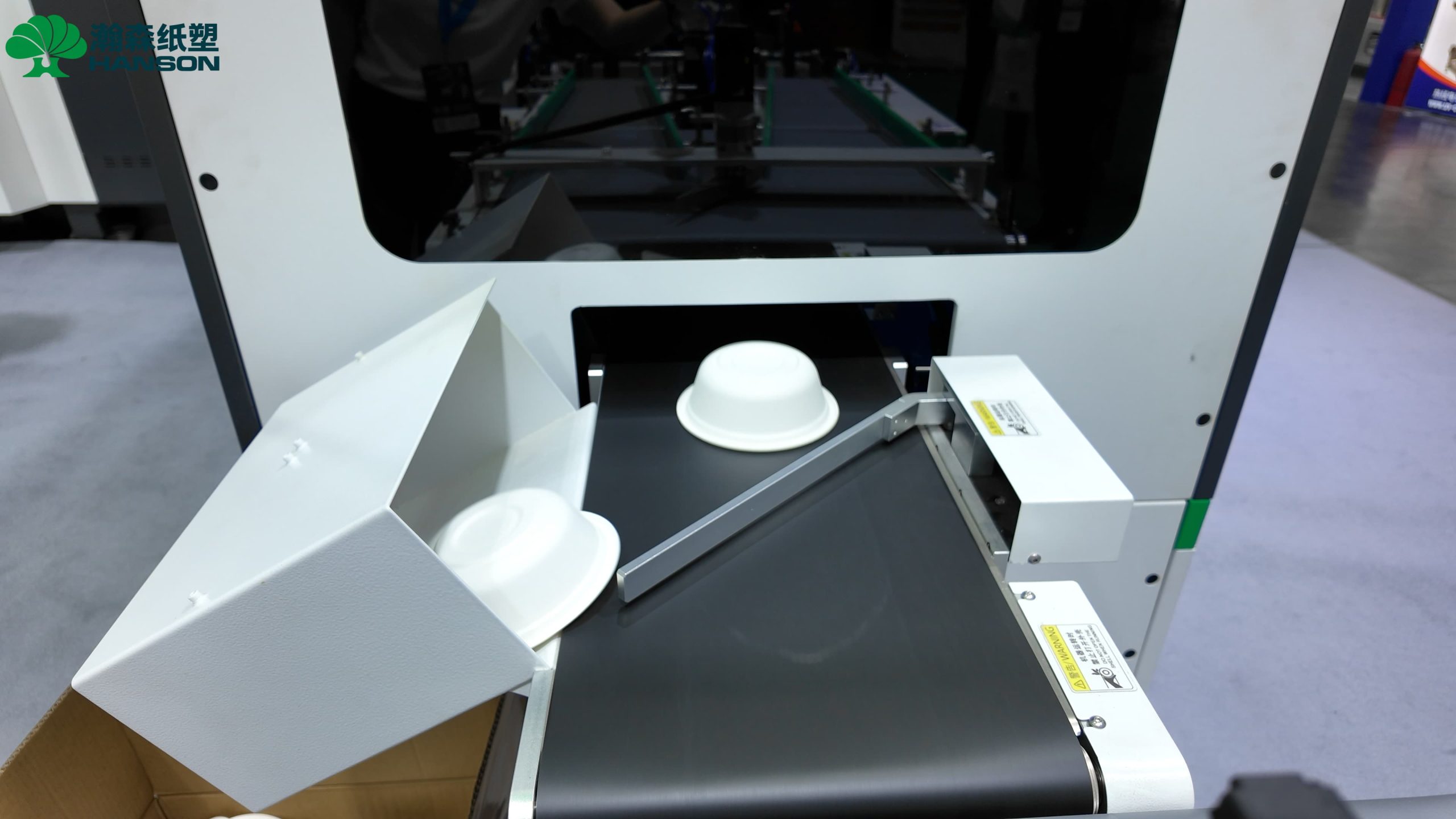
Why Hanson Pulp Molding Emphasizes Equipment-Tooling-Process Synergy
As a specialist in turnkey pulp molding solutions, Hanson Pulp Molding believes that equipment and molds should never be evaluated in isolation. To ensure that highly automated configurations truly deliver stable commercial production, Hanson Pulp Molding provides a comprehensive approach centered on equipment-tooling-process synergy:
-
Integrated Mold Design and Manufacturing: Hanson Pulp Molding possesses extensive capabilities in mold design, manufacturing, and optimization. Starting from the product structural design phase, the engineering team aligns draft angles, mesh configurations, and drainage paths with the machine’s vacuum and hot pressing parameters, ensuring seamless demolding and consistency.
-
Joint Debugging and Production Validation: Equipment delivery does not mean the project is finished. Hanson Pulp Molding provides joint debugging services that encompass tooling adjustments, process parameter tuning, and yield rate improvement. Validating the molds on the actual equipment under real production conditions guarantees optimal performance.
-
Existing Tooling Optimization: For existing plants looking to increase automation or introduce new products on their current lines, Hanson Pulp Molding also provides tooling optimization and modification services to unlock the hidden potential of older molds.
In the molded fiber industry, true expertise isn’t just about how fast a machine can run. It is about deeply understanding the interplay between materials, tooling, and the final product.
FAQ
Q: Can I just change the mold to produce a different pulp molding product on the same automated machine? A: Not necessarily. Changing the mold is only one part of the equation. Different products often require adjustments to the pulp slurry furnish, forming time, vacuum levels, hot pressing temperature, and trimming settings. This is why automated lines rely on joint debugging of the equipment, process, and tooling.
Q: Does increasing the number of mold cavities always increase production capacity? A: While more cavities generally mean more products per cycle, the number of cavities is limited by product size, weight, the mold’s drainage efficiency, and the equipment’s vacuum and pressing load capabilities. Adding too many cavities without sufficient process support can lower product yield and actually decrease the actual daily capacity.
Q: Can old manual molds be installed directly onto a new automatic pulp molding machine? A: Typically, they require evaluation and modification. Molds designed for manual machines often have different positioning tolerances, interfaces, and draft angle requirements compared to fully automated tooling. Running them without optimization can lead to transfer failures or frequent downtime. Hanson Pulp Molding can provide tooling optimization services to assess and adapt existing molds.
Conclusion
The reasonable extent of pulp molding mold automation is not measured by its mechanical complexity, but by how flawlessly it synchronizes with the equipment’s cycle, the process requirements, and post-processing automation. By working backward from the final product’s demands and treating the equipment, mold, and process as a unified system, manufacturers can guarantee a higher return on investment and stable commercial production.
If you already have a product sample, 3D drawing, or specific automation upgrade needs, but face challenges in mold compatibility and forming quality, Hanson Pulp Molding can help. We evaluate your project based on product geometry, tooling design, forming process, and equipment configuration to provide comprehensive joint debugging or mold optimization solutions.
WhatsApp: +86 15920604830
Email: linchuangcheng@hspulpmolding.com