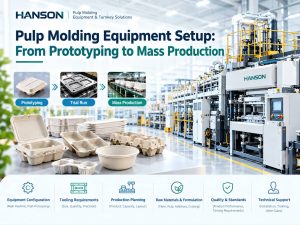
In a molded fiber project, taking delivery of the machinery is only the first step. When conducting factory acceptance testing (FAT) or on-site commissioning, many investors make the mistake of focusing solely on the machine’s theoretical dry-run cycle time. However, producing high-quality molded fiber products requires a complex synergy between the equipment, the process, and the tooling.
A pulp molding mold (often referred to as molded fiber tooling) is not just a standard accessory. It is a critical engineering component that directly influences forming performance, dimensional accuracy, surface finish, dewatering efficiency, and ultimately, your stable mass production capacity. To ensure a successful project, factory acceptance must evaluate the complete interaction between the equipment and the molds.
Here are the four key indicators you should check during pulp molding mold and equipment acceptance.
1. Dewatering Efficiency and Wet Preform Moisture Content
The fundamental challenge in the pulp molding process is removing water efficiently. The earlier and more effectively water is extracted, the less thermal energy is required during the drying or hot pressing stage.
During acceptance testing, evaluate the forming mold’s performance:
-
Mesh and Drainage Performance: The wire mesh covering the forming tool, combined with the vacuum system, must ensure uniform and rapid water drainage without excessive fiber loss.
-
Wet Preform Moisture Content: Check the moisture content of the wet preform immediately after forming and before it enters the hot press mold. For example, under specific process conditions with Hanson Pulp Molding’s tableware equipment, the wet preform moisture content can be controlled to <60%. Inefficient mold drainage forces the equipment to compensate with longer hot-pressing times, severely limiting daily output.
2. In-Machine Transfer and Demolding Stability
After the initial vacuum forming stage, the wet preform still contains significant moisture and has relatively low mechanical strength. It must be safely moved from the forming mold to the transfer mold or hot press mold.
-
In-Machine Mold Transfer: A successful acceptance test should demonstrate a high success rate during this transfer phase. The draft angles of the mold, the surface finish of the tooling, and the precise servo positioning of the equipment all play crucial roles.
-
Product Integrity: Any pulling, tearing, or deformation during transfer indicates an issue with either the mold design or the equipment’s pneumatic/servo timing. Precision tooling ensures smooth demolding, thereby increasing your overall yield rate.
3. Dimensional Accuracy and Surface Quality
For premium industrial molded fiber packaging and high-end foodservice items, the tooling directly defines the final product’s texture and structural integrity.
-
Hot Pressing Effectiveness: In a wet press or thermoformed fiber process, the wet preform is pressed and dried inside a heated mold. Acceptance should include a thorough inspection of the final product’s wall thickness uniformity and the clarity of complex details (such as small radii and deep cavities).
-
Surface Finish: The hot press mold must be precisely engineered to prevent surface defects like burn marks, blistering, or rough fiber exposure. High-quality tooling guarantees the smooth, premium finish required for consumer electronics packaging.
4. Actual Production Capacity vs. Theoretical Cycle Time
A common misconception is calculating daily capacity based merely on the machine’s fastest theoretical cycle time.
-
Actual Production Capacity: True daily capacity is the result of single-cycle time, the number of mold cavities, individual product weight, forming time, hot pressing time, and the equipment’s actual uptime.
-
Tooling Maintenance Frequency: Observe the molds during continuous test runs. If the mesh frequently clogs or scaling occurs, requiring constant downtime for cleaning, your actual production capacity will drop significantly. More cavities do not automatically equal higher capacity if the mold area, vacuum efficiency, or equipment load limits are exceeded.
The Importance of Equipment, Tooling, and Process Synergy
If you purchase your equipment from one supplier and your molds from another, acceptance testing often becomes a blame game. If the product surface is poor, the machine builder blames the mold maker; if capacity is low, the mold maker points to the machine’s vacuum or pressure systems.
As a specialist in turnkey pulp molding solutions, Hanson Pulp Molding approaches acceptance from the perspective of the final product: Product → Material → Process → Mold → Equipment → Mass Production.
Hanson Pulp Molding not only manufactures advanced forming equipment but also provides comprehensive mold design, tooling manufacturing, and optimization services. During installation and commissioning, our engineering team conducts joint debugging of the equipment, molds, and pulping parameters (such as pulp consistency and freeness). By ensuring that the tooling and equipment are perfectly matched, we help our clients smoothly transition from testing to stable commercial production.
FAQ
1. Why does my production capacity change when I swap molds on the same machine? Production capacity is not solely determined by the equipment. Different products require molds with different areas, cavity numbers, and drainage efficiencies. Additionally, product weight influences forming and hot pressing times, meaning the actual daily output (in pieces or tons) will vary depending on the specific tooling used.
2. What causes the wet preform to stick in the mold and fail to transfer? This is typically caused by insufficient draft angles in the mold design, damaged mesh, mold surface scaling, or improper timing of the vacuum and compressed air blow-off. It requires troubleshooting both the tooling structure and the equipment’s process parameters.
3. Can I test an old pulp molding mold on a new machine during acceptance? It is possible, but you must first evaluate the mold’s dimensions, mounting interfaces, drainage design, and compatibility with the new equipment’s pressure limits. Hanson Pulp Molding can provide mold optimization services to adapt existing tooling to new production lines.
Conclusion
Evaluating a pulp molding mold and equipment setup is ultimately a stress test of your entire manufacturing system. High dewatering efficiency, stable mold-to-mold transfer, precision surface quality, and reliable uptime are the true indicators of a profitable production line. By partnering with a turnkey solution provider capable of joint tooling and equipment debugging, investors can significantly reduce the risks associated with production ramp-up.
Ready to Optimize Your Molded Fiber Production?
If you already have a product sample, 3D drawing, product dimensions, or a target daily capacity, Hanson Pulp Molding can help evaluate the molding process, tooling design, and equipment configuration for your specific project.
WhatsApp: +86 15920604830
Email: linchuangcheng@hspulpmolding.com