
When sourcing pulp molding molds, many procurement managers and factory owners fall into a common trap: they approve the tooling based entirely on a handful of flawless, aesthetically pleasing samples. However, a perfect prototype only proves that the fundamental geometric design and single-shot forming capabilities are viable. Reliable large-scale production (mass production) demands much more. It requires the tooling to maintain an exceptional yield rate, strict product consistency, and an efficient cycle time under continuous, high-stress operational conditions.
Ultimately, the true measure of a mold’s success lies not in the controlled environment of a laboratory, but in its performance amidst the temperature fluctuations, mechanical shocks, and slurry variations on a real-world factory floor.
The Fundamental Gap Between a “Perfect Sample” and “Mass Production”
Why is there such a massive discrepancy between an initial sample and the final production run? The answer lies in the operating environment.
During the prototyping phase, the mold is typically tested under ideal conditions. The slurry concentration is perfectly balanced, the forming time is generously extended to ensure optimal fiber deposition, and manual intervention corrects minor flaws before the product is presented to the buyer.
In contrast, large-scale production is a rigorous, relentless environment. The tooling must interface with a pulp pool where cyclic feeding causes constant variations in pulp concentration. The mold undergoes continuous thermal expansion from repeated heating cycles, and it must withstand the mechanical impact of rapid mold closing and opening. Therefore, a mold designed for true mass production must be engineered with superior structural rigidity, highly efficient thermal conductivity, optimal mesh side drainage, and precise mold clearance. Anything less will inevitably result in costly downtime and a surge in scrap rates.
5 Key Metrics for Molded Pulp Tooling Mass Production Acceptance
To mitigate procurement risks, molded fiber packaging manufacturers must establish an objective, quantifiable acceptance checklist. When evaluating molded pulp tooling for large-scale production, consider these critical dimensions:
1. Continuous Trial Production Cycle and Yield Rate
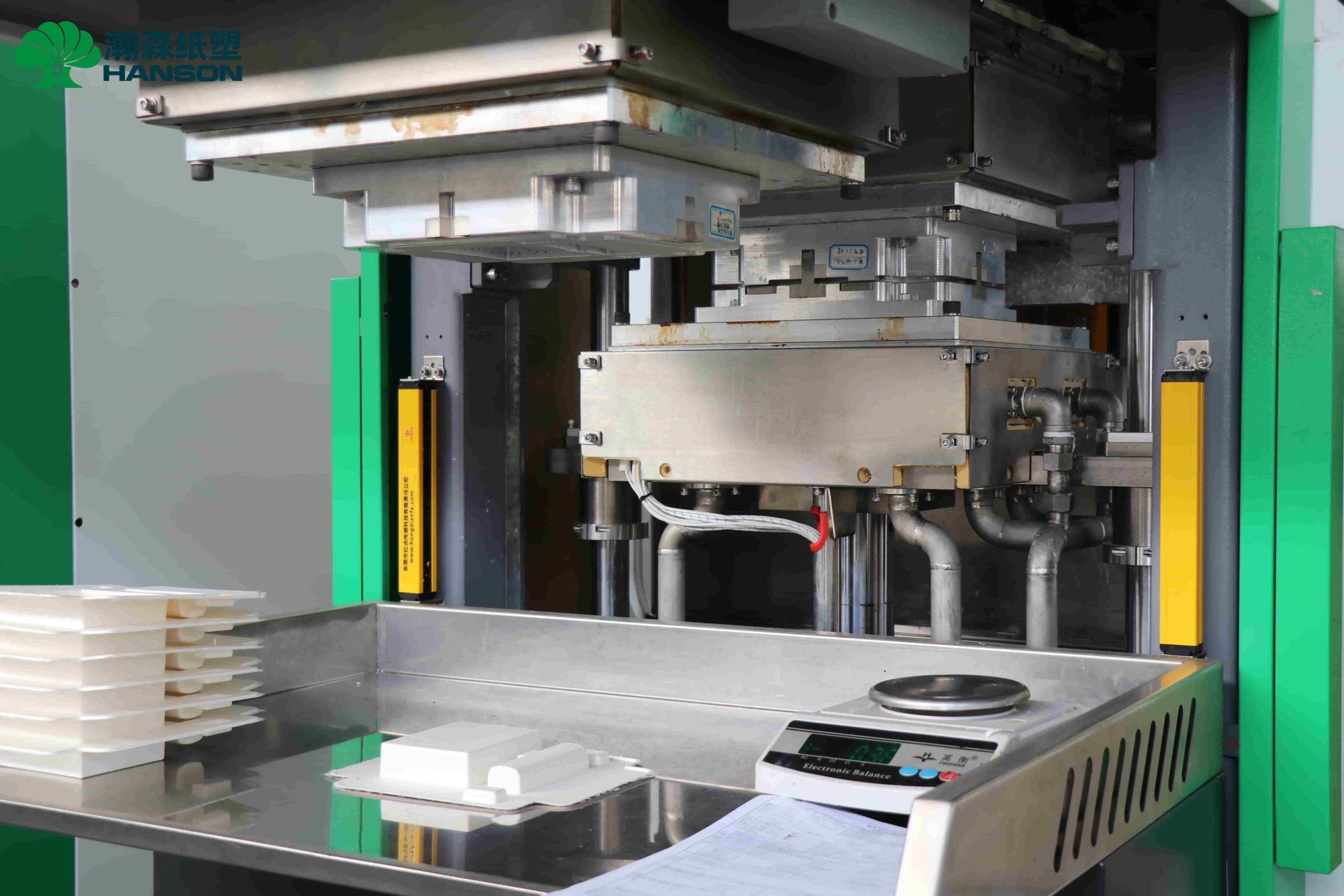
Accepting a mold after watching it run for just ten cycles is a critical mistake. A proper mass production acceptance protocol requires a continuous trial run of at least 4 to 8 hours on your actual production line.
-
Yield Rate Verification: Monitor the scrap rate under a normal operational cycle time. Look for recurring defects such as broken wire mesh, incomplete forming in specific cavities, or substandard wall thickness. A premium set of pulp molding molds should achieve a stable yield rate of over 95% during continuous operation, depending on the product’s complexity.
-
Thermal Stability: Does the mold warp or cause the product to stick after hours of continuous heating? This extended trial is the ultimate test of the raw material’s quality and the effectiveness of the stress relief processes applied during the mold’s manufacturing.
2. Product Consistency and Mold Clearance
A “good-looking sample” might be cherry-picked from a batch of fifty, but reliable mass production means the 1,000th product must perfectly match the very first.
-
Weight Tolerance: If the products show significant weight discrepancies between different positions on a multi-cavity mold, it typically points to uneven vacuum distribution or inconsistent mold clearance across the tooling.
-
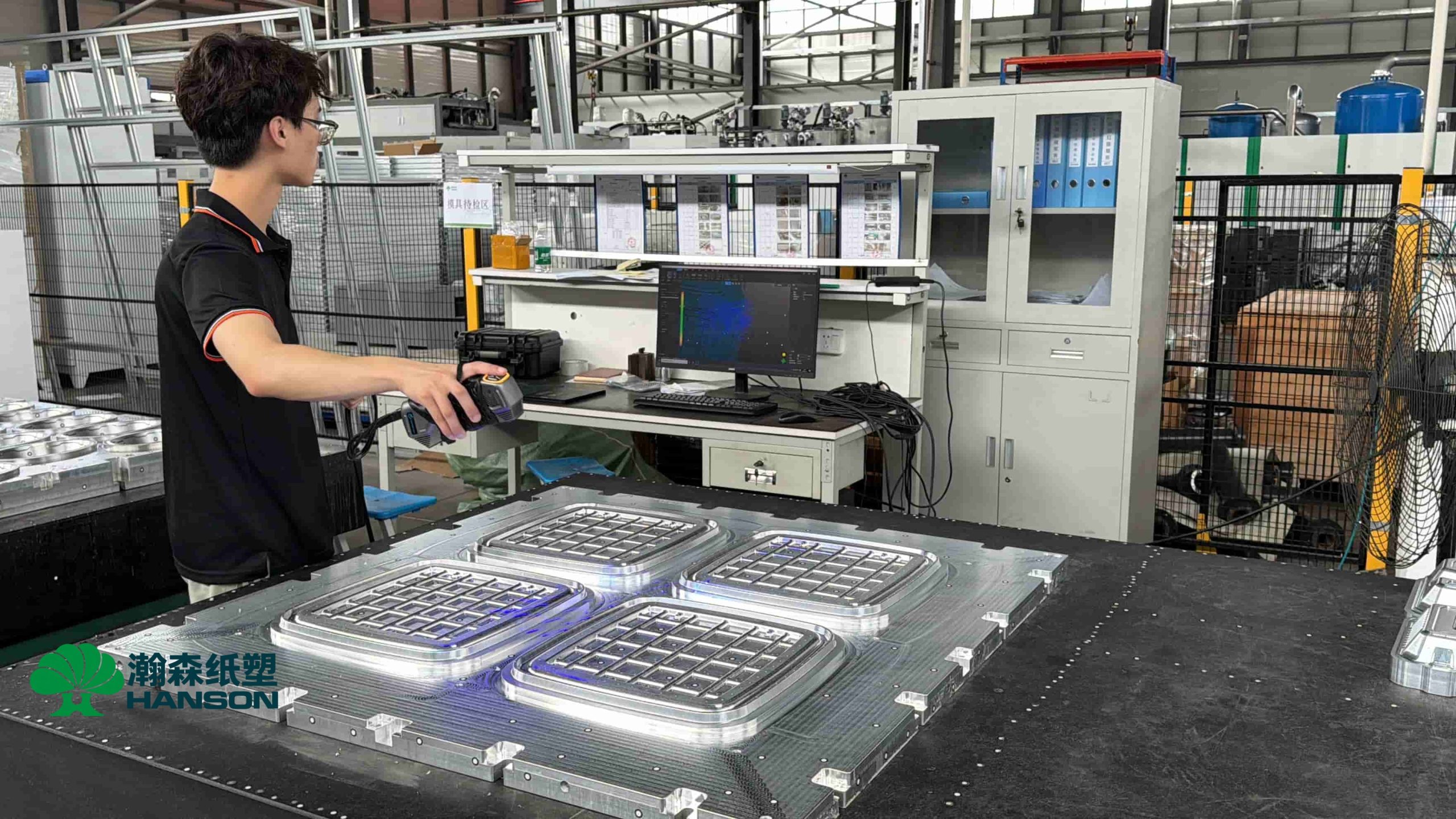
Wall Thickness and Assembly: Measure the distance between the smooth side (cosmetic side) and the mesh side. Inconsistent closing height or irregular mold clearance will lead to dimensional variations, causing interference issues when the molded fiber components are ultimately stacked or assembled.
3. Achieving the Target Cycle Time
During the procurement and trial phase, always compare the cycle time required to produce the perfect sample against the target cycle time needed for profitable mass production. In order to produce a flawless sample, subpar molds often require artificially extended pulp suction and hot-pressing times. Authentic mass-production tooling features scientifically optimized drainage holes and vacuum channels. This allows for rapid dewatering and transfer within an extremely short cycle time, ensuring your facility meets its output targets without sacrificing quality.
4. Convenience of Cleaning and Maintenance
One of the most persistent headaches for production supervisors is frequent wire mesh blockages.
-
During the continuous trial, observe how quickly the mesh side accumulates stray fibers or sticky residue from chemical additives like AKD emulsion.
-
Is the tooling structure designed to allow operators to quickly clean the surface using high-pressure water guns without causing damage?
-
If localized components—such as specific sections of the wire mesh—need to be replaced, can this maintenance be performed online? Tooling that must be entirely removed and shipped back to the mold manufacturer for minor mesh repairs will severely disrupt your large-scale production schedule.
Troubleshooting Priorities: Don’t Always Blame the Tooling
When defects occur during a trial run, implementing a scientific diagnostic approach is vital. It is a common engineering misconception to attribute all issues—such as material shortage, product deformation, sticking to the mold, or excessive burrs—solely to the pulp molding molds. You must differentiate between tooling faults, slurry conditions, equipment precision, and process parameters.
-
Incomplete Forming or Material Shortages:
-
First Priority: Check the pulp pool liquid level, accurate quantitative pulp feeding stability, and vacuum negative pressure limits.
-
Tooling Check: If process conditions are verified as normal, inspect the mold to see if the suction holes in the affected cavity are clogged, or if the localized mold clearance is too tight, preventing fiber deposition.
-
-
Sticking to the Mold and Demolding Difficulties:
-
First Priority: Verify if the heating temperature is adequate and if the compressed air blow-off pressure is sufficient. Also, check if the ratio of release agents or PFAS-free additives is balanced.
-
Tooling Check: Inspect the demolding draft angle of the tooling and ensure the smooth side is polished to the required high-precision finish.
-
-
Excessive Burrs or Uneven Trimming:
-
First Priority: Evaluate the punching pressure and positioning accuracy of the trimming equipment.
-
Tooling Check: Check the wear on the cutting edges and the alignment between the upper and lower molds.
-
Always adhere to the “single variable method” when adjusting parameters, and rely on on-site verification to confirm the root cause.
How Hanson Pulp Molding Ensures Mass Production Reliability
Exceptional lifecycle management for molded pulp tooling begins at the design stage. Hanson Pulp Molding operates an independent tooling division, grounded in the philosophy that “understanding the process and the equipment is just as important as understanding the mold itself.” We are not merely a machining shop; we are a comprehensive service provider dedicated to solving the real-world mass production challenges faced by molded fiber factories.
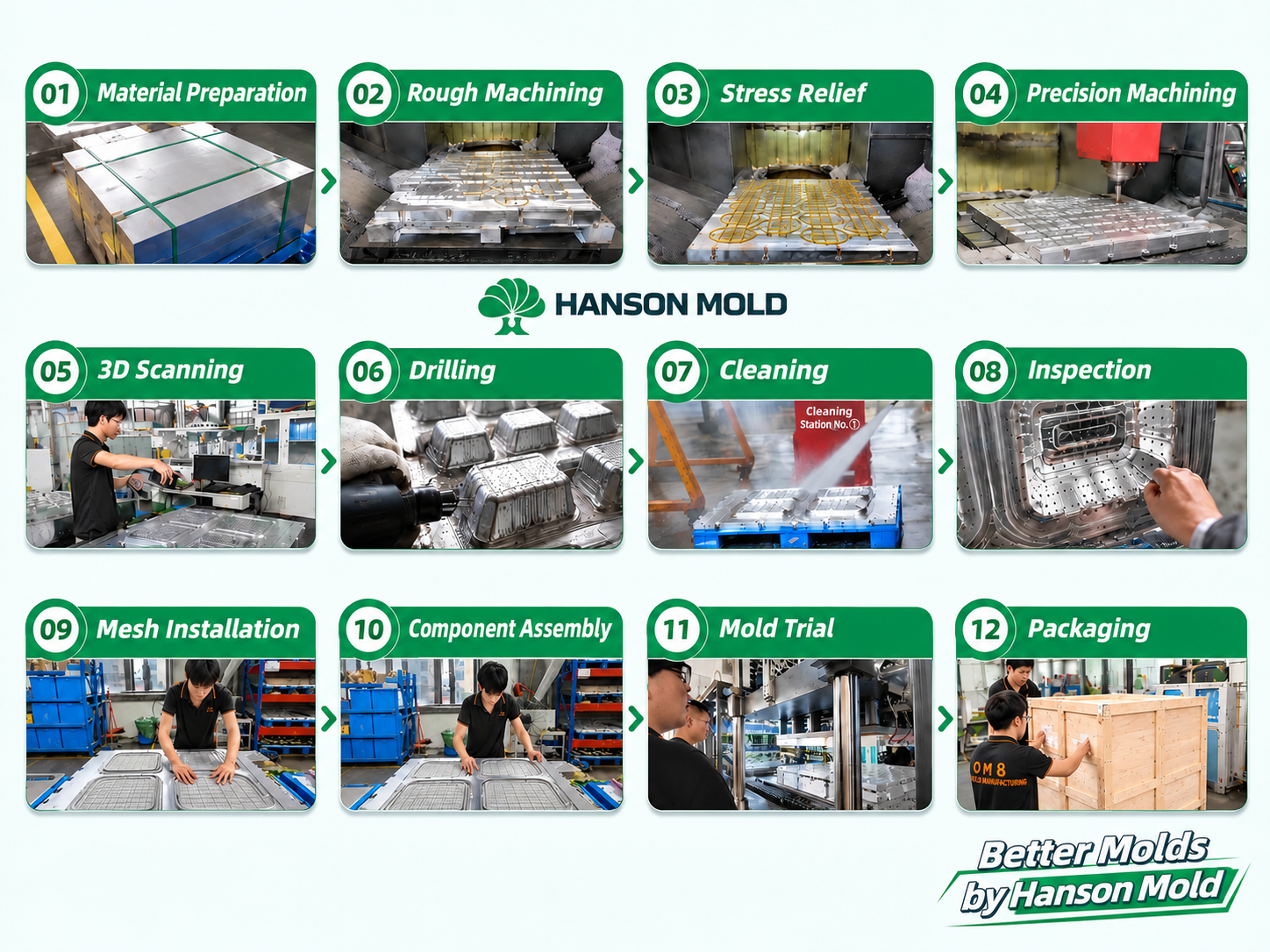
To ensure that every set of tooling delivers ultimate mass production reliability, Hanson Pulp Molding strictly implements 12 critical manufacturing nodes. Starting from the initial blank casting, we eliminate hidden deformation risks through standard stress relief procedures. Moving into the rough machining and fine machining stages, we utilize high-speed CNC machining centers with spindle speeds up to 24,000 RPM, guaranteeing immaculate mold clearance and dimensional precision.
The tooling then undergoes comprehensive 3D scanning for full-dimensional verification, followed by precise drilling, cleaning, re-inspection, and wire mesh covering. Finally, the process culminates in meticulous assembly and internal mold trials. Every single procedure is guided by stringent mass production standards.
Backed by the engineering expertise of 10 senior designers, we have 500 pulp molding molds manufactured to date. For factories adopting the pathway of integrating new molds with non-Hanson equipment, we provide a complete workflow—from product development and comprehensive tooling services to rigorous mass production support—ensuring a robust, highly reliable delivery experience.
Conclusion
Distinguishing a “good-looking sample” from a mold capable of “reliable mass production” is the most critical step in controlling costs and maximizing capacity in a molded fiber plant. By rigorously monitoring yield rates, verifying mold clearance, and enforcing strict cycle time limits during your acceptance trials, you will safeguard your long-term factory operations.
If you are evaluating tooling solutions for a new packaging project or struggling with capacity bottlenecks and yield rate issues on your existing molds, an expert assessment can make all the difference.
For overseas inquiries, tooling evaluations, or on-site support, please reach out to us at [International contact to be confirmed] to connect with Hanson Pulp Molding’s engineering team.
-
FAQ 1: Why is the product weight perfect during prototyping but inconsistent during mass production? Answer: Weight fluctuations during large-scale production are frequently linked to the consistency of the cyclic feeding system and vacuum pressure stability. If only a specific mold cavity produces lighter products, you must inspect that cavity for localized wire mesh blockages or restricted vacuum channels. Always adjust the vacuum settings and thoroughly clean the tooling on-site to verify the root cause.
-
FAQ 2: If the yield rate doesn’t reach 95% during the trial, should we immediately reject the mold? Answer: We highly recommend conducting a comprehensive on-site diagnostic first. Yield rates are heavily influenced by molding temperatures, slurry ratios, and equipment stroke accuracy. Troubleshoot following the priority sequence of process, equipment, and then tooling. If the issue is confirmed to be mold thermal deformation or improper draft angles, Hanson Pulp Molding can provide specific optimization and modification support.
-
FAQ 3: Can I order customized tooling from Hanson Pulp Molding if my factory uses non-Hanson forming machines? Answer: Absolutely. We fully support the pathway of integrating our new molds with non-Hanson equipment. We provide a complete workflow from product development and comprehensive mold manufacturing to mass production support. As long as you supply the accurate equipment stroke dimensions and mounting hole data, we can engineer reliable, customized mass-production tooling for your existing lines.
-
Ready to launch a new molded fiber project or need expert troubleshooting for mass production bottlenecks? Contact Hanson Pulp Molding at [+86 15920604830] for a comprehensive tooling evaluation and sample review.