
In the molded fiber industry, manufacturing a perfect prototype of an egg carton is a relatively straightforward process. However, consistently producing hundreds of thousands of uniform, cost-effective, and highly protective egg cartons every day requires a completely different engineering approach. When transitioning from product development to commercial mass production, simply looking at the theoretical cycle time of an egg carton machine is not enough.
Egg cartons are typical protective and buffering packaging products, generally manufactured using dry press or semi-dry press molded fiber processes. Their core requirements are protection, load-bearing capacity, stackability, and highly efficient mass production with strict cost control. Achieving stable mass production requires a systematic evaluation of line configuration, mold scaling, drying efficiency, and post-processing automation.
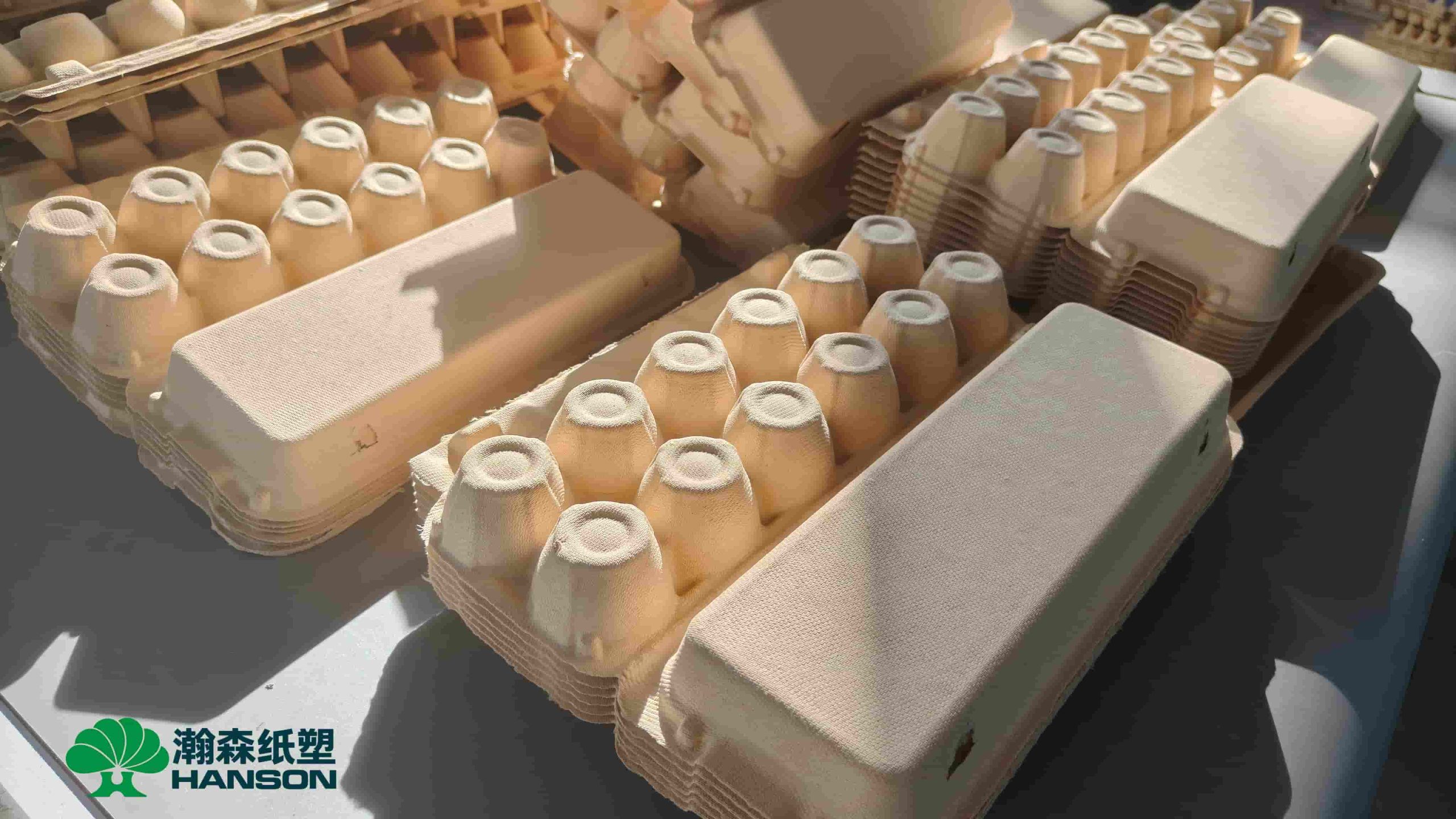
Scaling Up Tooling and Forming Efficiency
During the prototyping phase, a single-cavity or low-cavity mold is used to validate the structural design, material formulation, and forming feasibility. For commercial production, the forming equipment must be equipped with large-area, multi-cavity tooling to meet the target daily capacity.
However, simply increasing the number of cavities does not guarantee higher actual output. The configuration must balance product dimensions, part weight, vacuum dewatering efficiency, and machine load. If the dewatering efficiency during the forming stage is insufficient, the wet preform moisture content will remain too high. This transfers a massive thermal burden to the subsequent drying phase, slowing down the overall cycle time of the production line. Therefore, Hanson Pulp Molding calculates the optimal mold layout and forming parameters by working backward from the target daily output to ensure consistent forming efficiency.
Drying and Hot Pressing: The True Bottleneck of Dry Press Lines
The defining characteristic of dry press processes is that after the initial forming and vacuum dewatering, the wet products rely on an independent drying process to remove the bulk of the moisture, followed by optional hot pressing or shaping depending on the product requirements. In the semi-dry press process, partial moisture is removed before the product enters subsequent pressing and drying stages, balancing energy consumption, production capacity, and surface quality.
In a large-scale egg carton production line, the actual output is often determined by the throughput of the drying system rather than the speed of the forming machine alone. If a high-speed egg carton machine is paired with an inadequate drying tunnel, wet products will bottleneck on the conveyor. By removing more moisture through efficient mechanical or vacuum systems before thermal evaporation, manufacturers can significantly reduce the heating load, thereby optimizing the electrical energy consumption per ton of product.
Synchronizing Intelligent Pulping and Post-Processing Automation
High-volume egg carton production consumes vast amounts of raw materials. Even the most advanced forming equipment requires a stable pulp slurry to function properly. An intelligent pulping system manages consistency control, flow rates, and fiber blending. Fluctuations in pulp consistency directly cause variations in the weight and thickness of the egg cartons, compromising product strength and nesting during packaging.
Furthermore, post-processing automation is critical for controlling labor costs. Once the egg cartons are formed and dried, relying on manual labor for stacking, counting, and packaging breaks the continuous flow of automation and significantly increases the cost per unit. A well-planned dry press or semi-dry press line must integrate automatic stacking and unloading systems during the initial plant planning phase to achieve continuous commercial production.
Hanson Pulp Molding: Turnkey Solutions for Stable Commercial Production
For enterprises looking to enter the commercial production of egg cartons or protective packaging, purchasing a standalone forming machine rarely solves the interface issues between upstream pulping and downstream drying. As a specialist in turnkey pulp molding solutions, Hanson Pulp Molding provides more than just forming equipment.
Starting from the client’s final product requirements, Hanson Pulp Molding delivers complete production lines encompassing intelligent pulping systems, dry press or semi-dry press forming equipment, customized tooling, matched drying solutions, and post-processing automation. By synchronizing the production rhythm, process parameters, and inter-process logistics, Hanson Pulp Molding helps clients bridge the gap between theoretical capacity and stable commercial production.
FAQ
Why are egg cartons typically made using dry press or semi-dry press processes? Egg cartons prioritize protection, cushioning, and cost-effective high-volume production; ultra-smooth surface finishes are generally not the primary concern. Dry and semi-dry press processes utilize independent drying systems capable of processing large volumes of wet products efficiently, aligning perfectly with the commercial model for protective packaging.
Does increasing mold cavities automatically increase the daily production capacity? While more cavities can yield more pieces per cycle, the actual capacity is also influenced by the product weight, available vacuum pressure, dewatering efficiency, and the capacity of the drying system. If the drying line cannot keep up, the forming machine must slow down.
Why is the pulping system critical when buying an egg carton machine? If the pulping capacity does not match the forming equipment, the machines will experience downtime waiting for slurry. Additionally, stable pulp consistency is essential for maintaining uniform product weight and structural strength across hundreds of thousands of units daily.
Conclusion
Transitioning an egg carton project from prototype to mass production involves far more than comparing machine speeds and prices. The true drivers of a rapid return on investment and long-term profitability are the seamless integration of forming, tooling, dewatering, drying, and post-processing automation. Ensuring that all components of a dry press or semi-dry press production line are perfectly matched is the key to achieving high-efficiency, energy-optimized commercial production.
CTA
If you already have a product sample, 3D drawing, product dimensions or target daily capacity for your egg cartons, Hanson Pulp Molding can help evaluate the molding process, tooling design, and equipment configuration required for your project.
WhatsApp: +86 15920604830
Email: linchuangcheng@hspulpmolding.com