When molded fiber packaging needs enhanced water, oil, or gas barrier properties, lamination is often a highly effective post-processing solution. Whether you are producing premium food service disposables, medical packaging, or industrial protective packaging, selecting the right equipment is critical for ROI.
But how do you choose the right pulp molding laminating machine? Before comparing prices or general specifications, it is recommended to evaluate your production needs based on the following four practical questions.
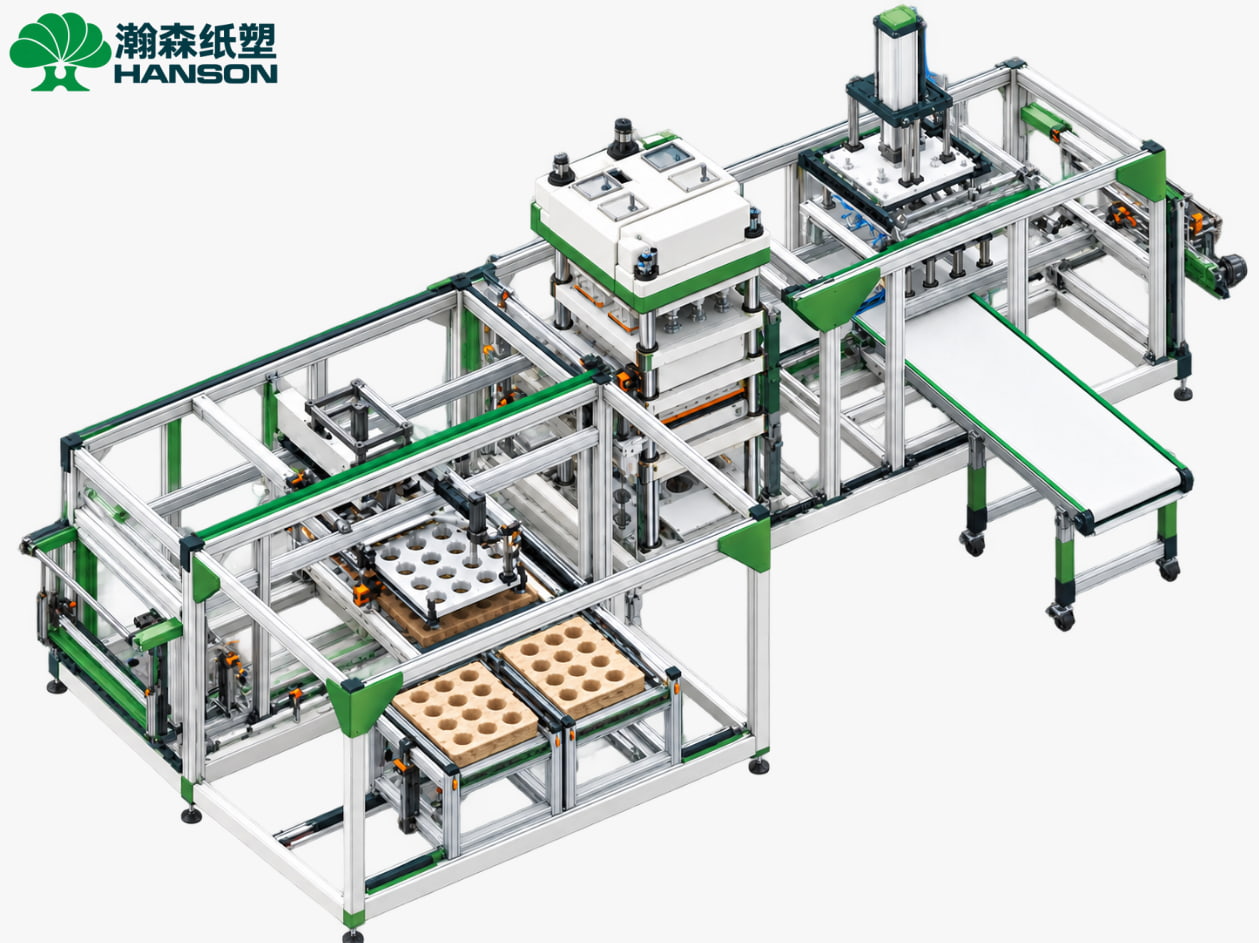
1. Does the Platen Size Match Your Product Dimensions? The first factor to check is the effective laminating area. For instance, the Hanson Pulp Molding automatic laminating line features a mold platen size of 1100 × 1100 mm. You need to calculate how many of your specific products can fit within this layout to determine per-cycle output. Additionally, verify the maximum product height. Equipment that accommodates a maximum product height of 80 mm can cover the vast majority of standard molded fiber bowls, trays, and lids on the market.
2. Is the Machine Compatible with Your Required Films? Market demands for film materials are diverse. Some projects require standard PE or PET, while eco-conscious brands may mandate PLA or PBAT. High-barrier applications might require EVOH or PP. The lamination equipment must provide precise temperature and pressure control to handle these variations. Machines utilizing electric heating combined with servo-driven lamination stations offer the stability and control precision necessary to adapt to different film properties smoothly.
3. How Does Cycle Time Translate to Actual Capacity? It is a common mistake to calculate daily capacity based solely on the machine’s mechanical speed. While a reliable pulp molding laminating machine may offer a lamination cycle of 15 seconds per mold, actual production capacity is strictly product-dependent. The real-world output depends on the product size, the number of cavities in the mold layout, and the specific film used. Always evaluate capacity based on your specific product layout rather than generic daily output claims.
4. Does the System Offer Integrated Automation? Manual transfer between lamination and trimming stations increases labor costs and potential product damage. Modern configurations prioritize automation. An efficient pulp molding lamination line integrates film unwinding, lamination, trimming, and product stacking into one continuous process.
Hanson Pulp Molding equipment utilizes a servo-driven trimming station with 80 tons of trimming force, ensuring clean cuts immediately after lamination. Furthermore, the hot press platen relies on a vertical up-and-down motion structure with a servo linkage mechanism. This design ensures uniform pressure distribution and helps maintain excellent platen parallelism, which is vital for consistent lamination quality.
Next Steps for Equipment Selection
Choosing the right pulp molding laminating machine requires aligning the machine’s capabilities with your exact product specifications.
If you are evaluating lamination for a molded pulp product, send Hanson Pulp Molding your product photos, dimensions, film requirements, and target performance. Our team can help evaluate the process and recommend a suitable equipment configuration based on your specific production conditions.