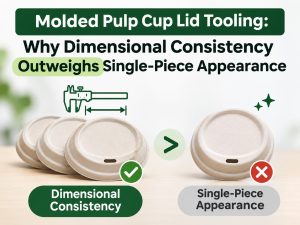
When pulp molded products emerge from the hot-pressing mold deformed or curved, the production line immediately suffers a significant yield drop. For tooling engineers and production supervisors, guessing the root cause leads to wasted cycle times. The most efficient troubleshooting path is to first inspect the physical tooling alignment—specifically the mold gap and total closing height—before making adjustments to moisture levels or temperature and pressure distribution.
Step 1: Inspecting the Mold Gap and Structural Alignment
More often than not, warping is a mechanical stress issue rather than a purely thermal one. Uneven mechanical pressure during the closing of the mold will inevitably cause the product to curve once the stress is released.
-
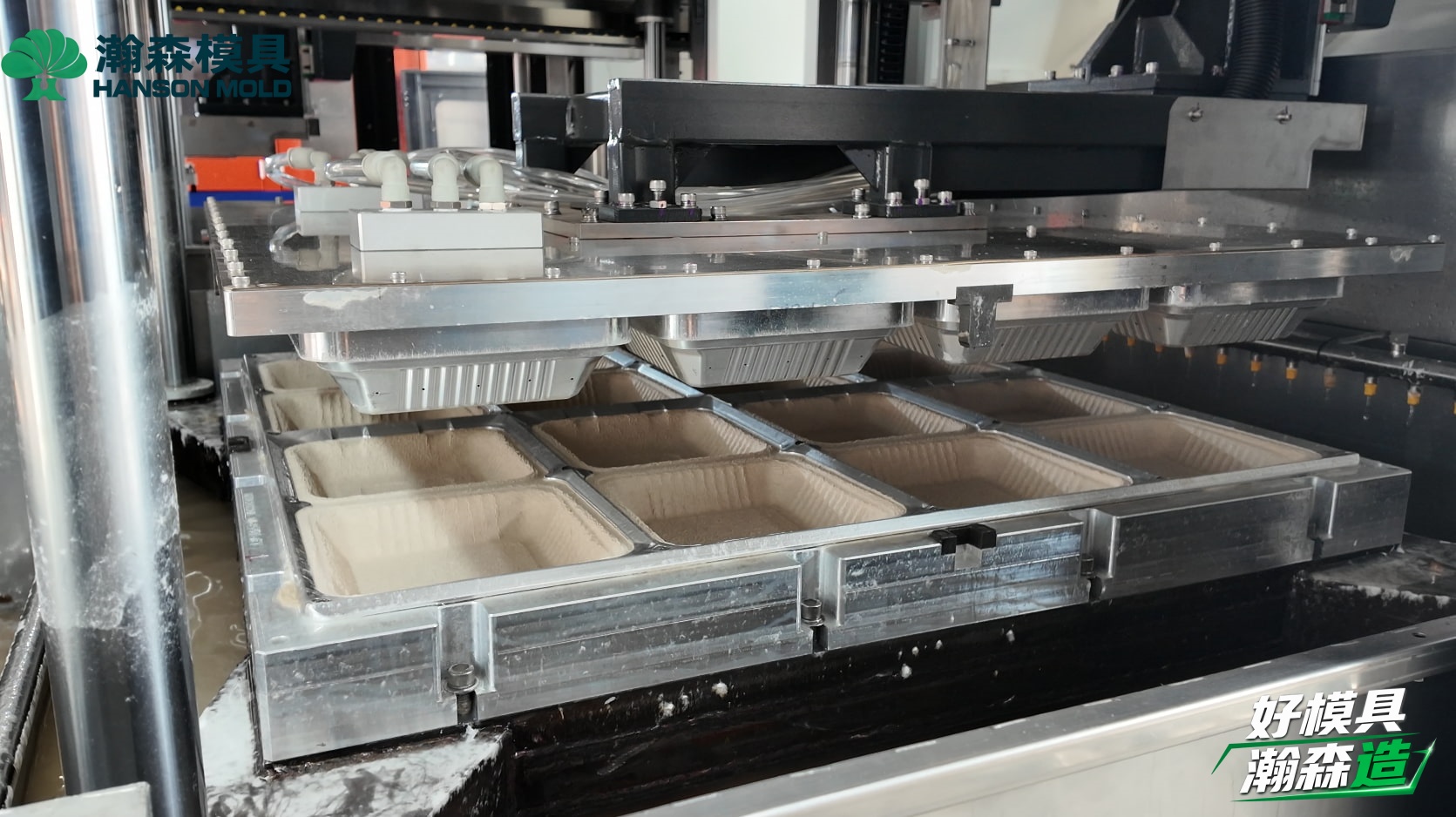
Mold Clearance (Mold Gap) Uniformity: Inspect the mold clearance across every cavity. If clamp screws are loose, the forming mold holder is shifted, or the upper and lower mold plates lack parallelism, the product will experience localized over-compression. This uneven squeezing generates internal stress, causing the product to warp after demoulding.
-
Closing Height and Adjustable Stroke: Verify that the machine’s adjustable stroke perfectly matches the tooling’s closing height. If the stroke is configured incorrectly, the hot press may mechanically bottom out before applying the correct set pressure to the product, resulting in inconsistent thickness and structural deformation.
-
Demoulding Property and Draft Angles: Inadequate draft angles or degraded mold surface finishes increase stripping resistance. Forcing the product out of the cavity creates pulling forces on the structural walls of the fiber packaging. Upon cooling, these stressed areas will curl.
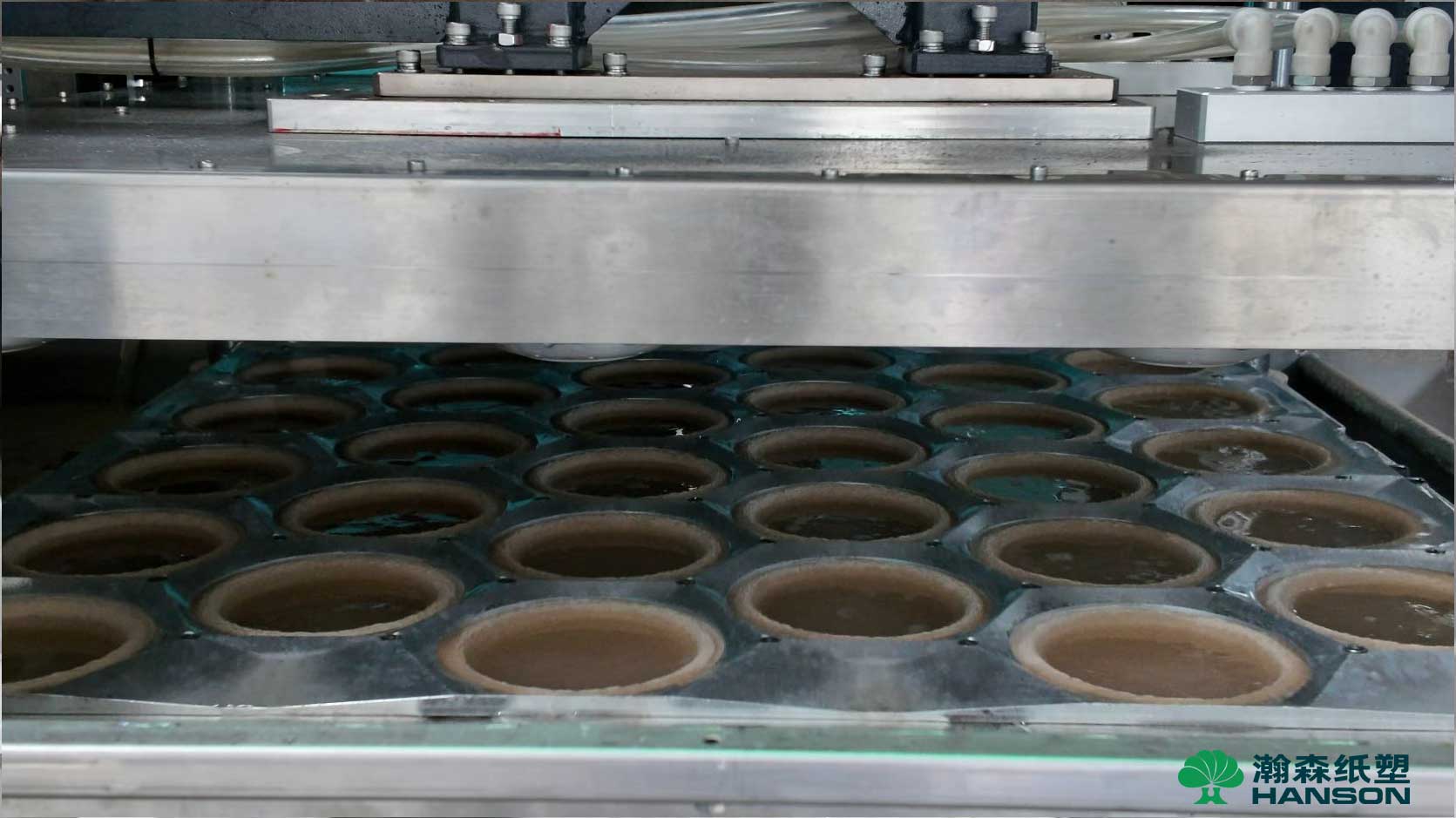
Step 2: Evaluating Thermodynamics: Moisture, Temperature, and Pressure
Once mechanical interference is ruled out, shift the diagnostic focus to thermodynamics and process control.
-
Wet Embryo Moisture Consistency: When wet products transfer from the suction mold, their moisture content must be uniform. If localized mesh blockages or uneven vacuum pressure cause moisture discrepancies, the evaporation rates during hot pressing will differ. Differential shrinkage directly translates to a deformed product.
-
Heat Distribution: Examine the temperature profile of the hot press heating plates. A significant temperature gradient across a single mold—such as cooler edges and a hotter center—prevents uniform stress release during the forming phase.
-
Cycle Time and Curing: Insufficient heating or holding time during the cycle leaves residual moisture locked inside the core of the pulp matrix. Once demoulded, the product will continue to dry in ambient conditions, leading to secondary warping.
Step 3: Post-Processing and Cooling Protocol
Freshly demoulded products retain residual heat and remain slightly plastic. Stacking them too densely or placing them on uneven surfaces immediately after stripping will cause gravity-induced deformation. Ensure adequate cooling buffer time and use flat staging fixtures to allow the products to stabilize.
Tooling Optimization and Support with Hanson Pulp Molding
Effective troubleshooting requires synergy between tooling design, machinery behavior, and pulp characteristics. With 500 pulp molding molds manufactured to date, Hanson Pulp Molding’s independent tooling division understands how precise mold engineering dictates real-world production stability.
Supported by 10 senior designers, we utilize high-speed CNC machining (up to 24000 RPM) and rigorous 3D scanning inspection at key manufacturing nodes—from stress release to fine finishing—ensuring flawless mold gap tolerances. Whether you are developing a new product or require optimization for existing molds on non-Hanson equipment, our experts provide comprehensive on-site support to eliminate warping and secure your mass production yield.
-
FAQ
-
Q: If the product is only warped on the edges, is the mold deformed? A: Not necessarily. Edge warping is frequently caused by localized low temperatures in the corresponding cavity or blocked exhaust vents preventing steam escape. Verify the edge temperature with a thermal gun and clear the vents. If the problem persists, use a feeler gauge to check the mold gap at the affected edges.
-
Q: Can increasing the hot pressing time permanently fix the warping? A: If the deformation is caused by residual internal moisture, slightly increasing the hot pressing cycle time can help. However, if the root cause is mechanical—such as a lack of mold plate parallelism or poor demoulding property—adjusting the time will not fix it. The tooling must be structurally recalibrated.
-
Q: Can your team help optimize old molds running on non-Hanson equipment? A: Yes. Our service framework includes “existing mold optimization -> mass production support.” Our on-site engineers will conduct a 3D scanning inspection to assess tooling wear, then evaluate your temperature, pressure, and pulp variables to provide a complete modification and machine-tuning solution.
-
-
Struggling with warped products or inconsistent yields? Contact Hanson Pulp Molding for expert tooling evaluation, existing mold diagnostics, and on-site mass production support. [+86 15920604830]