
When developing high-end pulp molded tableware, stable stacking is a non-negotiable requirement for efficient automated denesting, optimized packaging volume, and reduced transport costs. To prevent tableware from leaning or jamming when stacked, your molded pulp tooling must overcome three fundamental physical challenges: strict draft angle dimensional tolerances, absolute multi-cavity consistency, and the prevention of curling deformation during the hot-pressing stage. This requires a tooling supplier who understands both the machinery and high-precision machining.
1. Strict Dimensional Tolerance: The Physical Foundation for Jam-Free Stacking
Pulp molded tableware products feature thin-walled designs. When stacked, the draft angles of the side walls and the bottom radii of consecutive pieces must nest together perfectly without friction.
If the mold manufacturing lacks precision, microscopic deviations in the draft angle may not be visible on a single product. However, when 20 or more items are stacked, this tolerance accumulates, causing the stack to “grow” abnormally tall or the products to wedge tightly together. This not only risks bursting the packaging cartons but also causes automated dispensing machines at the end-user’s facility to fail.
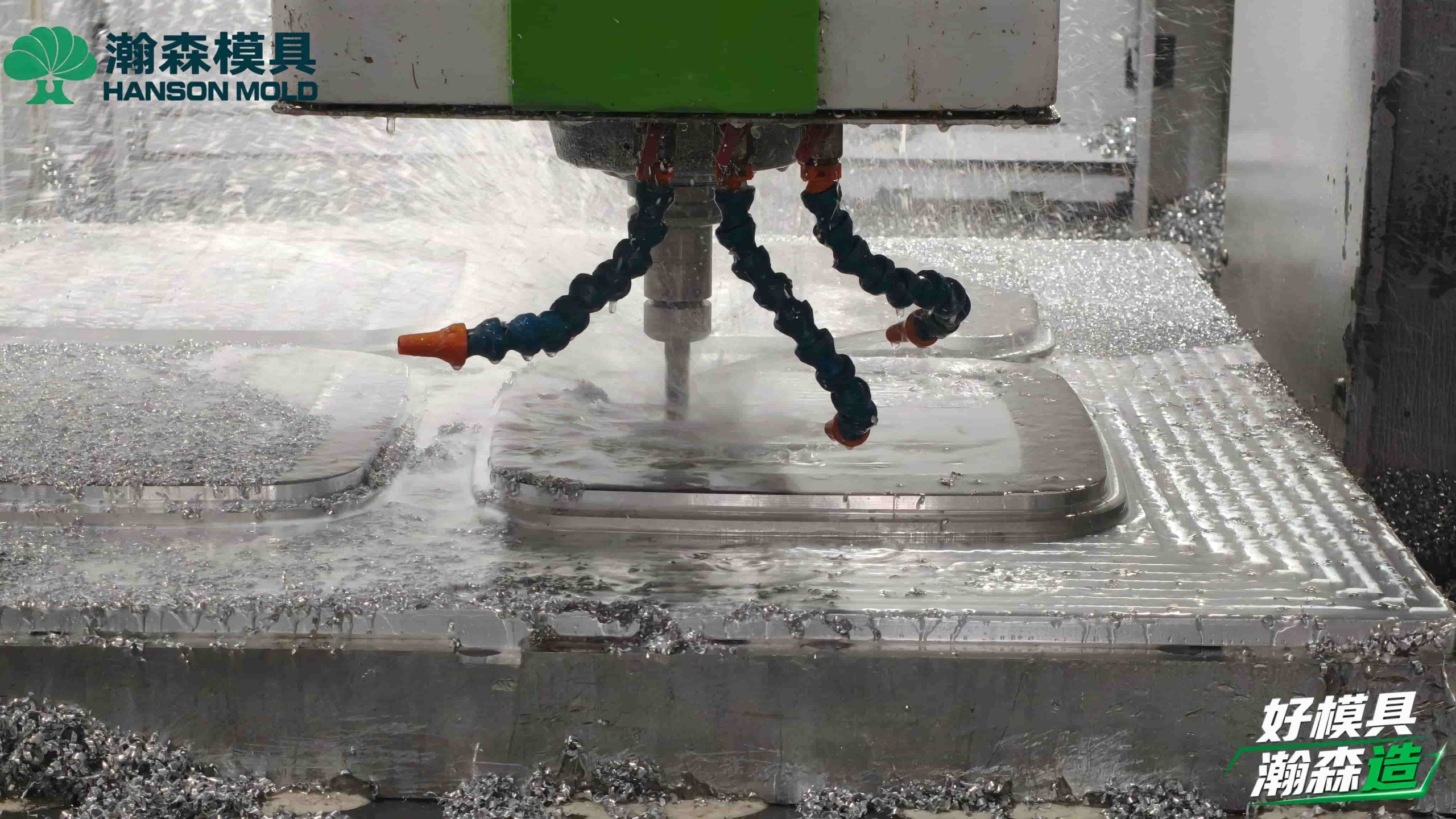
During the pulp molding product development phase, it is crucial to require your tooling supplier to utilize high-speed CNC machining equipment. For instance, Hanson Pulp Molding employs high-speed CNC machines reaching up to 24,000 RPM. This ensures that the curved surfaces in the finishing stage strictly match the tolerance requirements of the 3D design blueprints, laying the structural groundwork for smooth stacking.
2. Cavity Consistency: The Decisive Variable in Multi-Cavity Production
To meet mass production capacity, high-end tableware is typically produced using multi-cavity molds (e.g., 4-cavity or 8-cavity layouts). If there are minute discrepancies in the mesh frame dimensions, flow channel designs, or hot-pressing gaps between different cavities, the resulting products will exhibit varying shrinkage rates and weight deviations.
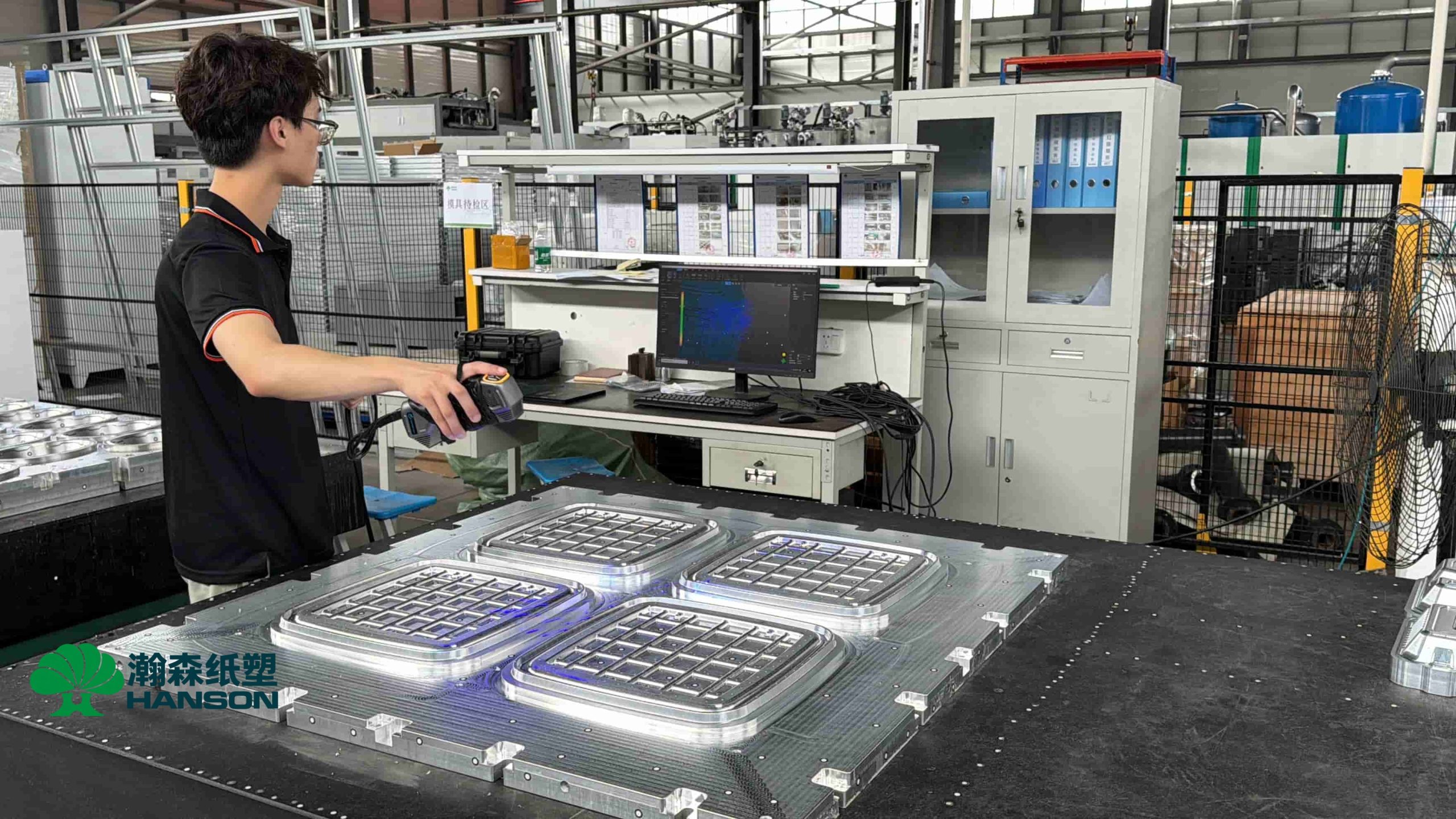
When products with different shrinkage rates are mixed during the automated stacking process, the uneven gaps will quickly cause the entire stack to lean drastically. High-quality mold manufacturing addresses this by introducing 3D scanning inspection after the finishing stage. This verifies that the actual dimensions of every cavity in both the forming and hot-pressing molds are identical to the original CAD files.
3. Overcoming Curling Deformation: Thermal Design in Hot-Pressing Tooling
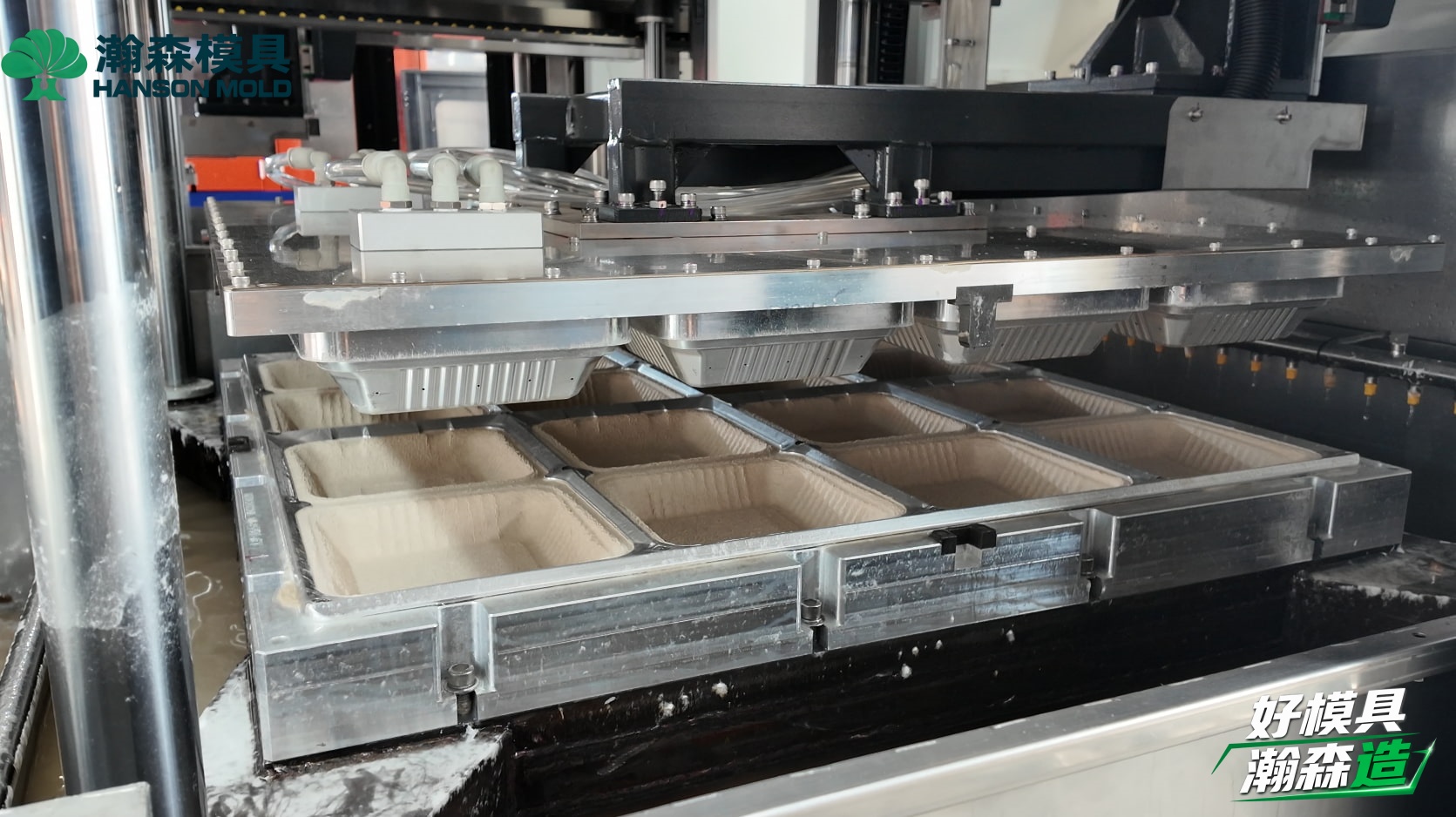
Pulp tableware utilizes a wet-press process, meaning high-temperature drying and shaping take place directly within the mold. Uneven heat distribution or unrelieved residual stress within the tooling are the primary culprits behind curling and wrinkling at the edges of the tableware.
Once the product edges warp, air gaps form during stacking, leading to an uneven distribution of weight. To prevent this, the mold design must feature a scientifically optimized layout for heating holes and vacuum channels to ensure uniform heat distribution. Furthermore, stress release treatments must be applied after rough machining. The clearance in the trimming mold must also be highly precise to avoid inaccurate trimming, which exacerbates physical interference during stacking.
With an independent tooling division and 500 pulp molding molds manufactured to date, Hanson Pulp Molding understands the complex thermodynamic interaction between pulp, machinery, and tooling. By providing comprehensive mold design and prototyping services, we effectively prevent deformation issues and ensure stable mass production for your new product lines.
4. Prototyping, Mold Testing, and the Stacking Inspection Checklist
Once the initial mold structure is designed and machined, actual verification through prototyping and mold testing is essential. Follow this priority checklist for pre-production inspection:
-
Testing Sample Size: Do not evaluate stacking based solely on the first piece. Continuously press and collect at least 50 to 100 products in a single run for actual stacking evaluation.
-
Simulated Denesting Test: Simulate automated material taking to observe if there is any noticeable resistance or friction when a product drops freely into the nested stack.
-
Load and Deformation Testing: Apply a standard weight to the top of a full stack (e.g., 50 pieces). After cooling, check if the product edges suffer irreversible deformation or stick together.
If minor deviations persist during the trial run, differentiate between pulp formulation issues, hot-pressing temperatures, and mechanical tooling errors. Do not blindly modify mold dimensions before identifying the root cause; always base modifications on actual on-site equipment debugging results.
-
FAQ
-
Q: The edges of our stacked pulp tableware are always uneven. Is this a mold design issue or a trimming problem? A: Both are possible. First, check the heating uniformity of the hot-pressing mold, as uneven shrinkage caused by thermal inconsistency is the main cause. If the product isn’t deformed but the edges have burrs or tilt, inspect the clearance of the upper and lower blades in the trimming mold to see if it is too wide.
-
Q: Why does a single product meet size tolerances, but a stack of 50 exceeds the height limit significantly? A: This is typically caused by excessive draft angle tolerance or poor transitional design between the bottom radius and the side wall. Even a 0.5-degree deviation in the draft angle creates cumulative errors (the “growing” phenomenon) across multiple layers. The mold’s finished surfaces need to be re-verified using 3D scanning.
-
Q: The new mold stacked perfectly during factory trials but jams during mass production at our facility. How do we troubleshoot this? A: You must evaluate actual on-site conditions. Confirm whether the vacuum pressure, hot-pressing temperature, and forming time match the trial conditions. Next, verify if the pulp type has changed. We recommend professional tooling engineers provide on-site support to isolate the variables.
-
-
If your high-end pulp molded tableware development is facing challenges with dimensional tolerances, leaning stacks, or curling deformation, contact Hanson Pulp Molding for a comprehensive tooling evaluation. Our senior design team provides targeted optimization for existing molds and reliable development plans for new projects. [+86 15920604830]