When setting up a molded fiber manufacturing plant, egg trays, egg cartons, and fruit trays represent one of the most consistent high-demand markets. These products typically utilize a dry press or semi-dry press molded fiber process, which prioritizes large-scale production, cost-effectiveness, and excellent protective properties.
Many investors face a common dilemma when evaluating egg tray equipment: Should they prioritize the fastest cycle time, the highest mold precision, or a fully automated setup? In reality, a successful egg tray project requires a strategic balance across all these factors to ensure long-term profitability.
Production Capacity: It’s More Than Just Machine Speed
For egg tray production, capacity is the foundation of profitability. It’s common to calculate theoretical daily output by multiplying the number of mold cavities by the machine’s forming speed. However, real-world capacity is determined by the entire production line’s synergy.
- The Drying Bottleneck: Egg trays are primarily manufactured using the dry press process, where the wet preforms are transferred into an independent drying tunnel to remove moisture. If the forming machine operates faster than the drying system can handle, wet products will pile up, and the entire line will be forced to slow down.
- The Semi-Dry Advantage: Hanson Pulp Molding sometimes employs a semi-dry press approach for specific projects, where a significant amount of moisture is removed before the final drying or hot pressing stage. This can help optimize energy consumption and improve overall drying efficiency.
- Pulp Preparation Matching: A high-capacity forming machine consumes a massive amount of pulp slurry per hour. If the pulping system is undersized, the forming equipment will experience frequent downtime waiting for raw materials.
Precision Requirements: What Quality Does an Egg Tray Need?
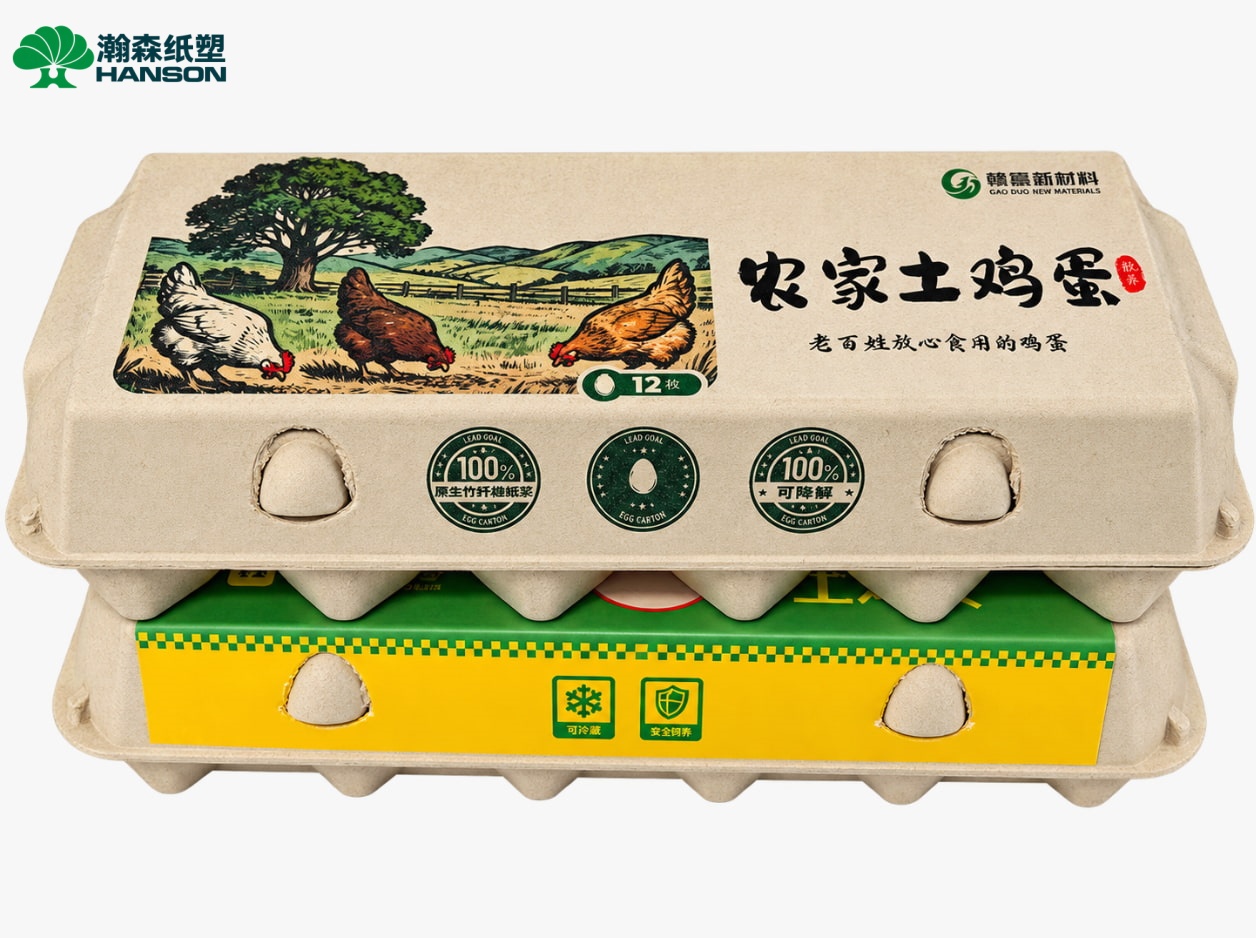
Unlike premium wet-press packaging used for consumer electronics, the primary function of an egg tray is protection, cushioning, and structural support. Therefore, the evaluation criteria for molds and equipment should be tailored accordingly:
- Structural Integrity Over Surface Smoothness: Traditional dry press products rely heavily on independent drying, which naturally leaves a more textured, fibrous surface. For egg trays, a highly polished finish is unnecessary. Instead, uniform wall thickness and strong rib designs are crucial for preventing egg breakage during transit.
- Stacking and De-nesting Precision: While extreme dimensional tolerance isn’t required, the mold design must ensure that the finished trays can stack tightly for shipping and separate smoothly when loaded into automatic egg-packing machines at the farm. This requires excellent mold draft angle design and consistent forming quality.
Automation Level: Aligning with Your Business Model
The automation level of egg tray equipment can range from semi-automatic lines with natural sun drying to fully automated systems featuring drying tunnels, automatic stacking, and packaging modules. The choice depends strictly on your project’s economics.
- Breaking the Post-Processing Bottleneck: For large-scale plants producing tens of thousands of trays daily, relying on manual labor for counting, stacking, and packaging becomes a severe bottleneck and increases the risk of human error.
- ROI and Labor Costs: The degree of automation should match the local labor costs and your investment budget. In regions with higher labor expenses, integrating automatic stacking and packaging into the egg tray production line is essential for maintaining a competitive cost per unit.
Hanson Pulp Molding’s Turnkey Solution for Egg Tray Plants
As a specialist in turnkey pulp molding projects, Hanson Pulp Molding understands that purchasing a single forming machine does not guarantee a successful factory. Success requires the seamless integration of pulping, forming, drying, and post-processing automation.
For clients investing in dry press and semi-dry press production lines, Hanson Pulp Molding provides comprehensive plant planning:
- Intelligent Pulping Systems: Designing robust pulping pipelines specifically for recycled paper, ensuring a stable slurry supply that matches the high-volume demands of egg tray forming.
- Synergy Between Mold and Process: Optimizing mold mesh and drainage structures to maximize water removal during the forming stage, thereby reducing the subsequent thermal drying load.
- End-to-End Automation: Configuring appropriately sized drying systems and integrating automatic stacking and packaging to ensure continuous, stable commercial production with minimal manual intervention.
FAQ
- Is it always better to have more cavities in the egg tray mold?Not necessarily. While more cavities can increase the output per cycle, it must be supported by the machine’s vacuum capacity, drainage efficiency, and structural load limits. An oversized mold on an inadequate machine will lead to poor forming quality and reduced equipment lifespan.
- Can the same equipment be used for both egg trays and premium electronics packaging?It is not recommended. Egg trays primarily use a dry press or semi-dry press route focused on high volume and buffering. In contrast, premium industrial packaging uses a wet press process requiring in-mold hot pressing for extreme precision and smooth surfaces. Different processes demand different equipment configurations.
- What is the total cost of setting up an automated egg tray plant?There is no fixed price for a complete plant. The total investment depends on your target daily production capacity, the required level of automation (e.g., whether you need an automated drying tunnel and stacking system), and the existing conditions of your facility. A detailed evaluation based on your specific goals is required for an accurate quotation.
Conclusion
When selecting egg tray equipment, look beyond the theoretical cycle time of the forming machine. Capacity must be supported by adequate drying and pulping systems; precision should focus on structural integrity and smooth de-nesting; and automation should be calculated based on long-term labor savings and line efficiency. By evaluating the entire production line as a cohesive system, you can build a highly profitable and resilient manufacturing operation.
CTA
If you are planning to set up a new molded fiber plant or expand your current egg tray production, Hanson Pulp Molding can evaluate the required capacity, tooling, process, and equipment configuration to provide a tailored turnkey solution.
WhatsApp: +86 15920604830
Email: linchuangcheng@hspulpmolding.com