When investing in a molded fiber packaging project, selecting the right equipment is one of the most critical decisions. For investors planning to produce egg cartons, a common dilemma arises during the equipment selection phase: Should the focus be entirely on machine speed, or is dimensional precision more critical? Should you invest in full automation, or keep capital expenditures low with semi-automatic options?
Unlike simple open egg trays, egg cartons feature clamshell structures, hinges, and locking clasps. They not only need to protect fragile contents but also require precise closure and stable stacking for retail display. Therefore, evaluating an egg carton machine goes far beyond merely looking at the theoretical cycle time.
As a turnkey specialist in pulp molding, Hanson Pulp Molding advises investors to approach equipment selection by analyzing the balance between capacity, precision, and automation based on the project’s real-world business model.
Capacity: Why the Drying System Matters More Than Cycle Time
Many buyers calculate their daily production capacity by simply taking the theoretical cycle time of the forming machine and multiplying it by the number of cavities in the mold. However, in actual mass production, the true bottleneck of a traditional dry-press pulp molding line is rarely the forming speed—it is the dewatering and drying efficiency.
In the dry-press process, the wet preform contains a significant amount of water immediately after forming. If these highly saturated wet products are sent directly into the drying tunnel, it demands massive thermal energy (natural gas or electricity) to evaporate the water. This prolonged drying requirement inevitably slows down the entire production line.
To resolve this bottleneck, Hanson Pulp Molding’s Automatic Dry-Press Pulp Molding Production Line incorporates a cold pressing (pre-dewatering) station. Before entering the oven, the wet preform undergoes a cold press with up to 120 tons of pressure, driven by servo systems. This crucial step removes excess moisture, substantially lowering the water content before drying. As a result, energy consumption drops, oven utilization improves, and the overall actual production capacity of the plant increases.
Precision: Hot Pressing is Essential for Hinges and Locks
While standard industrial protective packaging prioritizes cost and cushioning, egg cartons face an additional challenge: dimensional stability.
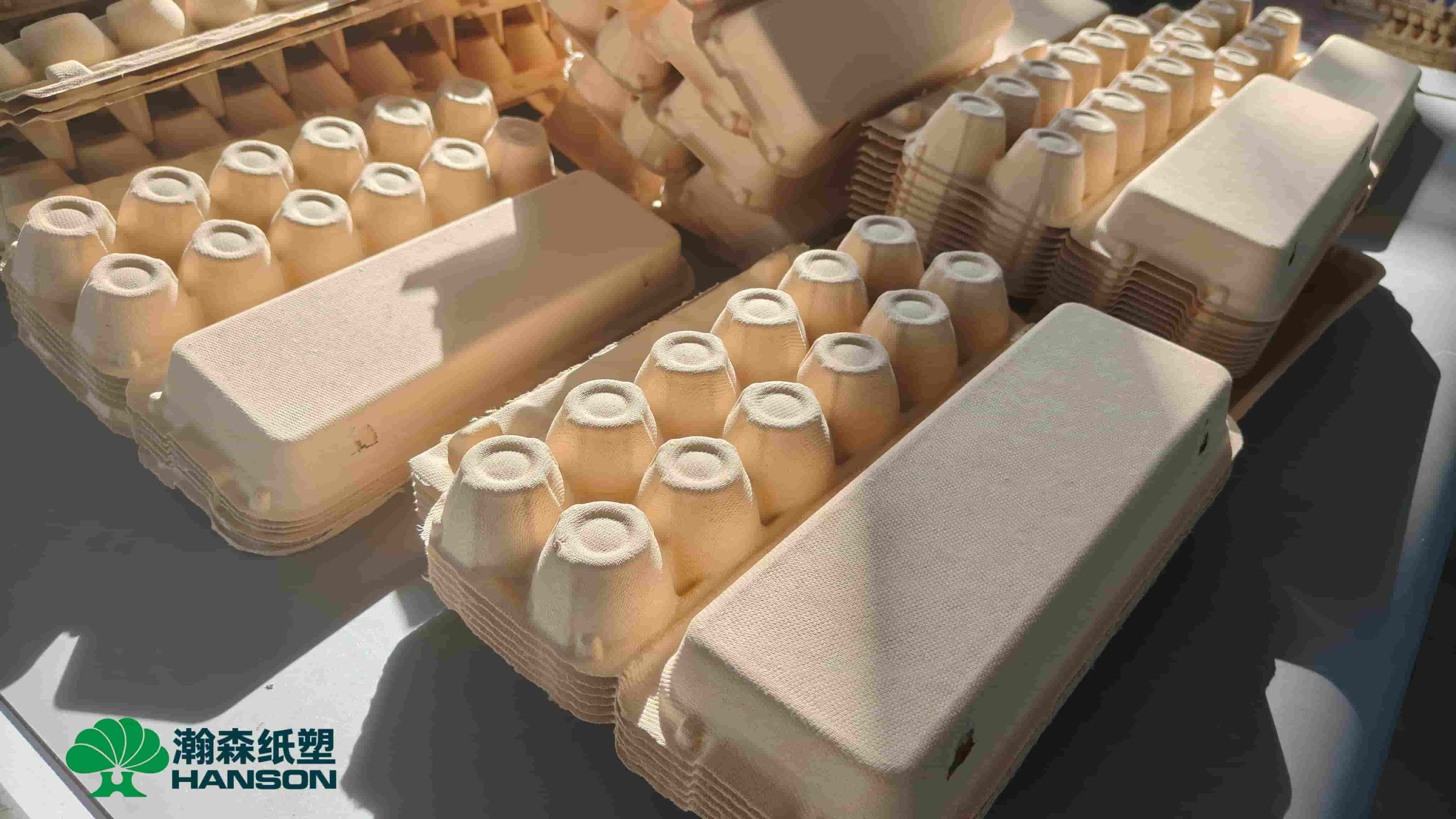
If a molded fiber egg carton undergoes excessive shrinkage or warping during the independent drying process, the hinge may not fold correctly, and the locking clasps will fail to align. This leads to a high defect rate and rejected shipments from retail clients.
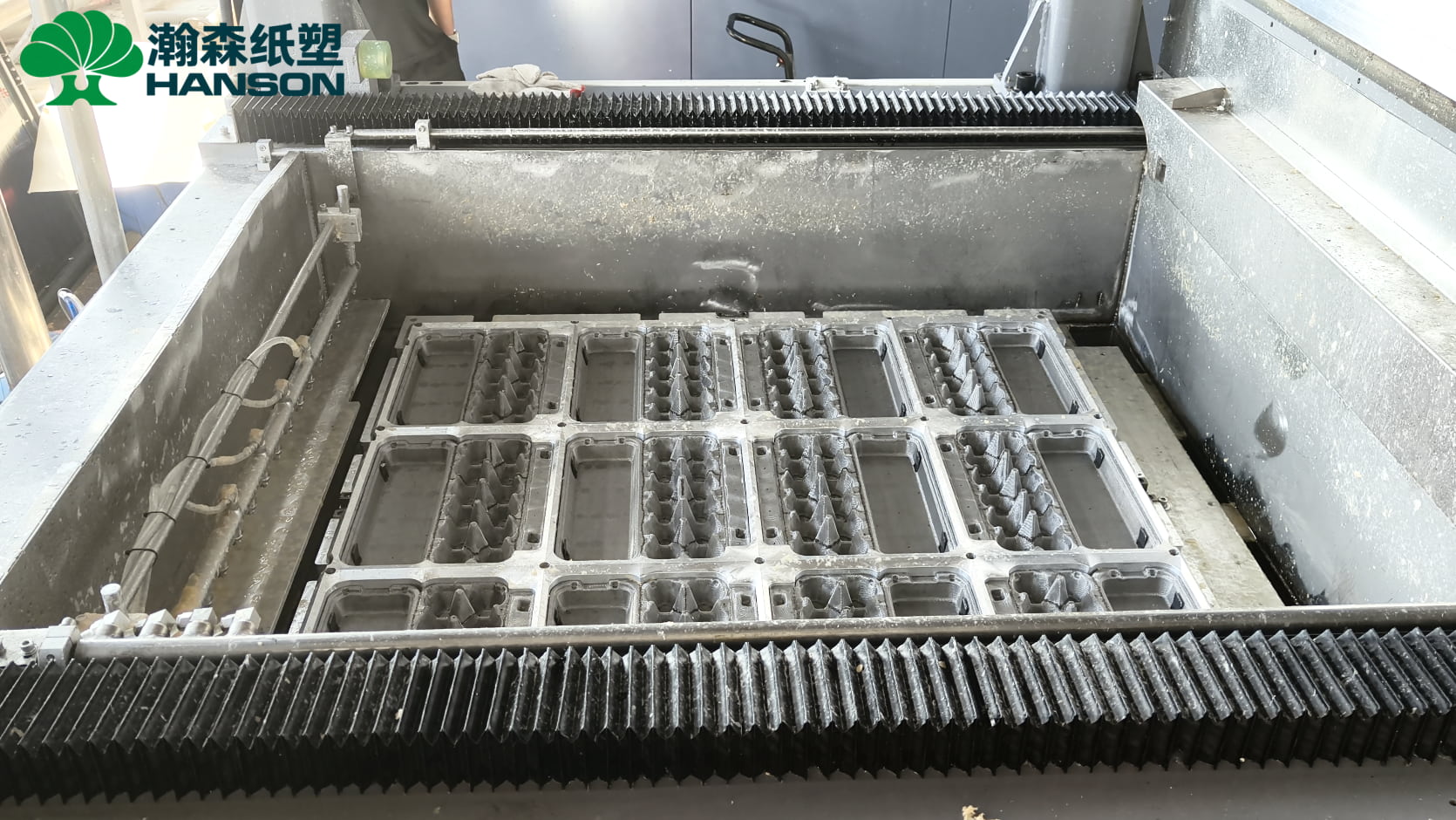
To ensure consistency, simply having high-quality forming molds is not enough. The production line must include a dedicated post-drying shaping process. Hanson Pulp Molding integrates high-pressure hot pressing stations directly into the automatic dry-press line. Once the egg cartons exit the drying tunnel, they are pressed in heated molds to correct any minor deformations, ensuring precise edges, reliable locking mechanisms, and excellent stacking stability.
Automation: Aligning with Your Commercial Goals
The choice between manual transfer and fully automatic production depends heavily on local labor costs, desired output consistency, and maintenance capabilities.
Traditional semi-automatic lines, where operators manually transfer wet preforms to drying racks, offer lower initial investment costs. However, manual handling of wet fiber can easily damage the product structure, leading to inconsistent product quality.
For large-scale, modern turnkey pulp molding plants, full automation is highly recommended. By utilizing robotic transfer systems and servo-driven positioning, the forming, cold pressing, drying, hot pressing, and stacking processes operate seamlessly. This not only significantly reduces the number of workers required but also ensures that complex products like deep-cavity egg cartons are transferred safely and consistently.
Hanson Pulp Molding’s Turnkey Solution
Setting up an egg carton factory is not about buying a standalone forming machine. The pulping system, forming equipment, tooling, and post-processing automation must be integrated into a unified technical logic.
As a turnkey specialist, Hanson Pulp Molding evaluates your project starting from the target product. By matching the right pulp preparation system, mold design, and the Automatic Dry-Press Pulp Molding Production Line, we help investors transition smoothly from initial plant planning to stable commercial production.
FAQ
Can a dry-press machine produce clamshell egg cartons? Yes. Egg cartons are typically produced using dry-press or semi-dry press processes. Because egg cartons require precise hinges and locking clasps, it is highly recommended to configure the production line with a hot pressing station after drying to correct any warping and ensure dimensional stability.
Why is pre-dewatering (cold pressing) important for an egg carton machine? Pre-dewatering reduces the moisture content of the wet preform before it enters the drying oven. This lowers the thermal energy required for evaporation, reduces product deformation, prevents mold scaling, and improves the overall uptime and efficiency of the production line.
How do I calculate the actual daily output of my egg carton line? Theoretical cycle times alone cannot determine daily capacity. Actual production capacity is influenced by the product weight, the number of mold cavities, drying efficiency, hot-press times, and equipment uptime. Capacity should be professionally calculated based on your specific product drawings and factory conditions.
Conclusion
When selecting an egg carton machine, the balance of capacity, precision, and automation is key to a profitable operation. Prioritizing pre-dewatering technologies and hot-press shaping ensures that your factory can produce high-quality, perfectly aligned egg cartons while maintaining high throughput and energy efficiency.
If you are planning to set up a new molded fiber factory or upgrade your existing dry-press line, Hanson Pulp Molding can evaluate the tooling, process, and equipment configuration based on your target product.
WhatsApp: +86 15920604830
Email: linchuangcheng@hspulpmolding.com