Many investors entering the molded fiber protective packaging sector encounter a common frustrating scenario: the product samples look flawless, but transitioning those samples to an egg tray machine for mass production results in low yields, severe product deformation, or excessive energy consumption.
The actual production capacity and quality of a pulp molding project are not determined by a single machine alone. They are influenced by the synergistic performance of pulping, forming, hot pressing, tooling, post-processing, and utilities. For products like egg trays, cup carriers, and industrial protective packaging that typically utilize the dry-press or semi-dry press process, evaluating a production line requires looking far beyond the theoretical cycle time.
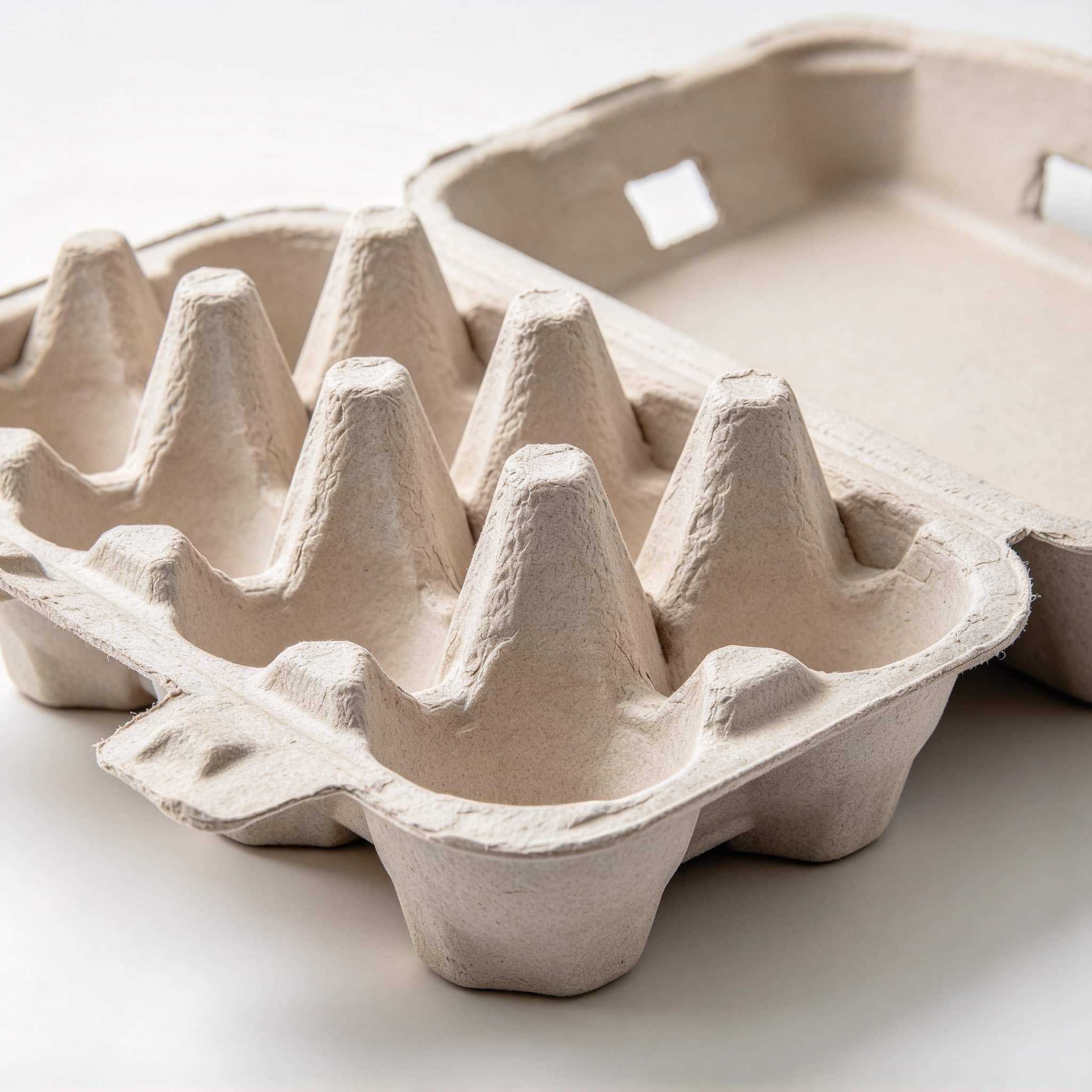
Why Do Egg Tray Samples Fail in Mass Production?
Prototyping and mass production operate under completely different environments. During the prototyping phase, engineers have the luxury of time to manually adjust the forming, dewatering, and drying parameters for a single batch. In a commercial setting, an egg tray machine must run continuously at high speeds.
If the tooling’s drainage design is inefficient, or if the drying tunnel cannot keep up with the forming station’s output, the actual uptime of the entire production line will plummet. Protective packaging requires bulk production efficiency and consistent structural strength. Therefore, the equipment configuration must be reverse-engineered from the specific commercial requirements of the final product.
The Role of Pre-Dewatering (Cold Pressing) in Egg Tray Machines
A common mistake during procurement is calculating daily capacity by simply multiplying the theoretical cycles per hour by the number of cavities. However, actual daily output is a complex result of product weight, cavity count, required drying time, uptime, and yield rate.
In a traditional dry-press process, wet preforms are transferred directly into a drying tunnel. If the moisture content is too high, it requires a massive amount of thermal energy to evaporate the water, which often causes the product to warp. To resolve this, the Hanson Pulp Molding Automatic Dry-Press Pulp Molding Production Line integrates dedicated cold pressing (pre-dewatering) stations immediately after suction forming.
The cold pressing stations utilize up to 120T of servo-driven pressure to significantly lower the moisture content before the wet preform enters the dryer. Engineering validation shows that coordinating cold extrusion with the drying process not only reduces product deformation but also minimizes mold scaling, thereby extending tooling maintenance cycles and increasing the overall uptime of the production line.
Drying and Hot Pressing: Balancing Quality and Energy Consumption
In the traditional molded fiber industry (often referred to as Type 1 or Type 2 processes depending on the wall thickness and transfer method), the drying phase is relatively independent of the forming phase. Because items like 4-cup carriers or heavy-duty egg cartons can have a single mold weight of up to 700g, precise thermal management is critical.
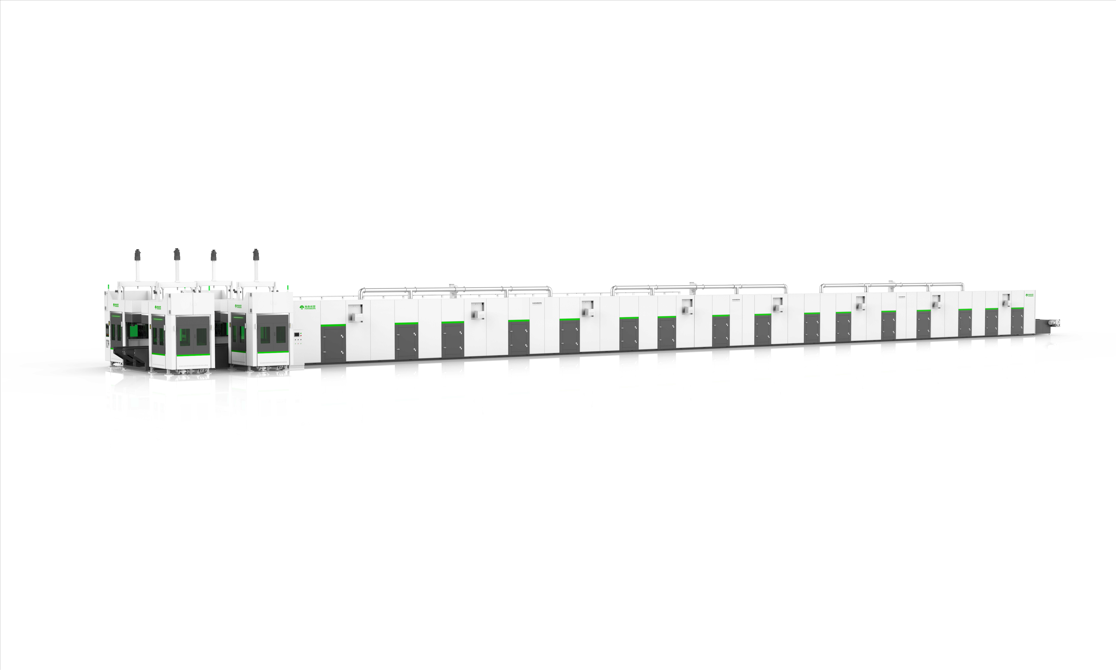
The Hanson Pulp Molding dry-press line features a double-layer, double-row drying system, followed by four servo-driven hot press stations. This configuration ensures that once the bulk of the moisture is removed in the oven, the hot press can accurately shape the surface and control dimensions, accommodating maximum product heights of up to 80 mm.
Post-Processing Automation: Truss Manipulators and Stacking
If the forming station produces wet preforms rapidly but the downstream stacking and transferring processes rely on manual labor, the bottleneck will simply shift to the end of the line.
To ensure stable mass production, the Hanson Pulp Molding automatic dry-press line utilizes truss manipulators to transfer products between all major stages: from forming to cold pressing, then to the dryer, hot press, and finally to the automatic stacking station. This eliminates manual handling, reduces damage, and enables continuous, highly automated operation.
Hanson Pulp Molding’s Automatic Dry-Press Solution
As a specialist in turnkey pulp molding solutions, Hanson Pulp Molding focuses on helping clients transition from product concepts to stable, commercial-scale manufacturing.
The Automatic Dry-Press Pulp Molding Production Line is designed specifically for high-volume buffering products. Its process flow is fully integrated: Suction Forming → Cold Pressing / Pre-Dewatering → Drying → Hot Pressing → Automatic Stacking. Equipped with a large 1300 × 1300 mm mold platen, the system provides flexibility for frequent mold changes and non-standard custom packaging.
Under appropriate production conditions, using a 40g 4-compartment cup carrier as an example, this production line can achieve an output of approximately 18 tons per 23 hours. On an integrated line basis, it consumes approximately 900 kWh of electricity and 280 m³ of natural gas per ton of product. (Note: Actual capacity and energy consumption depend heavily on product weight, geometry, tooling, and operational efficiency.)
FAQ
What is the actual daily capacity of an egg tray machine? There is no universal fixed number. Actual capacity depends on product weight, dimensions, mold cavities, drying efficiency, and effective running time. For instance, the Hanson Pulp Molding automatic dry-press line can produce approximately 18 tons per 23 hours when manufacturing 40g 4-cup carriers.
Why add a cold pressing (pre-dewatering) station to a dry-press line? Cold pressing lowers the moisture content of the wet preform before it enters the oven. This reduces product deformation during high-temperature drying, minimizes mold scaling, extends maintenance intervals, and improves overall line uptime.
Can I use the same machine for cup carriers and cup lids? No. Cup carriers (drink carriers) are cushioning products typically produced on a dry-press or semi-dry press line. Cup lids require extremely high precision, continuous edge trimming, and visual inspection, which are handled by dedicated automated systems like the ZAKS-9595.
Conclusion
Scaling up from a perfect egg tray or cup carrier sample to stable, profitable mass production requires a comprehensive approach. Investors must evaluate the equipment’s pre-dewatering capabilities, thermal efficiency, tooling design, and post-processing automation. A production line that coordinates servo-driven precision across forming, pressing, drying, and stacking is the most reliable foundation for commercial success.
If you already have a product sample, 3D drawing, product dimensions, or target daily capacity for your protective packaging project, these details can be used to evaluate the molding process, mold configuration, and equipment setup. Hanson Pulp Molding can guide your project from product validation through to turnkey plant planning and stable mass production.
WhatsApp: +86 15920604830
Email: linchuangcheng@hspulpmolding.com