
Evaluating Molded Pulp Tooling Precision: The Roles of CNC and 3D Scanning
In molded pulp manufacturing facilities, production managers often encounter frustrating issues when a new mold is installed: localized sticking, uneven wall thickness, or difficulty in demolding. Once variables like pulp slurry consistency and machine vacuum levels are ruled out, the root cause frequently points to the machining precision of the tooling itself.
Evaluating the precision of molded fiber tooling is not just about feeling the surface smoothness, nor should it be confused with production capacity. A reliable quality acceptance standard must be grounded in a rigorous inspection loop—from CNC machining control to final 3D scanning verification.
Tooling Precision vs. Production Capacity: What’s the Difference?
During project delivery and technical discussions, there is a common misconception that more cavities and shorter cycle times automatically equate to a “better” mold. In reality, production capacity is a combined result of mold layout, machine cycle parameters, and process conditions. Tooling precision, on the other hand, strictly concerns the geometric consistency of the product, the accuracy of draft angles, and the mating clearance between the forming and hot pressing molds.
If the mold’s machining precision is compromised, blindly pushing for higher capacity will only multiply the defect rate. For example, a minor deviation of just 0.5 degrees in the draft angle can cause severe edge tearing or mold sticking during high-speed operation. This leads to frequent machine stoppages for cleaning, ultimately destroying your actual output. Therefore, guaranteed precision is the prerequisite for stable mass production.
High-Speed CNC Machining: Securing the Dimensional Baseline
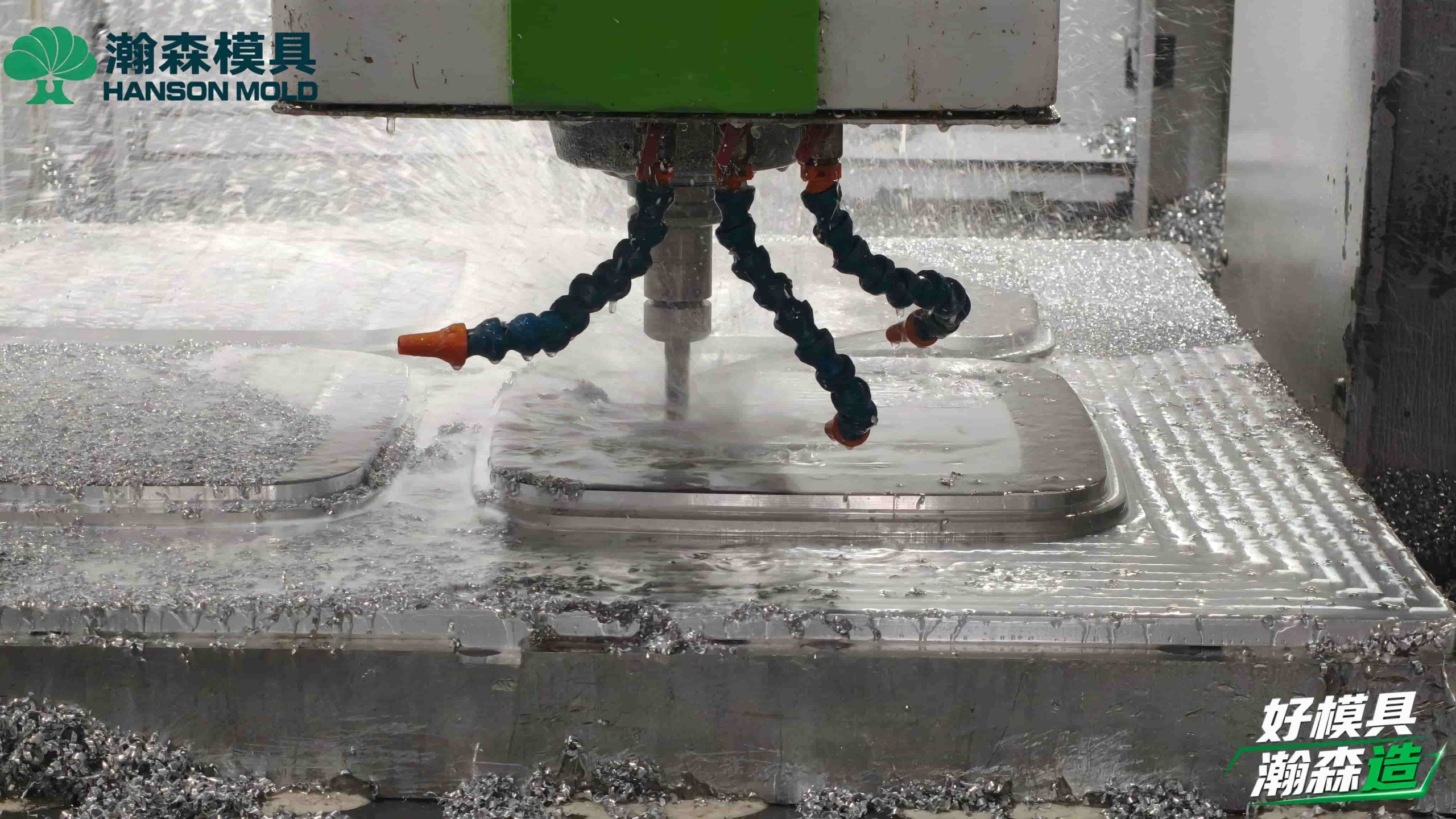
CNC machining plays a decisive role in establishing the contour baseline of molded pulp tooling. Traditional machining often leaves visible tool marks in curved transition areas. This is fatal for the subsequent mesh covering process, as an uneven substrate will cause the mesh wire to bulge, leaving undesirable marks or holes on the final packaging product.
To enforce strict in-process control, Hanson Pulp Molding utilizes high-speed CNC equipment (reaching up to 24,000 RPM) for aluminum tooling manufacturing. This high-speed cutting process not only achieves exceptional surface smoothness but also precisely controls complex geometries, draft angles, and drainage hole locations. CNC solves the “in-process manufacturing” challenge. It ensures that the theoretical 3D CAD model is flawlessly translated onto the raw aluminum block, providing a flawless physical baseline for subsequent drilling and mesh fitting stages.
3D Scanning Verification: The Final Defense Line
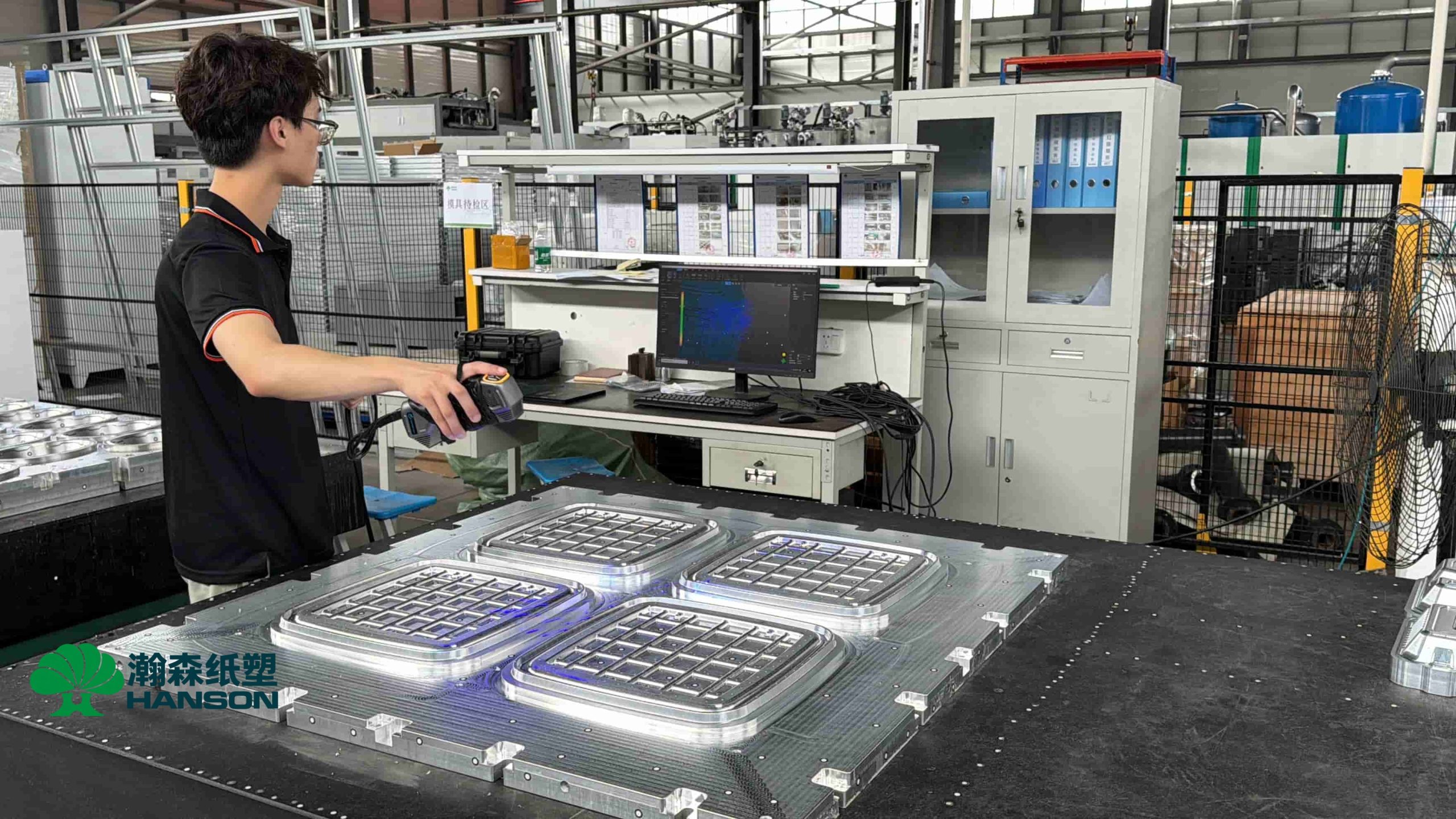
No matter how precise the initial machining is, minor deformations can still occur due to material stress relief, secondary setups, or polishing. Traditional calipers or coordinate measuring machines (CMM) struggle to efficiently and comprehensively map the errors on complex freeform surfaces. This is why 3D scanning technology has become indispensable in mold quality inspection.
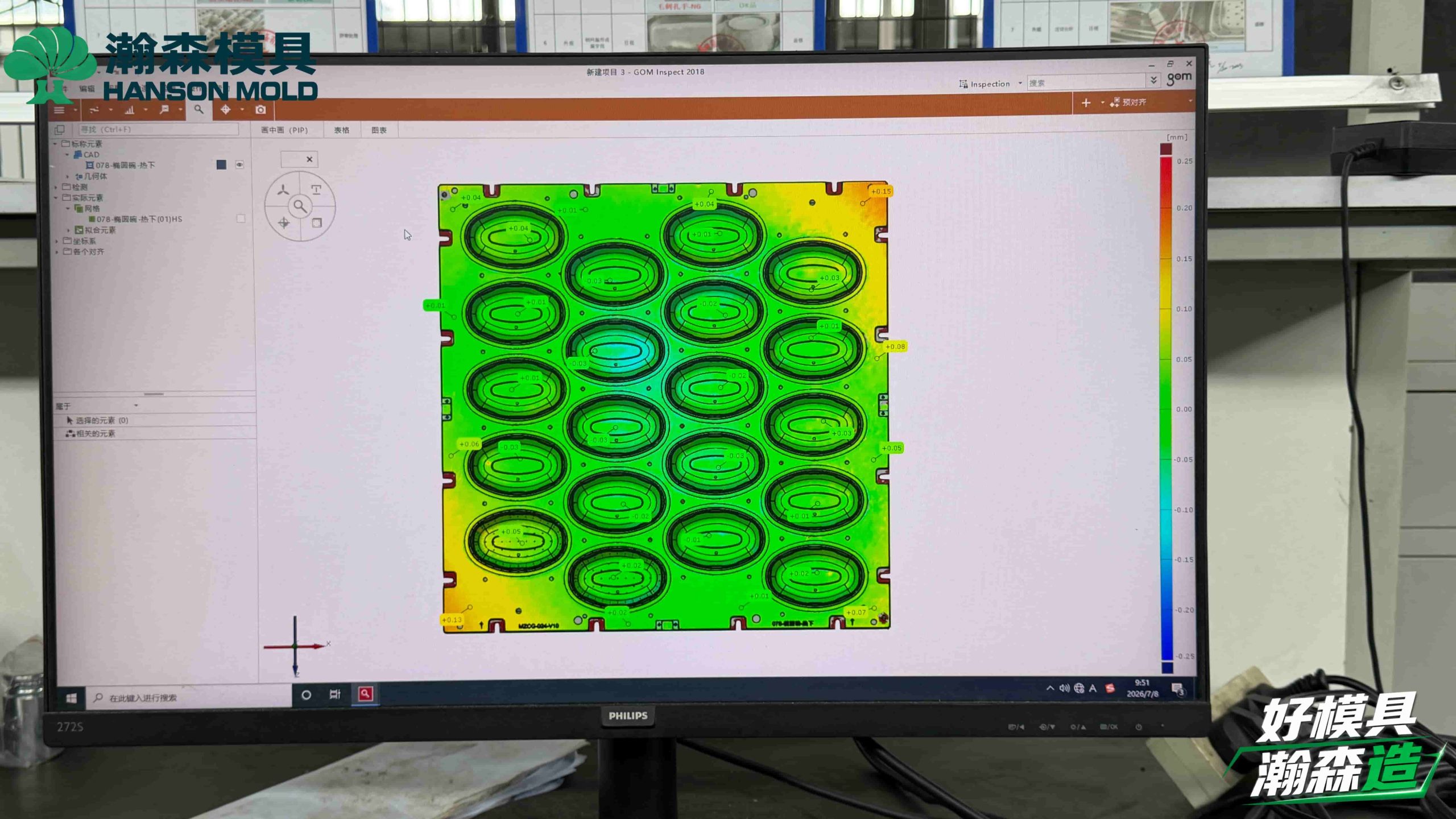
3D scanning handles the “final geometric verification.” By conducting a 360-degree non-contact scan of the bare mold, the system generates point cloud data and overlays it against the original CAD design. A color-coded map immediately highlights any tolerance deviations across every surface:
-
Draft Angle Verification: Identifies any microscopic undercuts or reduced draft angles that could hinder demolding.
-
Mating Surface Inspection: Checks the clearance uniformity between the upper and lower hot-pressing molds to prevent product crushing or weak pressing.
-
Hole Alignment Check: Ensures the relative positions of the vacuum holes and the forming profiles have not shifted.
A mold is only deemed ready for mass production and project delivery after it passes this rigorous 3D scanning assessment.
Mass Production Support and Project Delivery
Hardware handover is only the beginning of tooling delivery. A qualified molded pulp mold must demonstrate absolute stability under real-world operating conditions at the customer’s facility.
With 500 pulp molding molds manufactured to date and an expert team of 10 senior designers driving front-end development, Hanson Pulp Molding understands what it takes to succeed on the factory floor. Whether we are providing comprehensive tooling evaluation for new product development or optimizing existing molds for non-Hanson equipment, our data-driven precision standards ensure smooth transitions from initial sampling to full-scale mass production.
-
FAQ
-
Q: How does poor tooling precision specifically affect molded fiber products? A: Poor precision causes uneven mating clearances, resulting in inconsistent edge thickness or localized crushing. Inaccurate draft angles lead to severe sticking and tearing during demolding. Furthermore, an uneven surface prevents the mesh from fitting tightly, causing visible wire marks or holes on the finished product.
-
Q: If you use high-precision CNC machines, why is 3D scanning still necessary? A: CNC controls the machining process, but aluminum stress relief or ambient temperature shifts can cause microscopic deformations post-machining. 3D scanning provides a results-oriented, comprehensive inspection of complex curves, ensuring no tolerance stacking issues escape before delivery.
-
Q: Can you inspect and optimize old molds originally made for non-Hanson machines? A: Yes. For existing molds on non-Hanson equipment, we use 3D scanning to reverse-engineer and capture the current physical data. By comparing this with original designs, we pinpoint worn or deformed areas and execute targeted tooling optimization to restore or improve mass production yields.
-
-
Experiencing high defect rates or demolding issues in your molded fiber production? Contact the engineering team at Hanson Pulp Molding for expert tooling evaluation, sample review, and on-site support. [International contact to be confirmed].