
Molded Pulp Tooling Price Differences: Breaking Down Design, Machining, and Support Services
When a molded fiber packaging plant initiates new product development or needs replacement molds, procurement managers often receive tooling quotes that vary by 30% to 50% from different suppliers. This extreme price gap in molded pulp tooling is not merely a reflection of profit margins; it represents tangible differences in design philosophy, the completeness of machining nodes, material quality, and on-site mass production support.
Opting for the cheapest molded pulp tooling often means compromising on crucial steps like stress release, high-speed CNC precision, or on-site debugging. These shortcuts inevitably lead to hidden costs on the production floor, manifesting as uneven dewatering, product warping, or persistent sticking issues. In this article, we break down the core components of a molded pulp tooling quote to help you assess the true value of your tooling supplier.
Variable 1: Product Design and Engineering Capabilities
The structural foundation of any pulp molding mold directly dictates the cycle time and production yield. This is where high-end tooling manufacturers separate themselves from low-cost providers.
Venting and Dewatering Hole Layout The pulp molding process requires the rapid extraction of massive amounts of water and steam. Professional tooling engineers meticulously map out the hole distribution on both the suction mold and the hot-pressing mold, taking into account draft angles and fluid dynamics. Low-cost tooling quotes often rely on automated, cookie-cutter drilling patterns that ignore the unique geometry of deep cavities or complex chamfers. Inadequate venting results in poor local suction, uneven product thickness, and blistering or delamination during the hot-pressing stage.
Draft Angles and Structural Integrity Experienced designers utilize advanced 3D modeling to optimize draft angles, ensuring the transferring mold can smoothly grip and release the wet pulp blank. Hanson Pulp Molding operates an independent tooling division staffed by 10 senior designers. During the early product development phase, our engineers focus not just on aesthetics, but on the precise demolding path to eliminate risks of tearing and mold sticking. This rigorous upfront engineering is a major value-add built into a premium tooling quote.
Variable 2: CNC Machining Precision and the 12 Manufacturing Nodes
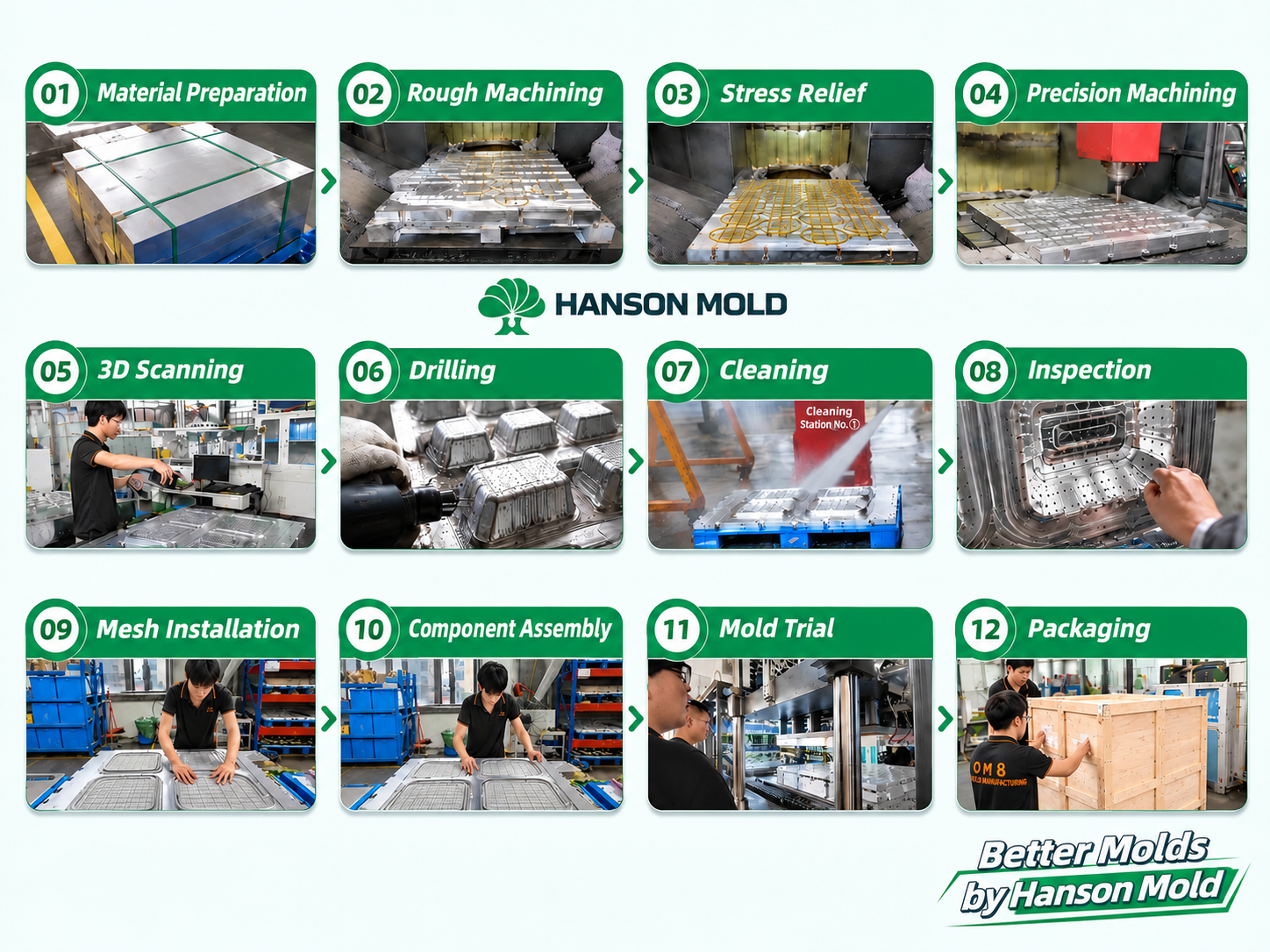
Skipping essential machining steps is the most common way budget suppliers drive down their prices. A fully compliant molded pulp mold must undergo a rigorous 12-step process, including rough machining, stress release, fine machining, 3D scanning, drilling, washing, re-inspection, mesh covering, assembly, and tryout.
The Cost of Skipping “Stress Release” Cheap molds are often moved directly from rough milling to fine machining. While this reduces lead time and tooling costs, the internal mechanical stress remaining in the aluminum blocks will eventually release during the extreme temperature fluctuations of the hot-pressing process. This leads to mold warpage, misalignment, and an uncontrolled hot-pressing gap. A standard, comprehensive tooling quote accounts for the necessary heat treatment required for stress release, ensuring dimensional stability over millions of cycles.
CNC Speed and Precision The surface finish of the forming mold holder and mold cores heavily impacts the cosmetic quality of the final packaging. Low-end workshops use standard, low-speed CNC machines that leave visible tool marks. In contrast, Hanson Pulp Molding utilizes high-speed CNC equipment capable of reaching 24,000 RPM. This high-velocity fine machining guarantees a flawless smooth side and tightly controlled clearance tolerances between the upper and lower molds, preventing product crushing and severe burr formation.
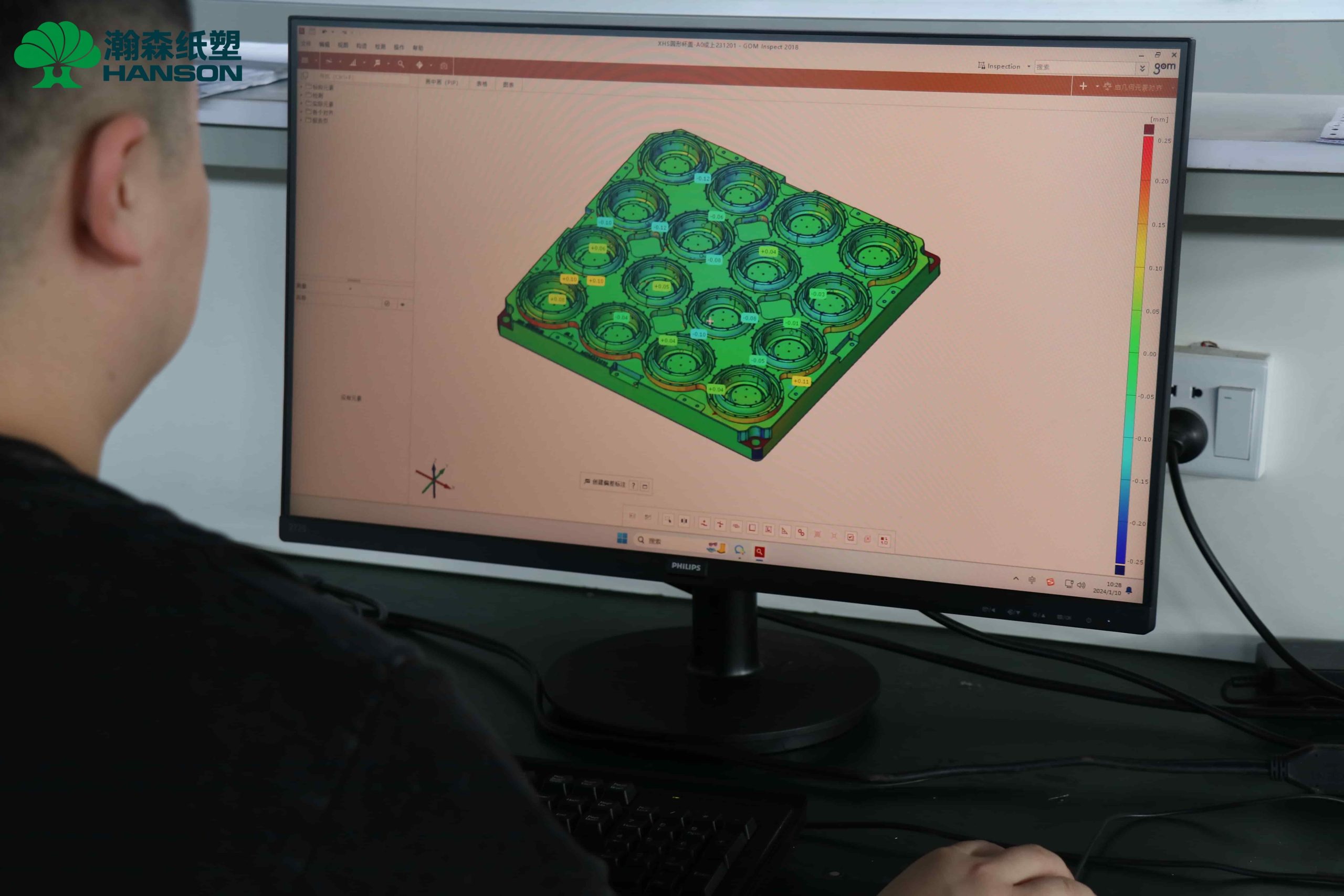
3D Scanning and Inspection Top-tier quotes include the cost of rigorous quality assurance. After fine machining, molds undergo 3D scanning to compare the physical product against the theoretical CAD model. This guarantees absolute precision before the molds ever reach your production line.
Variable 3: Assembly Standards and Mesh Covering
For wet-press molded fiber processes, mesh covering is a highly specialized manual craft that dictates the lifespan of the mesh side.
In budget tooling assembly rooms, operators often attach the stainless steel wire mesh focusing only on basic flatness, skipping the vital pre-stretching and precise contouring steps. During high-pressure dewatering, these poorly fitted mesh layers quickly loosen, wrinkle, or tear, leading to catastrophic machine downtime. A high-quality tooling quote factors in the cost of premium, high-tensile stainless steel mesh and the extensive labor hours of master fitters. Every deep corner and complex curve is meticulously covered and inspected to ensure the mesh perfectly adheres to the suction mold base. This not only extends maintenance cycles but also guarantees a consistent texture on the final pulp product.
Variable 4: On-Site Tooling Tryouts and Mass Production Support
Many factory owners evaluate a molded pulp tooling quote purely on hardware delivery, completely ignoring the cost of post-sales service.
Defining Troubleshooting Responsibilities When a newly installed cheap mold produces defective parts (e.g., product sticking, inconsistent weight, or flashing), budget mold makers often blame the pulp slurry formulation (such as incorrect AKD sizing ratios) or uneven machine pressure, refusing to provide on-site help. In reality, diagnosing pulp molding defects requires a holistic evaluation of the molds, the slurry, the machinery, and the process variables.
Full-Cycle Mass Production Support Hanson Pulp Molding’s capabilities extend far beyond design and basic assembly. We offer comprehensive on-site debugging and mass production support. Whether you are using Hanson equipment (complete tooling service to tryout validation) or non-Hanson equipment, our technical team works on the factory floor to eliminate variables. With 500 pulp molding molds manufactured to date, our rich field experience ensures that if a problem arises—whether it’s adjusting the suction time or fine-tuning the mold polish—we are there to solve it. This level of production security is something a low-cost, “one-off” transaction simply cannot offer.
How to Evaluate a Molded Pulp Tooling Quote (Checklist)
When communicating with tooling manufacturers and comparing prices, procurement managers should verify the following:
-
Request the Machining Checklist: Ensure the quote explicitly includes critical steps like “stress release treatment” and “3D scanning inspection.”
-
Verify Equipment Capability: Ask for the exact specifications of their CNC machines (e.g., max RPM) to gauge the expected surface finish.
-
Define the Scope of Service: Clearly outline in the contract whether the quote includes initial sample tryouts, on-site debugging, and clear responsibilities for production troubleshooting.
The price of molded pulp tooling is not just about raw aluminum and machine hours; it is an investment in design intelligence, machining precision, and long-term production stability.
B3 English Additional Information
1. English FAQsQ1: Why are some pulp molding tooling quotes 30% cheaper than the market average? A: The price gap usually comes from skipped critical processes and missing services. Low-cost quotes often omit the stress release treatment after rough machining, utilize low-speed CNC machines, skip 3D scanning, and offer zero on-site debugging support. These omissions drastically increase the risk of mold warpage and extended machine downtime during production.
Q2: Does the tooling price include on-site machine tuning and defect troubleshooting? A: Service scopes vary heavily between manufacturers. Budget quotes generally cover only the physical delivery of the mold. If sticking or warpage occurs, the buyer must troubleshoot the slurry or equipment independently. Hanson Pulp Molding, however, provides full-cycle support, from product development and complete tooling service to mass production validation.
Q3: The edges of our molded products keep getting crushed with our old molds. Is it because the mold was too cheap? A: Crushed edges can be caused by low machining precision in the molds, but they can also result from poor platen parallelism on the molding machine or incorrect pressing pressure. We recommend checking the hot-pressing gap uniformity first. Hanson Pulp Molding can also provide technical diagnostics and tooling optimization for non-Hanson equipment old molds.
2. CTA (Call to Action) Struggling to identify the hidden differences in tooling quotes? The Hanson Pulp Molding team is here to provide comprehensive tooling evaluations and on-site support. Contact our senior engineers for an overseas inquiry or tooling evaluation today, and secure a high-efficiency mold solution built for stable mass production. [+86 159 2060 4830].