
Holding a perfectly shaped, highly functional molded fiber cup carrier prototype is an exciting milestone. However, it is only the first step in a pulp molding project. Many investors find that when they transition from prototyping to mass production, they encounter unexpected bottlenecks. High moisture content leading to warped products, frequent machine downtime due to mold scaling, and actual daily output falling far short of theoretical capacity are common issues.
Scaling a molded fiber cup carrier from a prototype to millions of units requires more than just a fast forming machine. It requires a systematic approach that aligns pulp preparation, forming, dewatering, drying, and post-processing automation.
Why Dry Press is the Standard for Cup Carriers
The manufacturing process must align with the product’s end-use scenario. Cup carriers—whether 2-cup or 4-cup designs—serve primarily to hold, stabilize, and cushion beverages during transport. They require deep cavities and significant structural strength, but they do not require the extremely smooth, premium surface finishes seen in consumer electronics packaging.
For these reasons, the dry press (or semi-dry press) pulp molding process is typically the most economical and efficient choice for drink carrier machines. This process focuses on efficient forming and independent continuous drying, balancing the need for structural integrity with high-volume, cost-effective manufacturing.
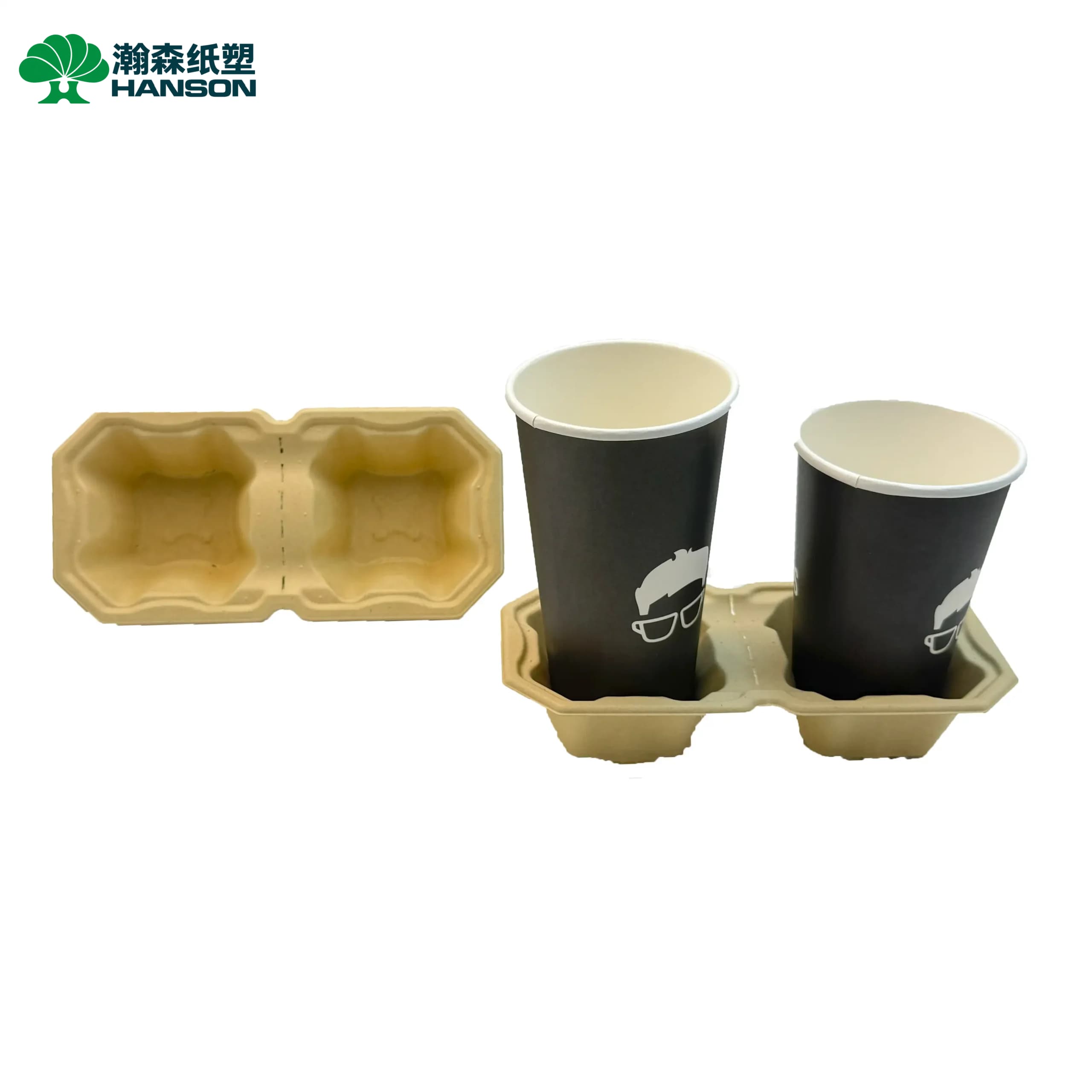
The Gap Between Prototyping and Mass Production
During the prototyping phase, engineers can manually adjust the drying time and handle wet preforms with care. In a continuous production line, however, minor process deviations compound rapidly:
-
Moisture Content Fluctuation: If wet preforms enter the dryer with excessive moisture, it significantly increases the energy required for evaporation. Worse, uneven drying can cause the cup carriers to warp and lose their dimensional stability.
-
Mold Scaling: Inadequate dewatering can leave residue on the forming tools and transfer meshes. Over time, this scaling forces the factory to halt production frequently for mold cleaning, severely reducing the actual production capacity.
Critical Configurations for a Cup Carrier Production Line
To achieve stable commercial production, a modern pulp cup tray machine line must be engineered as a cohesive system rather than a series of isolated machines. Taking the automatic dry-press pulp molding line by Hanson Pulp Molding as an example, a robust production setup involves several critical stages:
1. Cold Pressing and Pre-Dewatering
Relying solely on vacuum dewatering during forming is often insufficient for thick-wall products like cup carriers. Advanced production lines incorporate a servo-driven cold pressing (pre-dewatering) station immediately after forming. By mechanically pressing the wet preform before it enters the drying tunnel, the moisture content is significantly reduced. This step not only minimizes warping and shrinkage during drying but also reduces mold scaling, extending the maintenance cycle and improving the overall uptime of the line.
2. Continuous Drying and Hot Pressing
Given their bulk, cup carriers require thorough drying, typically utilizing a multi-layer tunnel dryer. Because molded fiber naturally shrinks as water evaporates, the line should include a hot pressing station after drying. This final pressing corrects any dimensional tolerances, ensuring that the finished cup carriers nest perfectly for transport and firmly grip the cups when in use.
3. Automated Stacking and Transfer
Cup carriers are bulky, and relying on manual labor for stacking and sorting can quickly create a production bottleneck. Incorporating automatic transfer mechanisms and stacking systems ensures a seamless flow from the dryer to the packaging area, maintaining a continuous production rhythm.
How to Evaluate Actual Production Capacity
When evaluating a molded fiber cup carrier machine, avoid relying on simple calculations based on theoretical cycle times. True capacity depends on the product weight, mold cavities, and the overall efficiency of the drying and post-processing stages.
For example, using a 40g 4-cup carrier as the standard, an automatic dry-press pulp molding production line from Hanson Pulp Molding (configured with 4 forming stations and 4 cold pressing stations) can achieve an output of approximately 18 tons per 23 hours under appropriate production conditions. If the product weight or structural complexity changes, both the tonnage and piece count will adjust accordingly.
Conclusion
Transitioning a molded fiber cup carrier from a successful prototype to stable mass production is a rigorous engineering challenge. It requires careful alignment of the forming process, cold pressing, continuous drying, and hot pressing. By focusing on a complete turnkey plant perspective rather than isolated equipment specifications, manufacturers can ensure consistent product quality and reliable daily output.
FAQ
What type of machine is used for molded fiber cup carriers? Cup carriers belong to the protective packaging category, and they are typically produced using dry press or semi-dry press pulp molding lines. It is important to note that a cup carrier is completely different from a cup lid; therefore, they require entirely different equipment configurations, complete with forming, cold pressing, and independent drying systems.
Why is cold pressing (pre-dewatering) necessary in a dry press line? Cold pressing squeezes out excess water from the wet preform before it enters the dryer. This reduces the energy required for drying, minimizes the risk of product warping, reduces mold scaling, and ultimately increases the uptime of the production line.
What is the daily production capacity of a cup carrier machine? Capacity is entirely dependent on the specific product. For instance, using a 40g 4-cup carrier, the automatic dry press line from Hanson Pulp Molding can produce approximately 18 tons per 23-hour shift. Actual output will vary based on product weight, mold design, and plant management.
If you already have a product sample, 3D drawing, or a target daily capacity for your drink carriers, Hanson Pulp Molding can evaluate the tooling, process, and equipment configuration to help you build a stable production line.
WhatsApp: +86 15920604830Email: linchuangcheng@hspulpmolding.com