As the global molded fiber packaging industry enters a mature market phase, the key drivers behind equipment purchasing are undergoing a significant shift. Global B2B buyers are placing increasingly stringent requirements on barrier performance for premium foodservice packaging, medical products, and high-end consumer electronics inserts.
For manufacturers, this means that simply investing in new forming machines to expand production capacity is no longer the only strategy for winning new business. Instead, upgrading existing product performance through post-processing equipment has become increasingly important for securing new orders and maintaining competitiveness.
Trend 1: From Basic Forming to Functional Upgrades
When conventional molded pulp products require enhanced water resistance, oil resistance, oxygen barrier properties, or specific surface effects, the front-end forming process alone may not be sufficient to meet end-use requirements.
Lamination has become an effective process for addressing these challenges. By combining polymer films with molded fiber substrates, manufacturers can significantly expand the range of applications for their products. The market now requires not only traditional PE or PET films, but also pulp molding laminating machines compatible with a wider range of film materials, including PLA, PBAT, EVOH, and PP, to meet different regulatory and functional requirements across regions.
Trend 2: Automated Integration of Post-Processing
In a highly competitive market, reducing labor costs and shortening production turnaround time are critical. Separating lamination, forming, die cutting, and stacking into independent processes that rely on manual handling can significantly slow down the overall production cycle.
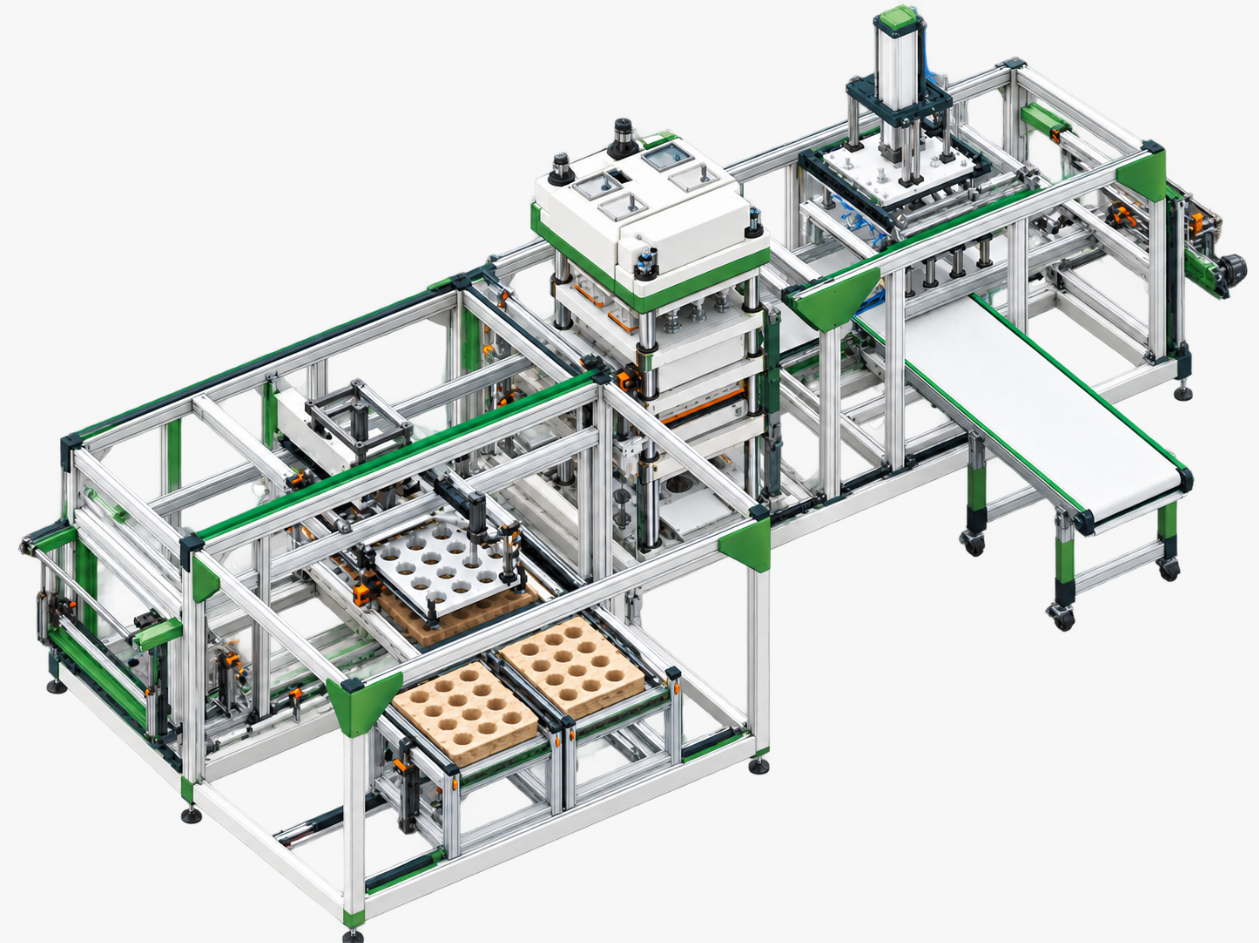
Modern equipment is increasingly moving toward automated integration. An automatic pulp molding laminating line seamlessly connects film unwinding, lamination, die cutting, and finished-product stacking. This coordinated operation eliminates intermediate waiting time and helps maximize the efficiency of the entire production line.
Trend 3: Greater Focus on Control Precision and Stability
High-quality lamination requires precise control of temperature and pressure during the thermal pressing process. Modern molded fiber laminating equipment is increasingly adopting fully servo-controlled motion.
The combination of servo-driven motion control and linkage mechanisms helps ensure more uniform pressure distribution, supporting the flatness and parallelism of the thermal pressing platens. This vertical up-and-down motion structure not only reduces mechanical complexity but also helps maintain long-term operating stability and product yield.
Upgrade Your Existing Production Line
When evaluating the addition of a lamination process, manufacturers need to assess whether the equipment specifications are compatible with their existing molds and product dimensions.
Hanson Pulp Molding’s automatic laminating line is designed to meet these evolving industry requirements.The equipment features a mold platen size of 1100 × 1100 mm, a lamination cycle time of 15 seconds per mold, and an 80-ton die-cutting force, supporting products with a maximum height of 80 mm. Please note that actual production capacity varies depending on specific product dimensions and mold layout.
If you are evaluating lamination for a molded pulp product, send Hanson Pulp Molding your product photos, dimensions, film requirements, and target performance. Our team can help evaluate the process and recommend a suitable equipment configuration.