
When molded fiber packaging requires enhanced waterproof, oil-proof, or barrier properties, lamination is one of the most effective post-press solutions to evaluate. As manufacturers begin sourcing a pulp molding laminating machine, the most frequent question is regarding production capacity.
Often, equipment specifications will highlight a lamination cycle time, such as “15 seconds/mold.” It is tempting to simply divide the working hours by 15 seconds and multiply by the number of cavities to calculate fixed daily production. However, in real-world manufacturing, evaluating capacity based solely on cycle time is an incomplete approach. Actual output is heavily product-dependent and relies on several critical equipment configurations.
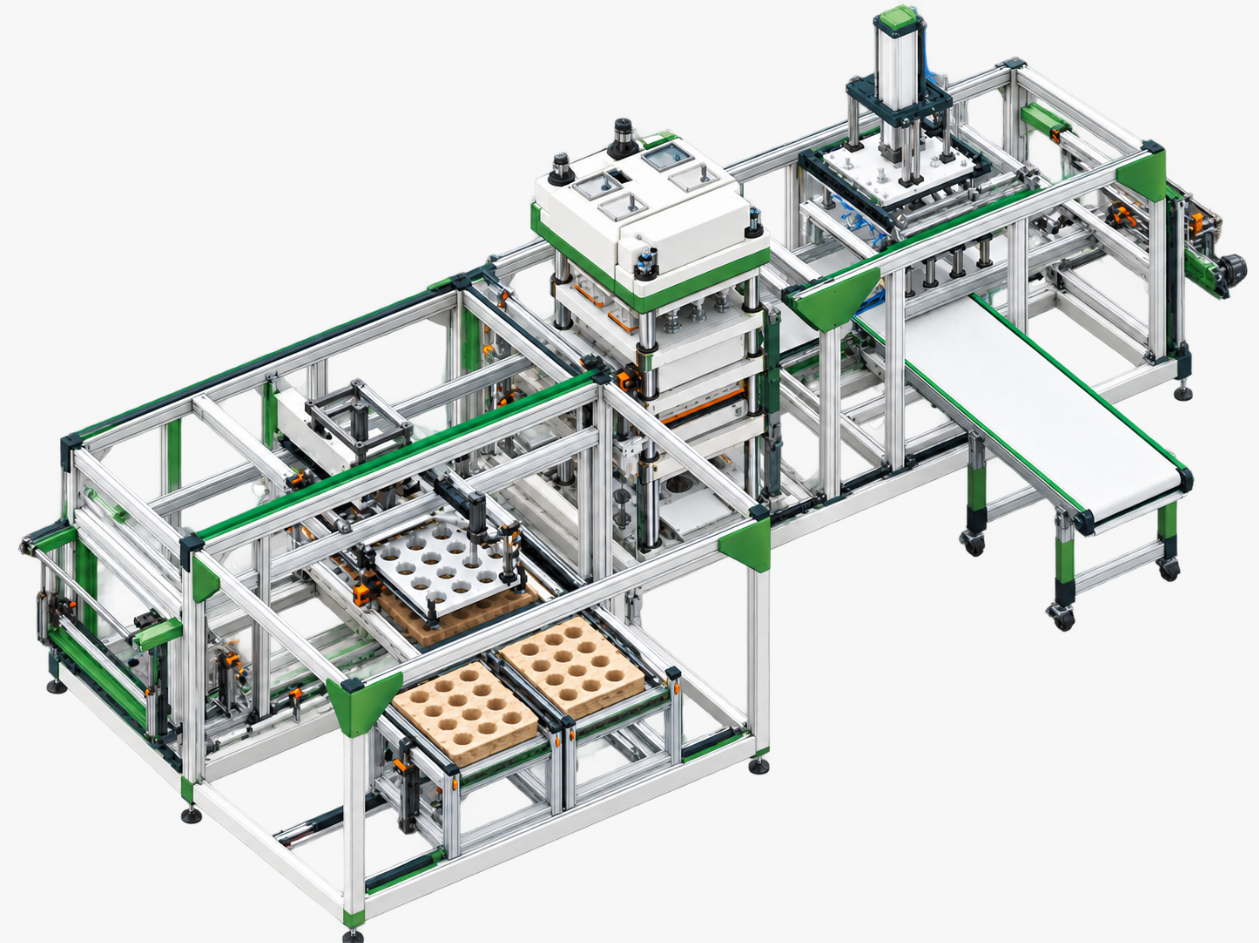
1. Mold Platen Size Determines Output Per Cycle
A 15-second cycle time only measures speed, not volume. The actual production volume per cycle is dictated by the mold platen size. A compact platen will restrict the number of products that can be processed simultaneously. In contrast, equipment like the Hanson Pulp Molding automatic laminating line utilizes a generous 1100 × 1100 mm mold platen. This larger working area allows for the layout of more tableware or industrial packaging units within that same 15-second window. Therefore, the first step in determining true capacity is matching your product dimensions against the platen size to calculate the cavity count.
2. In-Line Trimming Eliminates Bottlenecks
Lamination is only one step in the process; once the film is applied, the excess material around the product edges must be trimmed. If a standalone laminating machine is used, the products must be manually transferred to a separate trimming press. This manual handling creates a bottleneck that completely negates a fast lamination cycle. To maintain continuous production, a complete pulp molding lamination line should integrate trimming directly. By coordinating film unwinding, lamination, 80-ton servo-driven trimming, and automatic product stacking, the line eliminates intermediate handling and ensures all stations operate at a matched, efficient pace.
3. Structural Stability and Servo Control
Theoretical cycle times only translate into real production if the equipment runs stably without frequent downtime. Lamination requires precise heat and pressure. The structural design—such as servo-driven linkage mechanisms that ensure uniform pressure distribution and precise mold parallelism—is vital. Furthermore, relying on vertical mold motion rather than complex horizontal movements reduces mechanical complexity and potential failure points. Stable, servo-controlled operation minimizes waste and maximizes effective running time.
4. Product Compatibility and Film Requirements
Ultimately, capacity is product-dependent. The depth of the product (accommodating maximum product heights up to 80 mm) and the specific film material being used (such as PE, PET, PLA, PBAT, PP, or EVOH) will influence the optimal processing parameters.
Summary While a 15-second lamination cycle is a strong baseline indicator of machine performance, it should not be the sole metric for calculating daily output. True manufacturing efficiency comes from maximizing layout on a large platen and ensuring seamless automated transitions between lamination, trimming, and stacking.
If you are evaluating lamination for a molded pulp product, send Hanson Pulp Molding your product photos, dimensions, film requirements, and target performance. Our team can help evaluate the true production capacity and the most suitable equipment configuration for your specific process.