When molded fiber packaging needs to meet demanding oil resistance, water resistance, or special barrier requirements, lamination is an important post-processing solution worth evaluating. However, when overseas customers purchase a pulp molding laminating machine, the primary technical decision is whether to choose a standalone machine or an integrated fully automatic laminating production line.
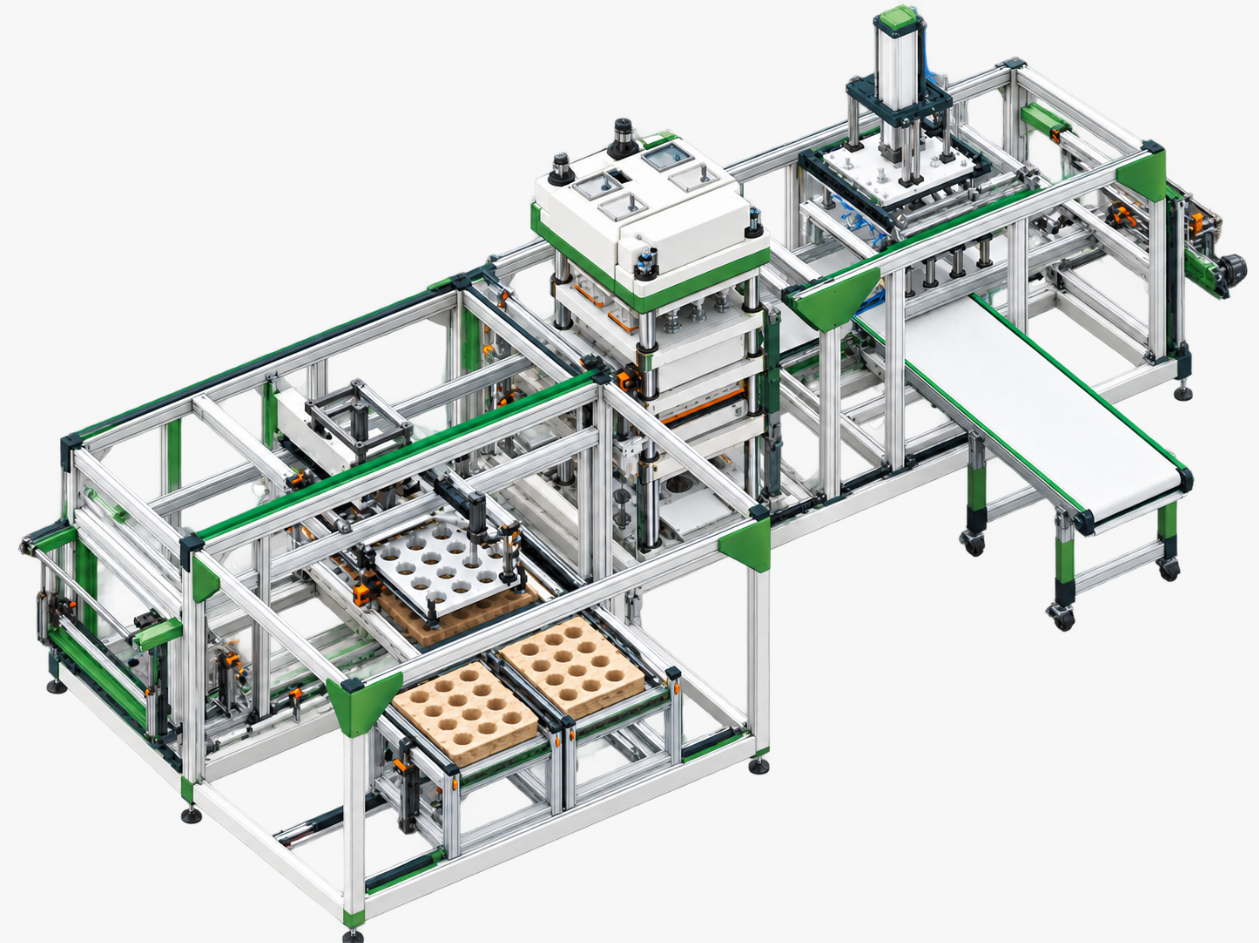
Process Gaps with Standalone Lamination Machines
Traditional standalone machines typically rely on operators to manually transfer products between different workstations. After lamination, workers must move the semi-finished products to a separate trimming machine for edge trimming. This operating model not only significantly increases labor costs, but the time differences and positioning deviations caused by manual handling can also easily affect trimming accuracy and the consistency of the finished products.
Efficient Integration of a Fully Automatic Laminating Production Line
To reduce reliance on labor and improve product consistency, a fully automatic production line provides a more integrated industrial configuration. Hanson Pulp Molding provides a highly integrated automatic production line covering the complete continuous process from film unwinding and lamination to trimming and product stacking (Film unwinding → Lamination → Trimming → Product stacking).
The production line uses a fully servo-driven system to control each workstation. Its integrated lamination-and-trimming design significantly reduces intermediate waiting time, allowing the overall production line efficiency to be fully utilized.
Key Mechanical Technologies and Specification Verification
When evaluating overseas purchases and selecting equipment, the following technical specifications should be carefully verified:
- Thermal Pressing and Mechanical Structure: The equipment adopts a servo linkage structure, with the hot-pressing platen moving directly up and down. This design reduces structural complexity and provides more uniform pressure distribution, helping maintain the flatness and parallelism of the platen.
- Film Compatibility: The equipment is compatible with a wide range of film materials, including PE, PET, PLA, PBAT, PP, and EVOH.
- Specifications and Production Capacity: The equipment features a large 1100 × 1100 mm mold platen and a die-cutting pressure of up to 80 tons, supporting products with a maximum height of 80 mm. The lamination cycle is approximately 15 seconds per mold (15 s/mold), while actual daily output depends on the specific product dimensions and mold layout (capacity is product-dependent).
If you are evaluating lamination processes for molded fiber products, please send Hanson Pulp Molding your product photos, dimensions, required film material, and target performance specifications. Our technical team can assess process feasibility and recommend suitable equipment configurations based on your production conditions.