
When investing in a pulp molding project, buyers frequently encounter a puzzling situation: the price quotes for a pulp molding mold (tooling) designed to produce the exact same product—such as a smartphone insert or a food container—can vary drastically among different suppliers.
This significant price gap naturally leads to the question: Isn’t a mold just a piece of metal shaped to press pulp? Why is there such a massive difference in cost?
In reality, molded fiber tooling is far from being a simple, disposable accessory. It is the central nervous system of the forming process. It directly dictates dewatering efficiency, wet preform transfer stability, hot pressing quality, and final product consistency. Two molds that appear identical on the surface can result in vastly different daily production capacities and yield rates due to their internal design and machining precision.
This article breaks down the core technical differences behind the varying price tags of pulp molding molds, helping you make a more informed procurement decision.

What Drives the Price Difference in Pulp Molding Molds?
1. Material Selection and Machining Precision
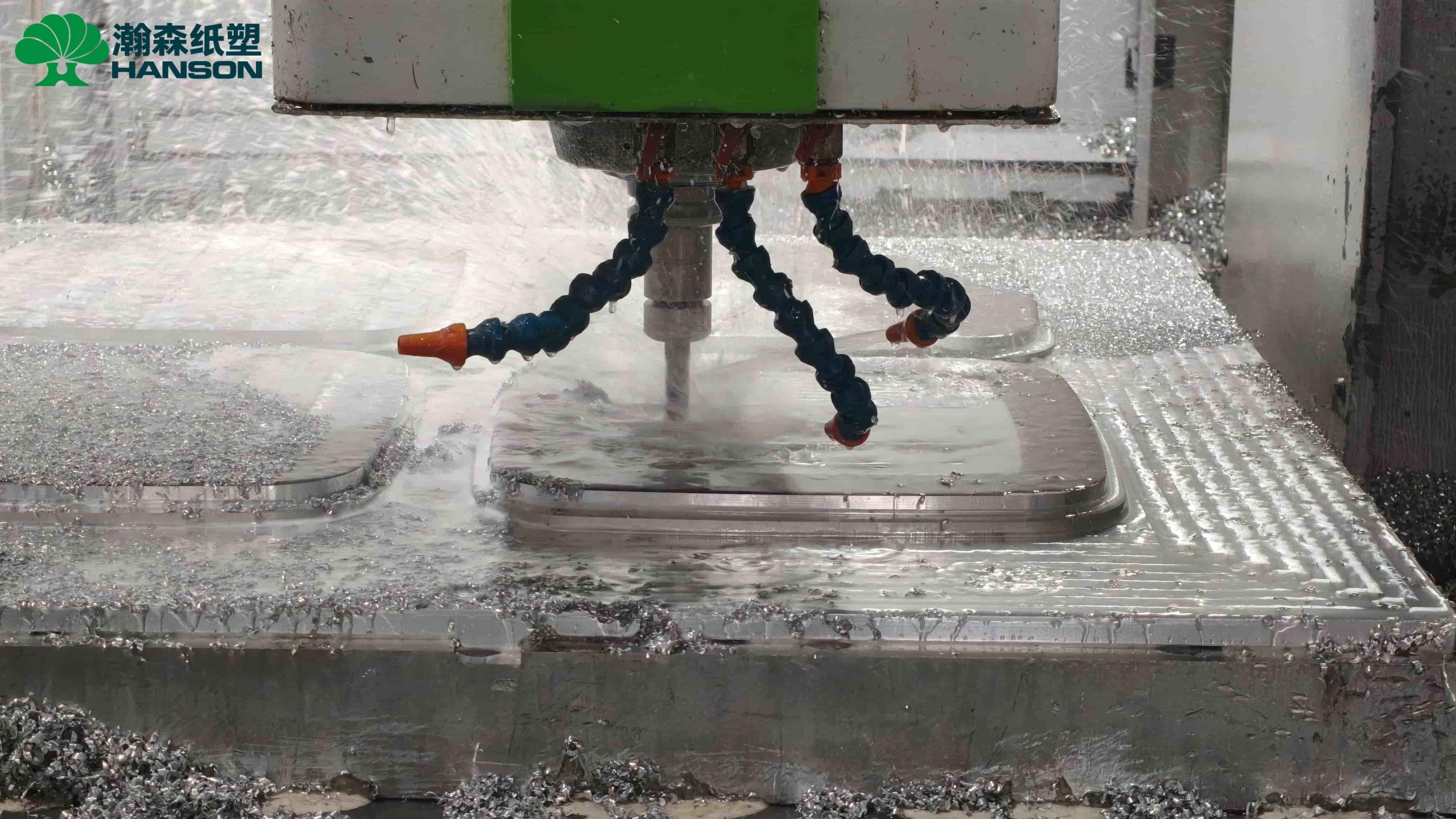
Pulp molding generally requires forming molds (forming tools) and hot press molds. The materials used and the precision with which they are cut are primary cost drivers. High-end tooling is typically crafted from high-strength aluminum or copper alloys, utilizing highly precise CNC (Computer Numerical Control) machining. For premium industrial molded fiber packaging (often classified as Type 3 thermoformed fiber), even microscopic tolerances can cause the final packaging to fail when assembling consumer electronics. Lower-priced molds often compromise on material density and machining accuracy. This not only shortens the tooling’s lifespan but also makes it susceptible to localized deformation under continuous high pressure and temperature, resulting in uneven product wall thickness.
2. Drainage and Mesh Structure Design
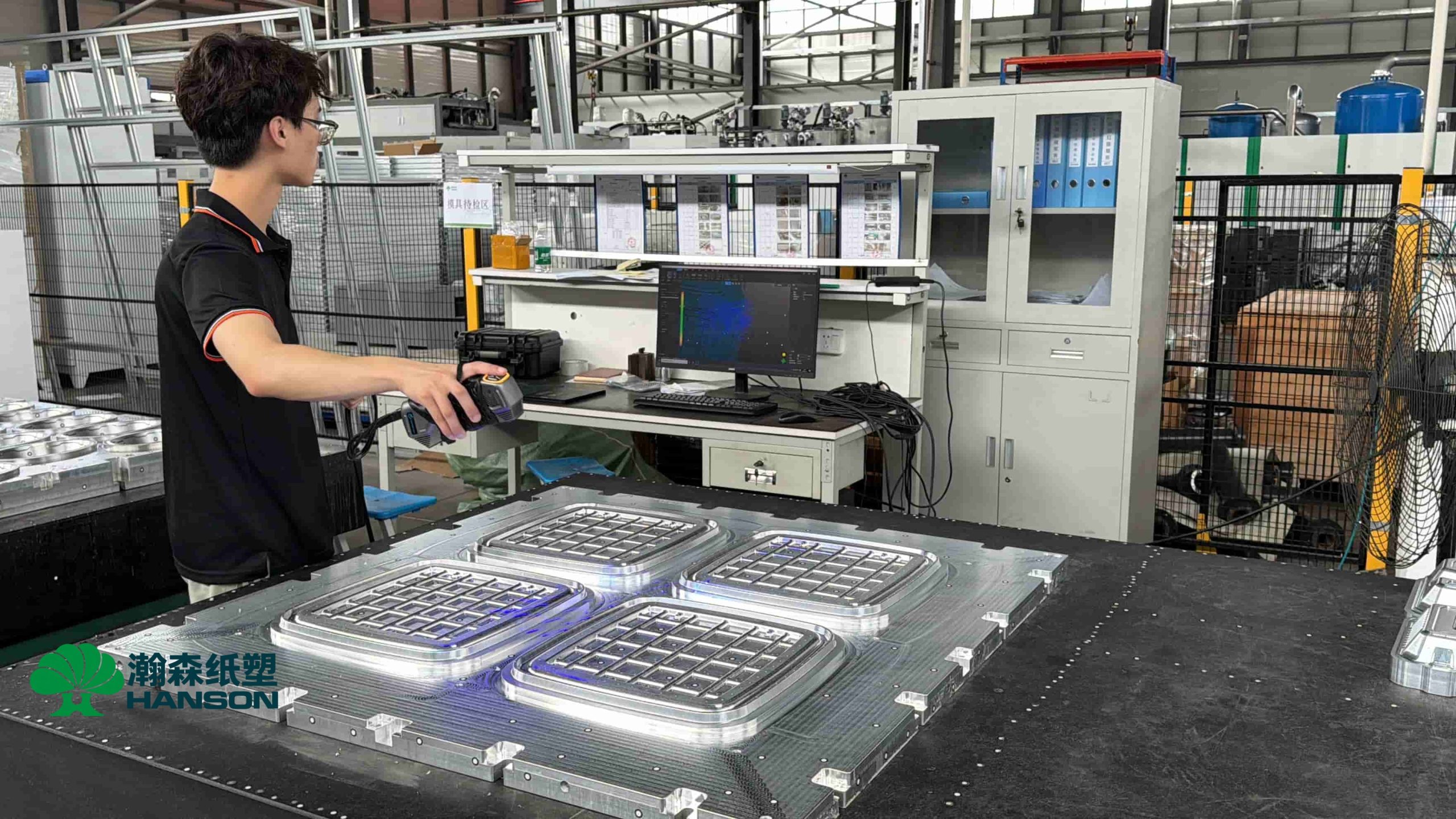
This is the hidden technical battlefield of a forming mold. The mesh covering the surface and the internal drainage holes determine how efficiently the vacuum can draw water through the fibers.
-
Premium configurations: Feature scientifically calculated drainage channels that allow for rapid and uniform dewatering. This lowers the moisture content of the wet preform, which ensures stable transfer out of the forming mold and significantly reduces the energy required during the subsequent hot pressing or drying stage.
-
Low-cost configurations: Often suffer from poor drainage, leading to uneven vacuum distribution or localized water accumulation. This forces operators to extend the forming time—slowing down the entire machine’s cycle time—and frequently causes watermarks or inconsistent product weight.
3. Cavity Layout vs. Equipment Payload
A common misconception is that simply increasing the number of cavities on a mold will automatically increase daily output. However, mold layout must perfectly match the forming machine’s vacuum capacity, pulp slurry distribution, and hot-press mechanics. Expert tooling design uses fluid dynamics and process experience to space cavities appropriately. If a mold is overcrowded just to inflate the theoretical output number, the pressure difference between the center and the edges will lead to high defect rates on the outer cavities, actually dragging down the actual production capacity.
4. Hot Press Tooling Surface Finish and Draft Angles
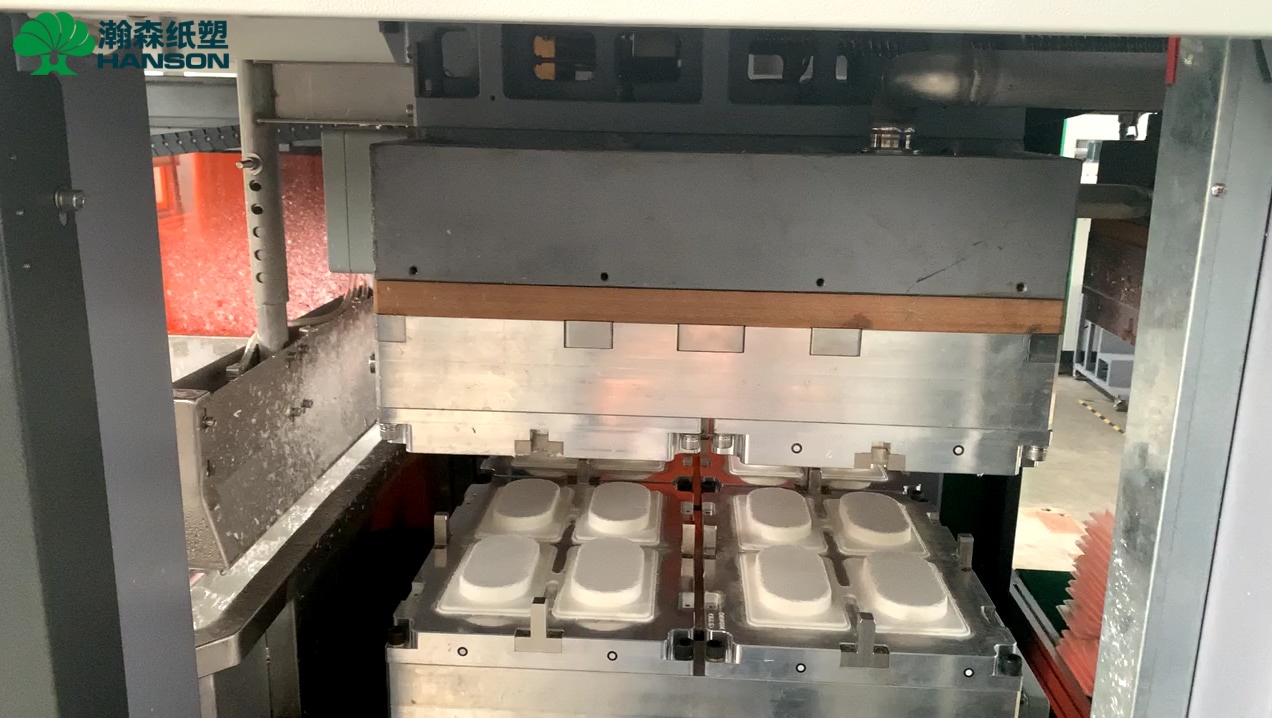
For wet-press pulp molding—where the wet preform is transferred directly into heated molds for drying and pressing—the surface of the hot press mold is critical. High-quality hot press molds undergo specialized polishing and sometimes receive advanced coatings, coupled with scientifically calculated draft angles. This gives the final product a smooth, dense, and premium surface finish while ensuring effortless demolding. If the mold surface is rough or the draft angles are miscalculated, the wet product will stick to the mold. This leads to constant machine stoppages for manual cleaning, destroying the line’s continuous automation and efficiency.
How Tooling Design Impacts Actual Daily Production Capacity
When evaluating a pulp molding machine, buyers should not rely solely on the theoretical cycle time listed in a brochure. Your actual daily output is a combination of machine parameters + tooling efficiency + process stability.
If a mold drains slowly, the forming time must increase. If a hot press mold distributes heat unevenly, the pressing time must be extended to prevent the product’s core from remaining wet. If demolding is not smooth, automated stacking systems fail. Therefore, attempting to save upfront costs by choosing subpar tooling almost always results in long-term production bottlenecks, high energy waste, and frustrated operators.
Tooling Optimization: Upgrading Existing Production Lines
For existing molded fiber factories experiencing issues like product warping, dimensional instability, or demolding failures, the solution is not always buying a brand-new production line. Many operational headaches stem from a mismatch between the current mold design and the production process. By conducting technical upgrades on old molds—such as re-engineering the drainage paths, upgrading the mesh, or optimizing the thermal fluid channels—manufacturers can significantly improve product yield and cycle speed without heavy capital investment in new host machinery.
Equipment, Tooling, and Process: The Hanson Pulp Molding Approach
As a specialist in turnkey pulp molding solutions, Hanson Pulp Molding operates on a core philosophy: Equipment and tooling cannot be treated as separate entities; they must be engineered synergistically around the final product.
Many apparent “equipment failures” or capacity shortfalls are actually caused by molds that do not adapt dynamically to the slurry conditions and the machine’s mechanical rhythm. Hanson Pulp Molding integrates in-house mold design, structural validation, and machine manufacturing. Whether you are validating a new product design via a prototyping machine or looking to scale up to full commercial production, our deep understanding allows us to execute joint debugging of the equipment, mold, and process. We ensure that your investment translates into stable mass production, staying true to our belief: Understand molds, understand processes, and understand equipment better.

FAQ
1. If I use a different supplier’s mold on the same pulp molding machine, will my capacity change? Yes, significantly. Different molds have varying dewatering efficiencies, heat transfer rates, and demolding capabilities. A mold that drains faster reduces forming time, and one that heats evenly reduces hot pressing time. These factors directly influence the actual number of cycles the machine can complete in a day.
2. Why do some molded fiber products warp or deform after production? Warping is typically a combined result of equipment parameters, tooling design, and process control. On the tooling side, if uneven mold thickness leads to inconsistent dewatering, or if the hot press mold does not distribute heat uniformly, the moisture evaporates at different rates across the product. This creates internal stress, causing the product to warp upon cooling.
3. Do I only need to change the mold to produce a different product on my machine? Not necessarily. While changing the mold is the primary physical step, different product weights, depths, and geometries require you to re-adjust the pulp consistency, vacuum duration, hot-press temperature and pressure, trimming alignment, and stacking parameters. This is why equipment-process synergy is crucial.
Conclusion
A pulp molding mold is not just a block of consumable metal; it is the central process hub that dictates forming quality, wet preform moisture content, and energy efficiency. Making a procurement decision based purely on the lowest price tag—without evaluating drainage design, heat transfer, and machining precision—will inevitably trap your project in a cycle of endless debugging and diminished capacity once commercial production begins.
If you already have a product sample, 3D drawing, or are facing yield and deformation issues on your current production line, simply adjusting machine parameters might not be enough. Hanson Pulp Molding can evaluate the mold configuration, process route, and equipment setup based on your target product to ensure stable mass production.
WhatsApp: +86 15920604830 Email: linchuangcheng@hspulpmolding.com