Jumping directly into molded pulp food box tooling customization without defining key product specifications often leads to project delays, poor yield, or wasted prototyping costs. To ensure smooth mold testing and stable mass production, it is vital to finalize several core parameters during the initial molded fiber product development phase.
Specifically, you must confirm the target weight and dimensions, wall thickness and draft angles, machine platen size, capacity goals, and pulp formulation. Failing to lock down these variables beforehand can result in severe issues during trial runs, such as product warping, demolding failures, or an inability to meet daily production targets. Here is the essential checklist to verify before starting your mold design.
1. Dimensional Baselines: Size, Weight, and Shrinkage
The length, width, height, and target weight of the food box serve as the foundation for tooling design. Whether utilizing wet-press or dry-press pulp molding processes, shrinkage during drying and thermoforming is inevitable.
-
Shrinkage Rate Estimation: The mold cavity dimensions are never exactly the same as the final product size. Tooling engineers must calculate the expansion of the mold based on the expected shrinkage rate of the target weight and fiber type.
-
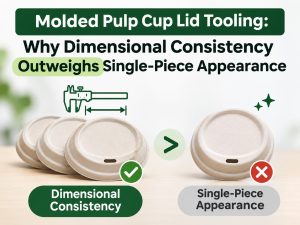
Closure and Stacking Specs: For clamshells or containers with lids, the clearance tolerance for the locking mechanism must be clearly defined. For single-body bowls or trays, the stacking height is critical to ensure a specific number of units fit perfectly into standard shipping cartons.
2. Structural Feasibility: Wall Thickness and Draft Angles
Unlike injection-molded plastics, molded pulp relies on vacuum suction to form fibers onto a mesh, placing strict limitations on wall thickness and release angles.
-
Optimal Wall Thickness: For standard wet-press tableware, wall thickness is generally kept between 0.6mm and 1.0mm. Excessive thickness increases slurry consumption and significantly extends the hot-pressing time, bottlenecking production. Conversely, walls that are too thin can compromise the rigidity of the food box.
-
Draft Angles: This is a critical parameter to prevent the product from sticking to the mold or tearing during ejection. Adequate draft angles (usually 3° to 5° or more) must be incorporated into both the internal and external walls. Deeper containers, like soup bowls, require larger draft angles to ensure smooth demolding.
3. Production Alignment: Machine Platen Size and Capacity Targets
Discussing tooling customization without referencing the actual thermoforming equipment is impractical. The layout of the mold directly dictates mass production efficiency.
-
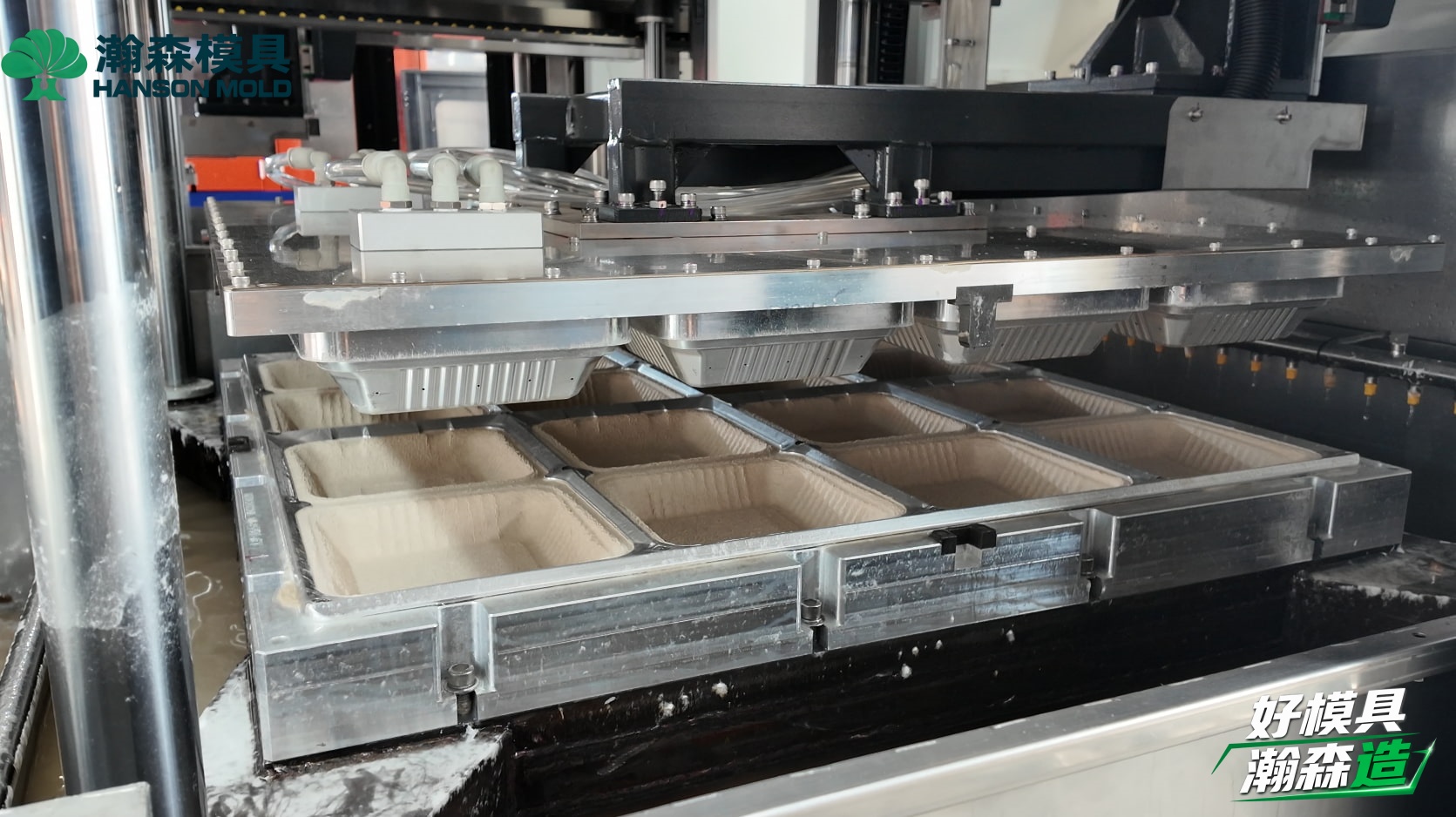
Machine Platen Specs: You must provide the exact dimensions of the upper and lower platens, the effective forming area, mold stroke, and clamping force of your existing or planned thermoforming machines.
-
Cavity Layout: By matching the platen size with your daily capacity goals, tooling designers can determine the optimal layout—whether a 2-cavity, 4-cavity, or 6-cavity configuration is most viable. Attempting to squeeze too many cavities beyond the effective pressure zone of the platen will result in uneven heat distribution and severe flashing on peripheral products.
4. Pulp Formulation: Influencing Mesh Selection and Shrinkage
The type of slurry used does more than just determine the physical strength of the food box; it directly impacts mold design parameters.
-
Fiber Characteristics: Different fibers—such as bagasse (sugarcane), wood pulp, or bamboo pulp—exhibit distinct shrinkage rates. If the pulp formulation is abruptly changed during production, the precisely engineered mold dimensions will no longer yield accurate products.
-
Mesh Wire and Surface Finish: The fineness of the pulp determines the micro-hole distribution on the forming mold and the required stainless steel wire mesh. High proportions of short fibers, like pure bagasse, demand specific anti-clogging designs for the mesh to maintain consistent vacuum suction.
5. Hanson Pulp Molding: Synergistic Tooling Development
Confirming these parameters requires both internal assessment and early collaboration with an experienced tooling manufacturer. With a dedicated tooling division and 10 senior designers, Hanson Pulp Molding has manufactured 500 pulp molding molds to date, offering comprehensive support from product development to sample review and mass production.
Once we receive your product parameters, our engineering team conducts comprehensive 3D structural analysis and draft angle interference checks. Utilizing high-speed CNC machining centers (capable of up to 24,000 RPM) and precise 3D scanning, we ensure exceptional tooling accuracy. Whether you are developing a new product alongside Hanson’s thermoforming equipment or require optimization of old tooling for non-Hanson machines, we provide robust on-site debugging and production support to maximize your yield.
FAQ
-
Q: What is the typical weight tolerance for molded pulp food boxes, and how does the mold control it? A: The standard weight tolerance for molded pulp tableware is generally controlled within ±5% to ±10%. During mold design, the target weight is managed by calculating the cavity volume, suction hole density, and forming time. However, maintaining consistent slurry concentration during actual production is equally vital for weight stability.
-
Q: Can we proceed with mold design if we haven’t finalized the machine platen dimensions yet? A: You can proceed with the 3D structural design of the single product and create a prototype mold (to test aesthetics and basic performance). However, for mass production tooling, exact platen dimensions are mandatory; without them, accurate cavity layout and runner design cannot be executed.
-
Q: If the food box lid doesn’t close tightly, is it entirely a mold design parameter error? A: Poor closure is not exclusively a tooling parameter issue. It could stem from insufficient locking depth in the initial design or inaccurate shrinkage estimation. However, uneven hot-pressing temperatures during mass production can also cause localized warping. A comprehensive troubleshooting approach based on physical molded samples is required.
Ready to develop a new line of molded pulp food boxes? Contact Hanson Pulp Molding for a professional tooling evaluation. Provide your preliminary product parameters, and our engineering team will guide you through cavity layout planning and prototyping strategies to ensure a seamless transition to mass production.