
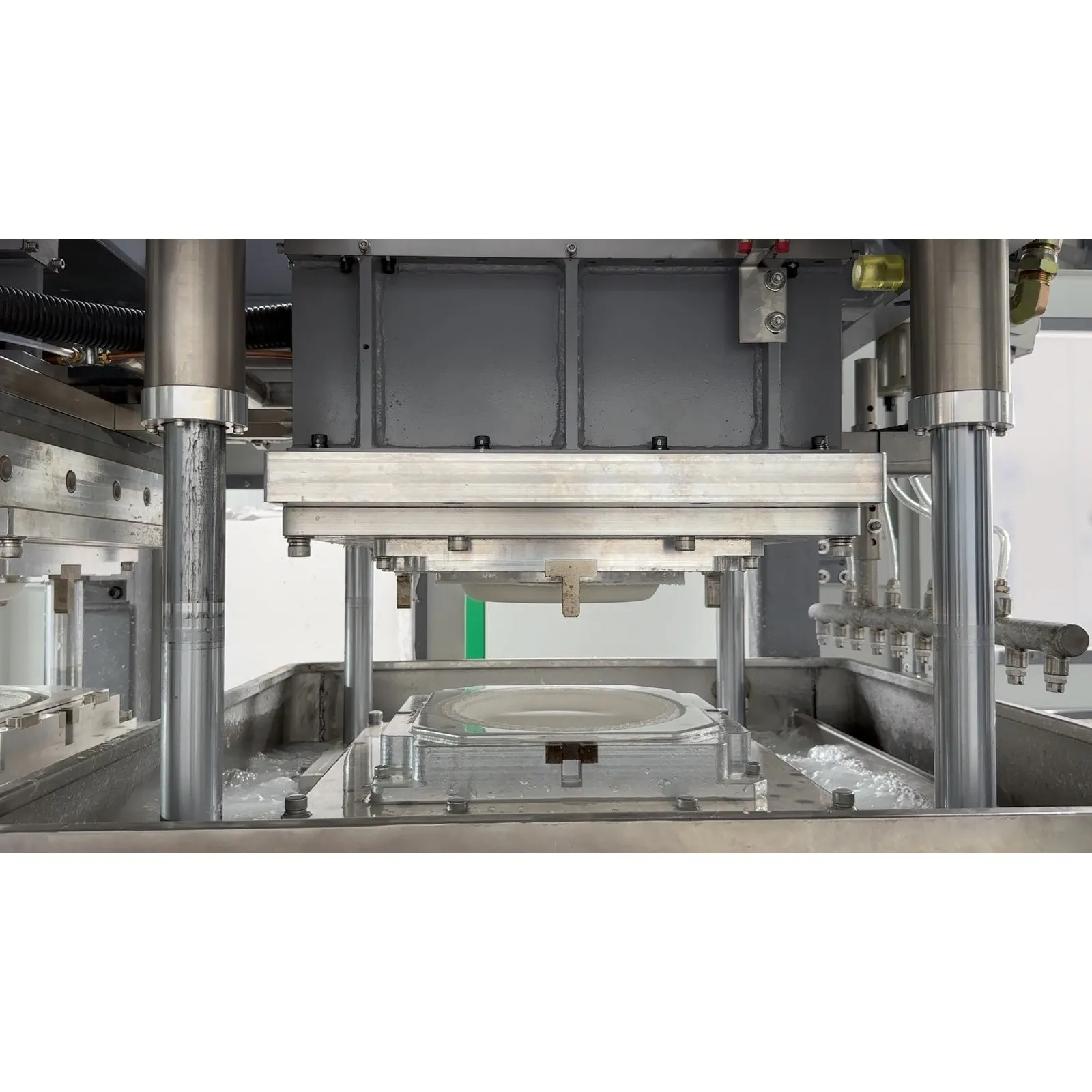
Features
Why Choose HANSON?
Our Own Mold Division, Design to Production
We run an independent mold division covering product development, mold design, manufacturing and testing. Because we build our own tooling, we control what decides your product range, how fast a new item reaches market, and how steadily you hold tolerances. We also optimize existing molds and retrofit equipment you already run, so a line that has lost its edge returns to spec without being replaced.
Complete Lines, Not Single Machines
Our portfolio covers tableware lines, industrial packaging equipment, cup lid lines and sampling lines, plus downstream automation for trimming, inspection, stacking and packing. Every station is engineered to the one after it, so the line reaches rated output instead of bottlenecking at the press or dryer. Start with one forming unit and expand into a full line as demand grows.
Turnkey Delivery With On-Site Support
We take a project from feasibility analysis and raw-material verification through layout, installation, commissioning and operator training. For turnkey projects we can place engineers on site and support ramp-up for up to six months — the period when most new plants either stabilize or stall. Ten service locations and 24/7 response keep that support running after warranty ends.
Proven at Scale, Certified for Regulated Markets
Our equipment runs in more than 20 markets, with roughly 150 units shipped a year and about half going to export customers across Europe, the Middle East, Southeast Asia and South America. Our forming equipment holds CE certification under the EU Machinery Directive, and 50 patents protect our structures, processes and automation systems. We serve listed companies, state-owned enterprises and leading packaging manufacturers.
We Have The Best Solutions for Your Business
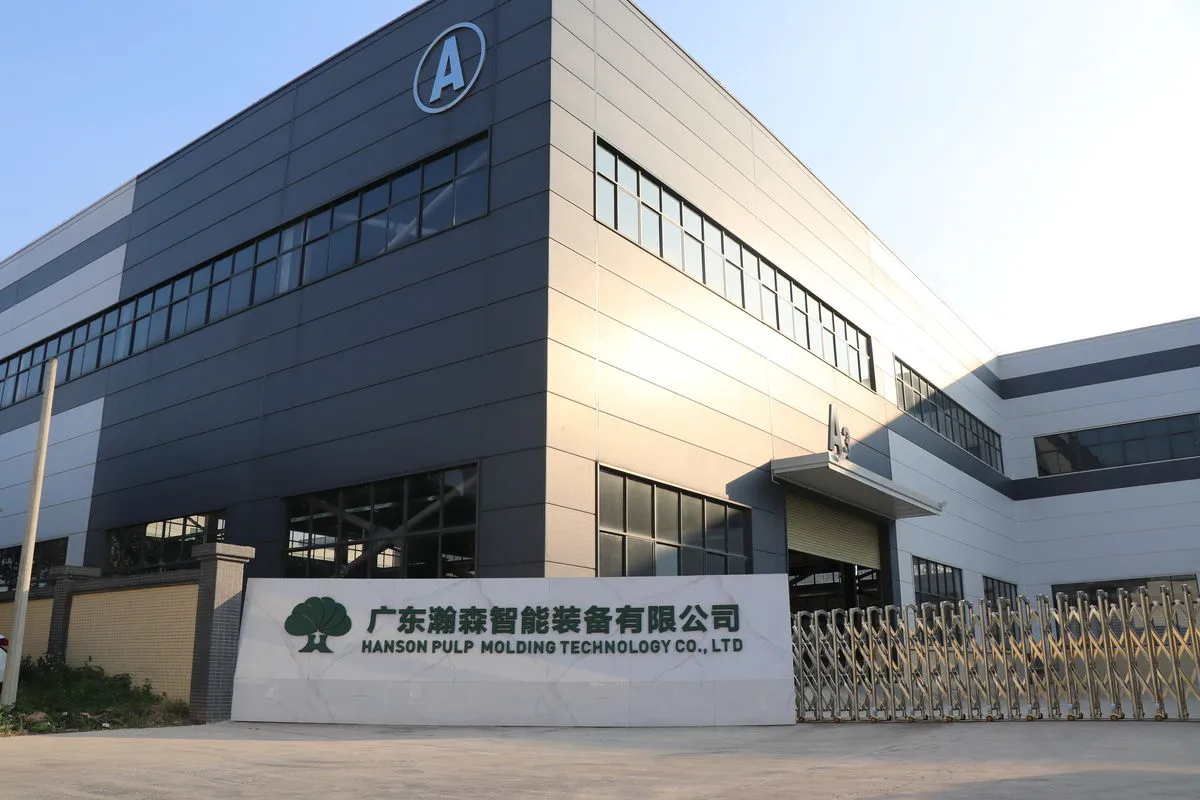
HANSON was founded in 2022 in Dongguan, Guangdong Province, China. Our 50,000 square meter facility employs more than 200 people, including a 50-engineer R&D team, and ships around 150 units a year to customers in more than 20 markets worldwide. We manufacture complete tableware production lines, premium industrial packaging equipment, plant-fiber cup lid lines and sampling lines, turning bagasse, bamboo fiber and recycled paper into tableware, egg trays, cup lids, cup carriers and protective packaging. What sets us apart is our independent mold division: with product development, mold design, manufacturing and testing all in house, we control the factor that decides how wide your product range goes and how reliably you hold tolerances. We deliver projects end to end, from feasibility analysis and factory layout to installation, commissioning and operator training, backed by 10 service locations and engineers who can stay on site through your ramp-up. Our equipment is CE certified and protected by 50 patents. Send us your product list and output target, and we will recommend the configuration that fits.
The short version
A pulp molding tableware machine produces food service products that must meet food contact rules, hold hot and wet food, and stack without deformation. Surface smoothness comes from press temperature and dwell. Fiber choice affects appearance, stiffness and unit cost. Tooling depth decides your product range and your ability to change over quickly.
The Product Range a Pulp Molding Tableware Machine Can Produce
The core tableware range covers round and square plates in several diameters, shallow and deep bowls, compartment trays for institutional catering, burger and sandwich clamshells, and food containers with optional lids. Beyond the core, producers add cutlery trays, sauce cups, dessert dishes and specialty items for airline or event catering, all of which run on the same machine with different tooling.
Product geometry matters more than most buyers expect. A flat plate is the simplest product and forgives the most process variation. A deep bowl with a high draw ratio is the hardest, because the fiber has to flow into a deep shape without tearing and the wall has to stay uniform through the base. Compartment trays sit in between but add complexity in the dividers, where fiber distribution is difficult to control.
Choose your starting range deliberately. Buyers who launch with three products they can sell reliably outperform those who launch with ten and master none. Start with the products where you have a customer conversation already underway, prove quality and delivery, then expand the tooling library with real market feedback rather than speculation.
| Product | Molding difficulty | Key quality point |
| Flat plates | Low | Rim strength and stack height |
| Shallow bowls | Medium | Uniform wall thickness |
| Deep bowls | High | Base density and rim crack resistance |
| Compartment trays | High | Divider formation and rigidity |
| Clamshells | High | Hinge strength and closure fit |
Surface Finish and Why It Drives Perceived Quality
Tableware is a consumer product. A buyer at a restaurant or a retail chain judges it by appearance and feel within seconds, and a rough surface or a visible press mark triggers rejection even when the part meets every dimensional specification. Surface finish is therefore a commercial requirement, not a cosmetic extra.
Surface smoothness comes from the press. Temperature, pressure and dwell determine how completely the fiber densifies against the mold face, and all three have to be consistent across the whole mold, not just on average. A platen that is hotter in the middle than at the edges produces parts that look different depending on where they were formed, and that variation is visible when they are stacked.
Fiber choice sets the ceiling for achievable finish. Short, bright fibers such as bagasse press to a smooth surface with less effort than long fibers, which tend to hold a slightly more textured appearance. If appearance is the priority, choose the fiber accordingly and confirm with samples before committing to tooling.
Coating is the final lever. An uncoated part has a natural fiber appearance that some brands prefer. A coated part offers a smoother surface and better barrier performance but adds a process step and affects compostability certification. Decide this at the design stage rather than after tooling exists, because coating requirements can influence mold design.
Food Contact Compliance for Tableware
Tableware contacts food directly, so it faces the full weight of food contact regulation. European markets expect compliance with framework regulation requirements and migration testing at the temperature and duration the product will actually see. North American buyers ask for documentation covering base fiber, additives and any coating. Both markets increasingly expect compostability certification before accepting a compostable claim.
The machine matters to compliance because it has to run a stable, documented process. Certification tests the finished product, but a plant whose process drifts produces samples that pass once and production that fails an audit. Ask any supplier which customer plants passed which audits on their equipment, and what process data accompanied the submissions.
Wet strength and grease resistance deserve attention in product design. A plate holding a hot curry and a bowl holding soup place different demands on the surface, and a formulation that handles one may fail the other. Test against your customers' actual dishes rather than against generic food simulants, and design the additive package around the results.
Track regulatory changes through the industry news pages, which cover packaging rules by market, and review application notes on the technical blog.
Unit Economics of Tableware Production
Tableware sits in a competitive market where buyers compare prices per thousand pieces, so unit cost decides whether a contract is worth having. Work from fiber consumption, drying energy, mold amortization, labor and rejection rate. The two largest and most controllable items are fiber consumption per piece and drying energy, and both are reduced by the same thing: a design that eliminates unnecessary wall thickness.
Stiffness at thin walls is what makes thin design possible. Bagasse and bamboo both deliver high stiffness, which is why they dominate the tableware segment despite costing more per ton than waste paper. The right comparison is cost per thousand pieces, not cost per ton of fiber, because a fiber that lets you remove material and shorten drying can be cheaper overall.
Rejection rate deserves more attention than it usually gets. A tableware line running at ninety five percent good parts is losing five percent of fiber, energy and labor every shift, which on a competitive product can exceed the entire margin. Most rejections trace back to process drift rather than equipment failure, which makes measurement discipline the cheapest profit improvement available.
Choosing and Sizing the Machine
Size against the product range you will actually sell and the volume each product will reach. Deep bowls take longer to form and dry than flat plates, so a line quoted against a plate will deliver less on a bowl. Ask for output figures per product family rather than a single headline number.
Consider the changeover requirement. A tableware plant serving several customers with different shapes changes molds regularly, and a machine that takes a full shift to change over loses a meaningful share of its available capacity. Ask how long changeover takes and whether process recipes are stored and recalled automatically.
Leave expansion room. Tableware businesses often grow by adding forming capacity for a second product family rather than by replacing the first line, and a layout with space, power and pulper capacity for that step expands far more cheaply. Ask the supplier to price the expansion stage as part of the original offer. The tableware machinery collection shows the range of configurations available.
Tooling and Product Development
Tooling is where tableware projects are won. The mold controls wall distribution, rim strength, stack height and surface appearance, and it has to hold all of those through thousands of thermal cycles. A supplier who makes molds in house can iterate quickly when a product needs adjustment; one who subcontracts tooling adds weeks to every change.
Develop product with a prototype loop rather than in one pass. Make a trial part, measure it, compare against the target, adjust the mold, repeat. Each iteration should change one variable so you learn what caused the difference. Three to five iterations is typical to reach an acceptable part when the process is disciplined.
Ask for dimensional data from delivered molds rather than specifications. Cavity to cavity repeatability tells you whether your stack heights will be consistent across every position in the mold. The mold and tooling program explains how these tools are designed and verified.
Running a Pulp Molding Tableware Machine Every Day
Daily operation settles into a rhythm once the process is stable. Operators check slurry concentration and freeness at the start of each shift, verify press platen temperature before the first production part, and take sample parts from each cavity at defined intervals. Those checks take minutes and catch the drift that would otherwise appear as rejects at the end of the line.
Mold maintenance runs on a schedule rather than on failure. Meshes are inspected for blockage, press surfaces are checked for deposits that affect surface finish, and trimming dies are measured for wear. A die that has drifted produces rims that look acceptable and stack poorly, and the defect is far cheaper to prevent than to sort out afterward.
Keep a product file for every item a pulp molding tableware machine produces: the mold number, the process recipe, first article measurements and the customer's specification. When a complaint arrives, that file turns diagnosis into comparison. When a new operator joins, it turns training into instruction rather than folklore. Plants that maintain these records consistently are the ones that hold quality steady across staff changes and product additions, and they are also the plants that pass customer audits without scrambling for evidence.
Final Thoughts
A pulp molding tableware machine is chosen on three grounds: the product range you can sell, the food contact compliance your markets require and the unit economics you can defend. Surface finish and stiffness come from fiber and press discipline, cost comes from thin design, and flexibility comes from tooling depth. Get those aligned and tableware production becomes a business rather than a technical exercise.
Send us your product list, target markets and expected volumes, and we will propose a pulp molding tableware machine configuration with tooling plan and utility figures.
Every proposal covers food contact documentation and a product development schedule.
Plan Your Tableware Range
Featured Products
Collection about HANSON




User Reviews
What users say about HANSON
Frequently Asked Question
Do you have any question?
Plates in several diameters, bowls, compartment trays, clamshells and takeaway containers. The range is defined by your mold set, so a buyer can start narrow and expand as customer demand develops.
Because perceived quality is judged at first touch. A dense, smooth surface signals a premium product and supports a higher price, while a rough or fuzzy surface undermines the sustainability story the product is sold on.
Requirements vary by market, but they generally cover fiber source, process cleanliness and finished-product testing. Confirm the documentation your target market expects before the line is configured, not after it is running.
Start from the product you will actually sell most of, size the forming and drying stages around it, and confirm the machine can add products later through molds. Sizing on a headline output figure is the most common and most costly error.