
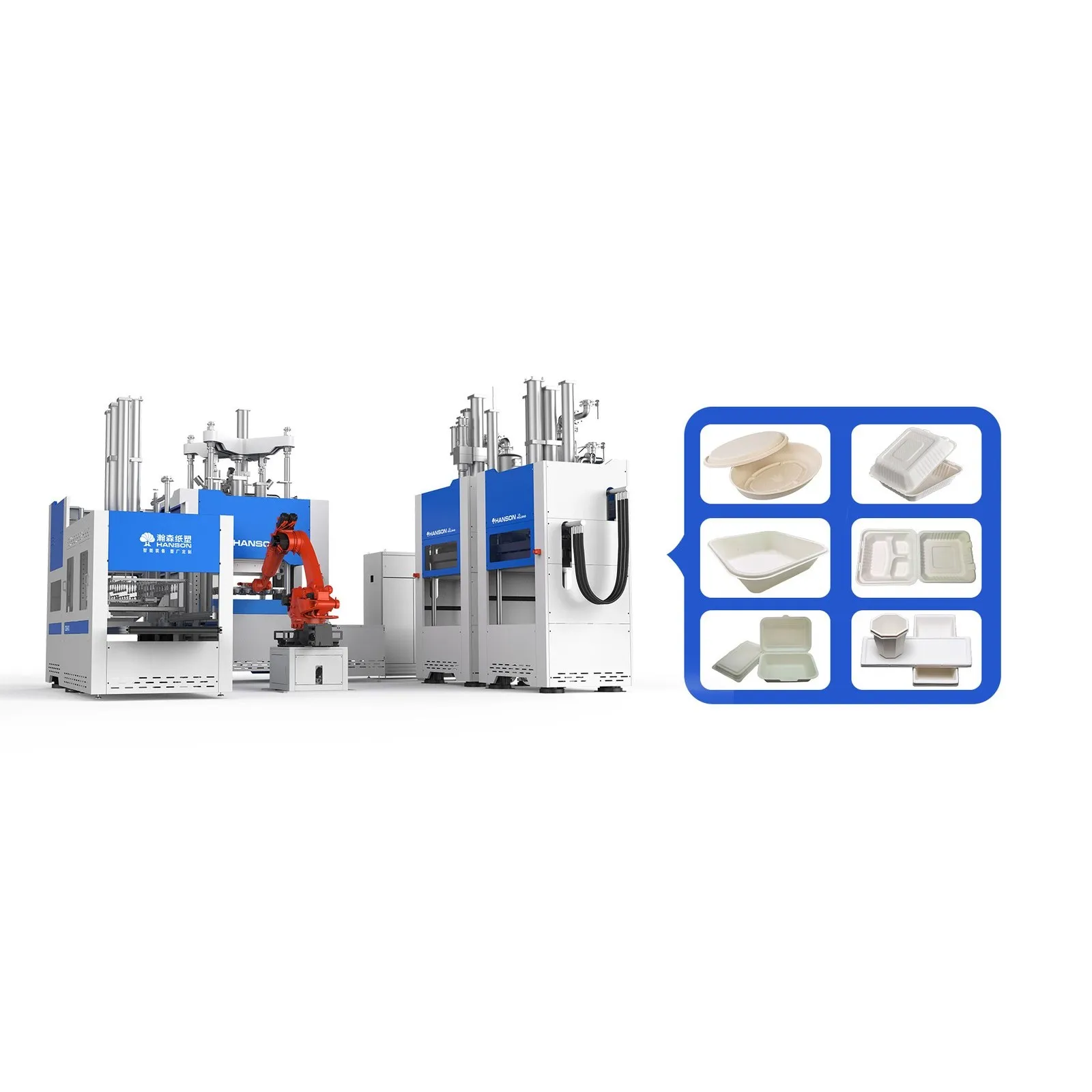
Features
Why Choose HANSON?
Our Own Mold Division, Design to Production
We run an independent mold division covering product development, mold design, manufacturing and testing. Because we build our own tooling, we control what decides your product range, how fast a new item reaches market, and how steadily you hold tolerances. We also optimize existing molds and retrofit equipment you already run, so a line that has lost its edge returns to spec without being replaced.
Complete Lines, Not Single Machines
Our portfolio covers tableware lines, industrial packaging equipment, cup lid lines and sampling lines, plus downstream automation for trimming, inspection, stacking and packing. Every station is engineered to the one after it, so the line reaches rated output instead of bottlenecking at the press or dryer. Start with one forming unit and expand into a full line as demand grows.
Turnkey Delivery With On-Site Support
We take a project from feasibility analysis and raw-material verification through layout, installation, commissioning and operator training. For turnkey projects we can place engineers on site and support ramp-up for up to six months — the period when most new plants either stabilize or stall. Ten service locations and 24/7 response keep that support running after warranty ends.
Proven at Scale, Certified for Regulated Markets
Our equipment runs in more than 20 markets, with roughly 150 units shipped a year and about half going to export customers across Europe, the Middle East, Southeast Asia and South America. Our forming equipment holds CE certification under the EU Machinery Directive, and 50 patents protect our structures, processes and automation systems. We serve listed companies, state-owned enterprises and leading packaging manufacturers.

We Have The Best Solutions for Your Business
HANSON was founded in 2022 in Dongguan, Guangdong Province, China. Our 50,000 square meter facility employs more than 200 people, including a 50-engineer R&D team, and ships around 150 units a year to customers in more than 20 markets worldwide. We manufacture complete tableware production lines, premium industrial packaging equipment, plant-fiber cup lid lines and sampling lines, turning bagasse, bamboo fiber and recycled paper into tableware, egg trays, cup lids, cup carriers and protective packaging. What sets us apart is our independent mold division: with product development, mold design, manufacturing and testing all in house, we control the factor that decides how wide your product range goes and how reliably you hold tolerances. We deliver projects end to end, from feasibility analysis and factory layout to installation, commissioning and operator training, backed by 10 service locations and engineers who can stay on site through your ramp-up. Our equipment is CE certified and protected by 50 patents. Send us your product list and output target, and we will recommend the configuration that fits.
The short version
An egg carton machine produces a protective package at very low unit cost, so cycle time and material use per piece decide profitability. Cup geometry, lid closure and stack strength are the three quality points buyers test. Recycled paper fiber is the standard furnish, and process consistency is what keeps the rejection rate low.
Cup Geometry: The Heart of Egg Carton Quality
Every egg carton specification starts with the cup. The cup has to be deep enough to hold the egg without letting it rest on the base, wide enough to accept the largest eggs in the grading range, and shaped so the egg sits on a ring of contact rather than a single point. Eggs vary in size within a grade, so the cup must accommodate the small end of the range without letting the largest egg sit too high and press against the closed lid.
The most common quality complaint in this business is egg breakage in transit, and the cause is usually cup geometry rather than fiber strength. A cup that is slightly too shallow bottoms out, so the egg rests on its wide end and takes every shock through the shell. A cup that is slightly too deep lets the egg shift laterally during handling. Both problems look identical to the packer and both are solved on the drawing board, not on the machine floor.
Cup-to-cup spacing matters as much as the cup itself. If the spacing is too tight, adjacent eggs touch and transfer shock between each other during handling. If it is too loose, the carton wastes material and takes more space in a shipping case. Ask your tooling supplier to show the spacing calculation against the egg size range you actually pack.
| Quality point | Failure symptom | Root cause to check |
| Cup depth | Breakage in transit | Cup bottoms out or egg shifts laterally |
| Lid closure | Cartons open in the case | Post height and hinge geometry |
| Stack strength | Crushed cartons in pallet stacking | Corner post wall thickness and press density |
| Edge finish | Dust in the grading line | Trimming die condition and press smoothness |
How an Egg Carton Machine Produces at Low Unit Cost
Egg cartons sell into a market where the price is set by the packer's purchasing department and the margin is thin, so the production economics matter more than on almost any other molded fiber product. Three variables decide your cost per thousand cartons: cycle time, fiber consumption per carton and rejection rate. Improving any one of them by a few percent changes whether the contract is profitable.
Cycle time depends on wall thickness and drainage. Cartons are thin walled compared with plates, so drainage is quick, but the deep cups still hold water and need a longer press dwell than the flat sections suggest. Operators who shorten dwell to gain speed end up with soft cups that deform in stacking, which shows up as customer returns rather than an obvious reject.
Fiber consumption per carton is set by wall thickness and trim waste. A carton designed with the minimum wall thickness that still passes the stacking test uses less fiber and dries faster, so material cost and energy cost fall together. This is why tooling design deserves more attention than the machine frame in most egg carton projects.
Rejection rate is the quietest of the three. A plant running at ninety five percent good parts loses five percent of its fiber, energy and labor on every shift, and on a low value product that is often the entire margin. Rejection usually traces back to slurry concentration drift or vacuum variation rather than machine failure, which makes measurement discipline the cheapest improvement available.
Fiber Selection for Egg Cartons
Old corrugated containers and mixed waste paper are the traditional furnishes for egg cartons, and they remain the most economical choice. Newspaper adds drainage speed but reduces strength, so it is usually blended rather than used alone. The mix ratio directly affects both the press behavior and the finished stack strength, so lock a blend specification with your fiber supplier and hold it.
Plant fibers such as bagasse and bamboo produce a stronger carton at thinner walls and support a renewable material claim that some retail chains want. The tradeoff is material cost, so these fibers make sense when the carton is sold as part of a branded premium egg line rather than as a commodity package. Model the cost per thousand cartons with each furnish before deciding.
Whatever fiber you choose, control moisture. Damp fiber changes slurry concentration and drainage, and the effect is a slow drift in carton weight that operators notice only when customers complain about stack height. Insist on a moisture specification with each delivery and store bales under cover.
Sizing an Egg Carton Machine Against Seasonality
Egg demand does not run flat through the year. Baking seasons and holiday periods push demand up sharply, and a plant sized for average demand will either miss those peaks or pay for idle capacity in the quiet months. Model your capacity against the peak months, then decide whether you would rather invest in extra capacity or run additional shifts during the busy period.
The calculation should start from cartons per week at peak, converted into cartons per shift, then divided by the sustained output of a candidate machine running your specific carton size. A twelve egg carton and a thirty egg tray run at different cycle times from the same frame, so quote capacity per product. Buyers who compare suppliers on a generic output figure usually discover the gap after installation.
Leave room for a second forming unit. Egg carton plants frequently scale by adding forming capacity rather than replacing the whole line, and a layout that reserved space, power and pulper volume for that step will expand at a fraction of the cost of a new building.
Tooling for Egg Cartons
Egg carton tooling is a specialization within mold making. The mold has to form thirty cups with even drainage, produce a hinge that folds without cracking, and hold post heights that stack consistently. Multi cavity egg tooling also has to keep every cavity within the same dimensional window, because a carton that stacks well from one cavity and poorly from another creates chaos in the packing line.
Ask for a dimensional report from a previously delivered egg carton mold rather than a specification sheet. Cavity-to-cavity variation data tells you more about a supplier's capability than any brochure. The mold and tooling program explains how these tools are designed, trialed and verified.
Plan the mold library around your customers' grading standards. A packer running a standard twelve egg carton has different needs from one running a thirty egg tray, and both may want a half dozen variant. Buying tooling in generations keeps cash under control and lets you learn from real reorder data before expanding.
Compliance and Food Safety Documentation
Egg cartons contact food, so the material must satisfy food contact rules in the destination market. Recycled fiber grades receive particular scrutiny because of the possibility of mineral oil or other contaminants carried in from the waste stream. Ask your fiber supplier for the documentation trail on recycled content, and test the finished carton against the migration protocols your buyers specify rather than assuming a generic paper grade will pass.
Compostability claims need certification before they can go on the package. Buyers in Europe and North America increasingly ask for third party certification rather than a manufacturer statement, and the certification tests the finished product. A machine that logs process parameters makes the sample submission straightforward, because the lab can see that the process is stable and the samples are representative.
For background on how packaging rules are changing across markets, the industry news pages track regulatory developments, and the technical blog covers material and application topics in more detail.
Running an Egg Carton Plant Profitably
Commissioning an egg carton machine is a measurement exercise. Take carton weights and cup depths from every cavity across full shifts, log them, and find which cavities drift first. That data separates mold problems from process problems and saves weeks of unfocused troubleshooting. It also gives you the baseline for every maintenance decision afterward.
Train operators to read drift before it becomes rejects. A slightly heavier carton, a slower drain or a marginally cooler platen all precede a dimensional problem by hours. On a product with this thin a margin, preventing rejects is worth far more than sorting them. Our project services team builds this measurement routine into the commissioning schedule.
Final Thoughts
An egg carton machine is judged on cost per thousand cartons and on breakage in transit, and both are decided by tooling design and process consistency rather than raw capacity. Get the cup geometry right, specify your fiber blend in writing, and measure every shift. Do that and the contract stays profitable even when the packer pushes on price.
Tell us the carton sizes you need and the egg grade range you pack, and we will propose a machine configuration with cavity count, cycle time and a tooling plan for an egg carton machine.
Proposals include fiber consumption per thousand cartons and a dimensional control plan for the packing line.
Plan Your Egg Carton Line
Featured Products
Collection about HANSON




User Reviews
What users say about HANSON
Frequently Asked Question
Do you have any question?
Cup geometry. The cup has to hold the egg firmly enough to stop it moving, but with enough give to absorb impact. Cartons that pass a drop test at the plant but fail in a distribution truck usually have a cup profile that is slightly too stiff or too shallow.
Through material efficiency and output per hour. Egg cartons are a commodity product sold on fractions of a cent, so the winners are lines that run continuously at high output with minimal fiber waste and a low rejection rate.
Most production uses recycled newsprint, mixed waste paper or old corrugated containers. The choice is driven by price and availability in your region plus the strength the carton needs, and buyers in different markets settle on very different furnishes.
Size the machine around your peak season and use the off-season for stock building or for other molded products that share the same fiber preparation. Trying to cover a seasonal peak with overtime on an under-sized line is the most expensive way to solve it.