
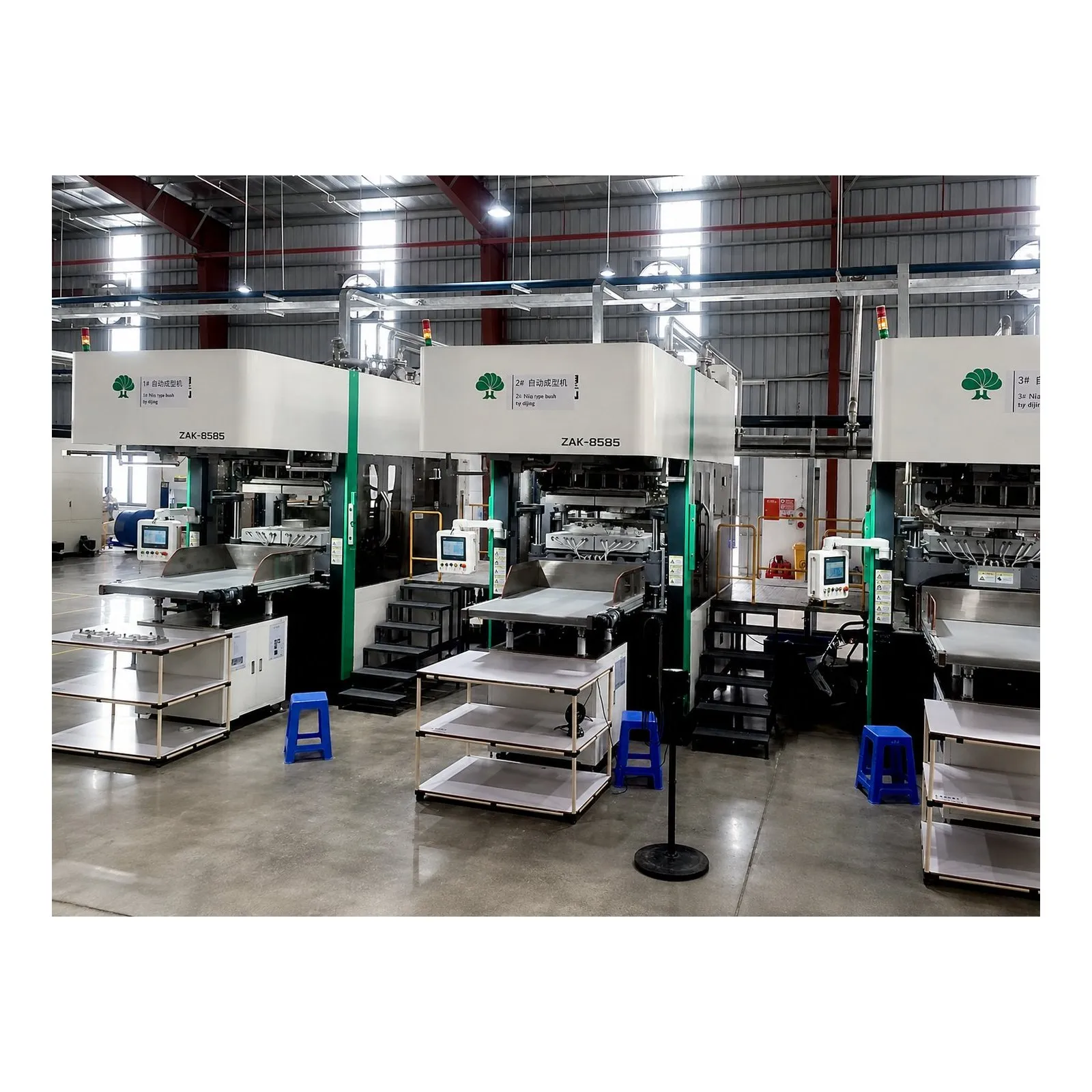
Features
Why Choose HANSON?
Our Own Mold Division, Design to Production
We run an independent mold division covering product development, mold design, manufacturing and testing. Because we build our own tooling, we control what decides your product range, how fast a new item reaches market, and how steadily you hold tolerances. We also optimize existing molds and retrofit equipment you already run, so a line that has lost its edge returns to spec without being replaced.
Complete Lines, Not Single Machines
Our portfolio covers tableware lines, industrial packaging equipment, cup lid lines and sampling lines, plus downstream automation for trimming, inspection, stacking and packing. Every station is engineered to the one after it, so the line reaches rated output instead of bottlenecking at the press or dryer. Start with one forming unit and expand into a full line as demand grows.
Turnkey Delivery With On-Site Support
We take a project from feasibility analysis and raw-material verification through layout, installation, commissioning and operator training. For turnkey projects we can place engineers on site and support ramp-up for up to six months — the period when most new plants either stabilize or stall. Ten service locations and 24/7 response keep that support running after warranty ends.
Proven at Scale, Certified for Regulated Markets
Our equipment runs in more than 20 markets, with roughly 150 units shipped a year and about half going to export customers across Europe, the Middle East, Southeast Asia and South America. Our forming equipment holds CE certification under the EU Machinery Directive, and 50 patents protect our structures, processes and automation systems. We serve listed companies, state-owned enterprises and leading packaging manufacturers.
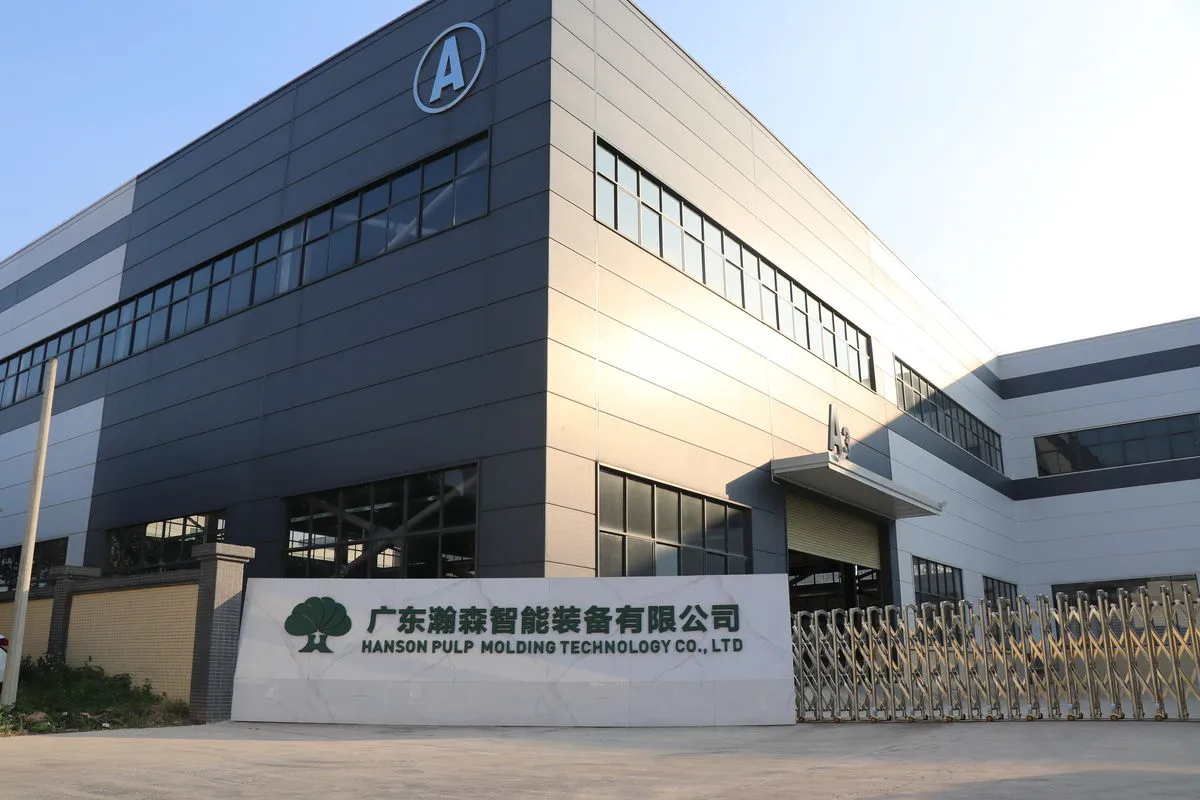
We Have The Best Solutions for Your Business
HANSON was founded in 2022 in Dongguan, Guangdong Province, China. Our 50,000 square meter facility employs more than 200 people, including a 50-engineer R&D team, and ships around 150 units a year to customers in more than 20 markets worldwide. We manufacture complete tableware production lines, premium industrial packaging equipment, plant-fiber cup lid lines and sampling lines, turning bagasse, bamboo fiber and recycled paper into tableware, egg trays, cup lids, cup carriers and protective packaging. What sets us apart is our independent mold division: with product development, mold design, manufacturing and testing all in house, we control the factor that decides how wide your product range goes and how reliably you hold tolerances. We deliver projects end to end, from feasibility analysis and factory layout to installation, commissioning and operator training, backed by 10 service locations and engineers who can stay on site through your ramp-up. Our equipment is CE certified and protected by 50 patents. Send us your product list and output target, and we will recommend the configuration that fits.
The short version
A pulp molding turnkey solution bundles design, tooling, equipment, installation, commissioning and training into one scope. It shortens the path to production but only delivers lasting value if the contract includes acceptance criteria and real knowledge transfer. Always define what is excluded as clearly as what is included.
What a Pulp Molding Turnkey Solution Scope Should Contain
A complete scope starts with product design. Before any equipment is specified, the supplier should work with you to define the products, their dimensions, wall thickness targets, stacking requirements and compliance needs. Skipping this step is the most common cause of a plant that is technically running but commercially useless, because the machine produces parts nobody can sell.
Tooling follows. A turnkey project should include the molds for the initial product range, with a defined number of cavities, a defined development process and a defined number of trial iterations. Vague language about tooling is where disputes begin, so insist on a list with cavity counts, materials and delivery dates for each tool.
Equipment supply covers every station from pulping through packing, plus the utilities connection points. Layout design translates that into a floor plan with process flow, service access and space for molds and maintenance. Utility planning covers the electrical, water, drainage, compressed air and ventilation requirements at both the starting configuration and the expansion stage.
Installation, commissioning and training complete the scope. This is the part buyers most often under-specify and later regret, because a turnkey contract that stops at installation leaves the hardest work, the process learning, to the buyer.
| Scope element | What good looks like | Warning sign |
| Product design | Defined product list with tolerances and target markets | Machine specification without a product discussion |
| Tooling | Itemized list with cavity counts and trial iterations | "Molds will be provided as required" |
| Layout and utilities | Drawings at starting and expansion configuration | Utility data provided verbally |
| Commissioning | Written engineer days and acceptance protocol | "A few days for handover" |
| Training | Supplier side training plus on site programs | Training mentioned only in passing |
The Advantage of Buying as One Project
The main benefit of a pulp molding turnkey solution is single point responsibility. When something does not work, there is one party accountable rather than a set of suppliers pointing at each other. On a molded fiber plant, where the machine, the mold, the fiber and the process all interact, that accountability is worth a great deal.
The second benefit is speed. A supplier who integrates design, tooling and equipment works in parallel rather than in sequence, so mold development and machine build advance together. Projects delivered this way typically reach production months earlier than projects assembled from separate purchases.
The third benefit is process knowledge transfer. A turnkey supplier develops the process recipe alongside the equipment, so the plant starts with proven parameters rather than discovering them through trial and error. That head start is often the difference between a plant that stabilizes in weeks and one that struggles for a year.
Where Turnkey Delivery Goes Wrong
The most common failure is dependency without capability. When every process decision depends on the supplier's engineers, the plant cannot respond when they are not available, and every product change becomes a project. Turnkey should build your team's capability, not replace it. Insist on training that includes the reasoning behind settings rather than a list of parameters to enter.
The second failure is an undefined acceptance event. If the contract says the plant will be commissioned without specifying how performance is verified, the project ends when the supplier decides it does. Define the acceptance test: which product, which output, which dimensional tolerances, measured over what period.
The third failure is an exclusion list that surfaces late. Civil works, foundations, electrical connections, freight, import duties and local labor are commonly excluded from turnkey scopes, and discovering them after signing turns a fixed budget into an open one. Demand a written exclusion list before the contract is signed, not after.
The fourth failure is tooling that is not tailored. A turnkey supplier shipping standard molds that are close to your product but not exactly right creates a plant that produces almost what the market wants. Tooling development should be part of the project, with trial iterations and customer samples built into the schedule.
Contract Terms That Protect the Buyer
Write the scope as an itemized list rather than a narrative. Every machine station, every mold, every training day and every drawing should appear as a line item. Narratives are easy to interpret generously on the supplier side and narrowly on yours, and interpretation is where projects lose time.
Attach a milestone schedule with payments tied to completion rather than to dates. Design approval, tooling delivery, shipment, installation, commissioning and acceptance are natural milestones. Linking payment to evidence of completion keeps the project moving and gives you leverage at each stage.
Confirm tooling ownership and drawing access. You should own the drawings for molds you paid for and be able to have them remade by another supplier if necessary. This clause protects you in a way that goodwill never does, and it costs the supplier nothing to agree to if they intend to keep your business.
Define the spare parts list and delivery terms before shipment. Common wear items such as meshes, seals, vacuum components and cutting dies should be identified with lead times, and a starter kit should travel with the equipment. A plant that stops for six weeks waiting for a wear item has lost more than the part costs.
Working With a Turnkey Partner After Start Up
The most productive turnkey relationships continue after commissioning. Suppliers who remain involved in product development and process improvement help plants add products faster and solve problems sooner. Plant teams that share operating data get better support because the supplier can diagnose from evidence rather than from description.
Plan your second product wave while the first is stabilizing. A turnkey supplier who already knows your process can often predict tooling requirements and process settings for a new product before the first trial, which shortens development considerably and reduces the number of iterations needed.
Keep the documentation current. Process recipes, drawing revisions and maintenance records belong in your system, not only in the supplier's. When staff change or an audit arrives, that documentation is what keeps the plant running. The project services overview describes how this support is structured after handover, and the factory overview shows the manufacturing capability behind a turnkey commitment.
Is Turnkey Right for You
Turnkey suits buyers who are new to molded fiber, who need to reach production quickly or who operate in a market where the cost of delay exceeds the turnkey premium. It also suits established manufacturers entering a new product family, where the supplier's tooling and process experience shortens a steep learning curve.
It suits buyers less well when they already have strong in house process capability and want to control each element of the project themselves, or when their product range is so specialized that no supplier's standard experience applies. In those cases, buying equipment and tooling separately with technical support can be more economical.
In either case, insist on capability transfer. A plant that understands its own process can renegotiate, expand and troubleshoot independently. A plant that does not will pay for every future change, whatever the original contract said. Browse the equipment ranges through the tableware machinery collection and the industrial packaging collection to see what a turnkey scope typically includes.
Timeline of a Pulp Molding Turnkey Solution
A pulp molding turnkey solution runs through four overlapping phases. Design and specification come first, covering the product list, tooling plan, machine configuration and utility requirements. Tooling development runs in parallel with equipment build, which is where the parallel work of a turnkey supplier saves the most time. Site preparation happens while the machines are being manufactured, provided the layout drawings arrive early enough for civil work to proceed.
Installation and commissioning follow shipment, and training runs through the commissioning period rather than after it. Operators learn better when they are producing real parts on a machine that is still being tuned, because they see the cause and effect of each adjustment. Suppliers who separate training from commissioning produce teams that know the sequence of buttons but not the reasoning behind them.
Acceptance closes the project, and it should be a measured event rather than a signature. Run the agreed product at the agreed output, verify the dimensional tolerances, confirm utility consumption against the specified table, and record the whole exercise. A pulp molding turnkey solution that ends this way leaves both parties with a shared record of what was delivered, which is far more useful than a warranty discussion six months later and considerably cheaper than renegotiating scope after start up.
Final Thoughts
A pulp molding turnkey solution is the fastest route from a business plan to a running plant, provided the contract is specific about scope, acceptance and exclusions, and provided the project transfers real capability to your team. Buy the outcome rather than the equipment list, and insist on the documentation that keeps the plant independent after handover.
Share your product targets, site conditions and timelines, and we will prepare a pulp molding turnkey solution scope with milestone schedule, tooling plan and acceptance criteria.
Scopes include a written exclusion list and an operator training program so your team runs the plant independently.
Scope Your Turnkey Project
Featured Products
Collection about HANSON




User Reviews
What users say about HANSON
Frequently Asked Question
Do you have any question?
Product design and mold engineering, machine supply by station, plant layout and utility drawings, installation, commissioning, process optimization on your fiber, operator training and a documented performance test.
A single point of responsibility. When the line underperforms, there is no argument between the machine supplier and the mold supplier, because both sit with the same partner. Integration risk moves off the buyer's desk.
Vague scope, undefined acceptance criteria and assumptions about what the buyer provides. If the contract does not state who supplies foundations, utilities and raw material, that gap becomes a delay and usually a cost.
A detailed scope list, acceptance criteria tied to a trial run, a milestone-based payment schedule, a definition of the buyer's and supplier's responsibilities, warranty covering molds as well as machines, and a training commitment.