
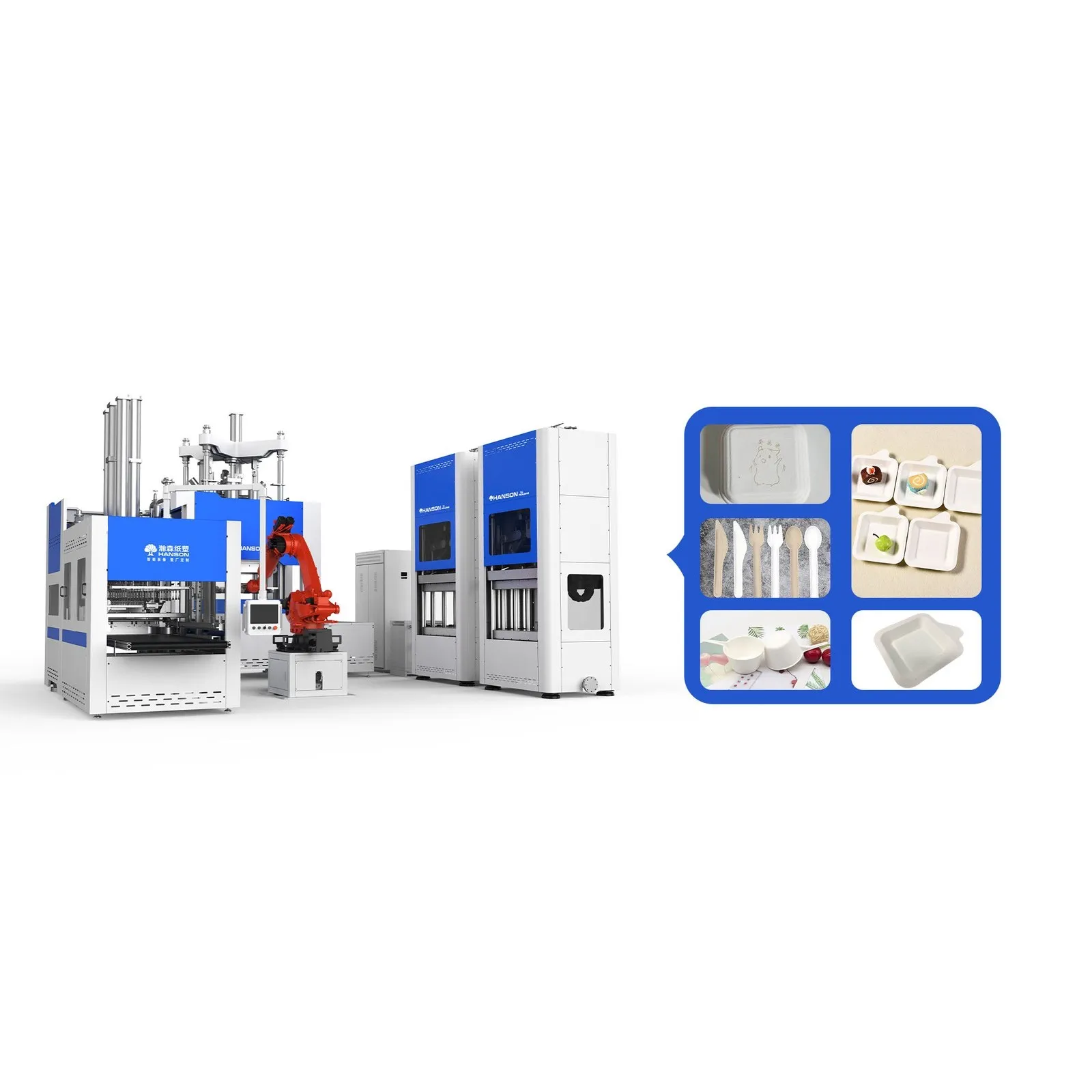
Features
Why Choose HANSON?
Our Own Mold Division, Design to Production
We run an independent mold division covering product development, mold design, manufacturing and testing. Because we build our own tooling, we control what decides your product range, how fast a new item reaches market, and how steadily you hold tolerances. We also optimize existing molds and retrofit equipment you already run, so a line that has lost its edge returns to spec without being replaced.
Complete Lines, Not Single Machines
Our portfolio covers tableware lines, industrial packaging equipment, cup lid lines and sampling lines, plus downstream automation for trimming, inspection, stacking and packing. Every station is engineered to the one after it, so the line reaches rated output instead of bottlenecking at the press or dryer. Start with one forming unit and expand into a full line as demand grows.
Turnkey Delivery With On-Site Support
We take a project from feasibility analysis and raw-material verification through layout, installation, commissioning and operator training. For turnkey projects we can place engineers on site and support ramp-up for up to six months — the period when most new plants either stabilize or stall. Ten service locations and 24/7 response keep that support running after warranty ends.
Proven at Scale, Certified for Regulated Markets
Our equipment runs in more than 20 markets, with roughly 150 units shipped a year and about half going to export customers across Europe, the Middle East, Southeast Asia and South America. Our forming equipment holds CE certification under the EU Machinery Directive, and 50 patents protect our structures, processes and automation systems. We serve listed companies, state-owned enterprises and leading packaging manufacturers.
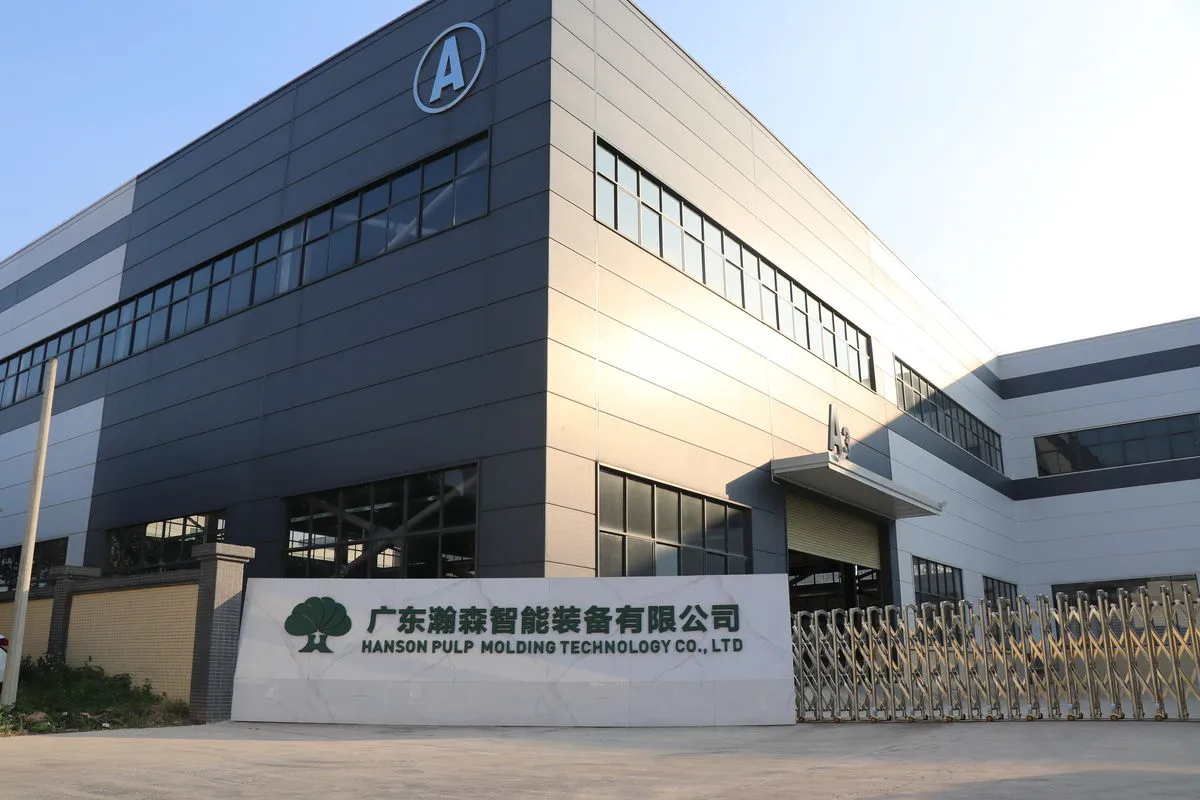
We Have The Best Solutions for Your Business
HANSON was founded in 2022 in Dongguan, Guangdong Province, China. Our 50,000 square meter facility employs more than 200 people, including a 50-engineer R&D team, and ships around 150 units a year to customers in more than 20 markets worldwide. We manufacture complete tableware production lines, premium industrial packaging equipment, plant-fiber cup lid lines and sampling lines, turning bagasse, bamboo fiber and recycled paper into tableware, egg trays, cup lids, cup carriers and protective packaging. What sets us apart is our independent mold division: with product development, mold design, manufacturing and testing all in house, we control the factor that decides how wide your product range goes and how reliably you hold tolerances. We deliver projects end to end, from feasibility analysis and factory layout to installation, commissioning and operator training, backed by 10 service locations and engineers who can stay on site through your ramp-up. Our equipment is CE certified and protected by 50 patents. Send us your product list and output target, and we will recommend the configuration that fits.
The short version
A cup carrier machine lives or dies on dimensional repeatability, because a two millimeter variation in cup well diameter turns a secure carrier into one that wobbles. Handle strength under a full six cup load is the second deciding factor. Because carriers sell at low unit value, cycle time and material use per piece matter more than on almost any other molded fiber product.
Product Design Rules for Cup Carriers
Start with the cups your market actually uses. Drink cup diameters vary by market and by chain, and a carrier designed around the wrong base diameter will either grip too tightly and crush the cup or sit loose and let it tilt. Measure the cups used by your target customers rather than working from a generic specification, and confirm whether those cups are tapered or straight walled, because the carrier has to hold both the base and the mid body.
Handle geometry is the second design decision. A carrier with a flat strap handle is cheap to make but concentrates stress at two points, so it tears when a customer carries six full cups across a parking lot. A rounded, wider handle distributes load and uses slightly more fiber but lasts. Ask for a load test protocol that specifies the number of cups, cup weight and the drop height a filled carrier must survive.
Stacking behavior decides your packaging and shipping cost. Carriers that nest deeply take less space in a carton, but too much nesting makes them hard for staff to separate during a rush. There is an optimum that most experienced tooling designers can hit after two or three trials, and it is worth spending those trials before mass production rather than after.
| Design factor | Why it decides success | Verification method |
| Cup well diameter | Controls grip and stability | Gauge every cavity across a full shift |
| Cup well taper | Matches real cup geometry | Test with the customer's actual cups |
| Handle width | Prevents tearing under load | Loaded carry and drop test |
| Wall thickness | Balances strength and material cost | Section cuts on trial samples |
How a Cup Carrier Machine Holds Tolerance at Volume
Dimensional repeatability in molded fiber comes from consistency in three places: slurry concentration, vacuum profile and press closure. If slurry concentration drifts, the fiber mat comes out heavier or lighter, and the pressed part shrinks or swells by a millimeter or two. That variation is invisible on a plate but fatal on a carrier, where a two millimeter change decides whether the cup sits firm or wobbles.
Vacuum profile consistency is the second lever. A forming mold that drains slightly unevenly produces a wall that is thick on one side, and when that part is pressed the thicker side pushes the cup well off center. The cure is a well designed mold plus a vacuum ramp that pulls evenly across the mold face, not a faster cycle.
Press closure tolerance comes third. Mechanical stops and parallelism on the pressing platens determine whether every cavity in a multi cavity mold gets the same thickness. Ask the supplier how parallelism is measured and what the specified tolerance is. A supplier who cannot answer that question has not built high precision carrier tooling before.
Material Choices for Cup Carriers
Recycled paper fiber is the standard furnish for cup carriers because the product does not need a bright appearance and the fiber is cheap. Old corrugated containers and mixed waste paper both work, though the mix ratio affects strength and drainage. Carriers made to support six full cups need a stronger furnish than two cup carriers, so fiber selection should follow the product, not the other way around.
Plant fibers such as bagasse or bamboo offer a marketing angle for chains promoting renewable materials, and they produce a stronger carrier at thinner walls. The tradeoff is a higher fiber cost and a slower forming cycle, which matters on a low value item. Run the numbers per thousand carriers before assuming a premium fiber is worth it.
Wet strength additives decide how the carrier behaves with condensation. A cold drink cup sweats, and a carrier that softens when wet will fail in a customer's hand. Specify a wet strength dose appropriate to your worst case and verify it with a loaded test after the carrier has been misted, not just when dry.
Sizing a Cup Carrier Machine for Real Demand
Cup carriers are a high volume, low margin product, which changes the sizing logic. Because the unit value is low, the machine must run fast and use as little material per piece as the design allows. That pushes buyers toward multi cavity molds and short cycles, but the shorter the cycle, the tighter the process window becomes, and the harder it is to hold the dimensional tolerance that carriers demand.
Model demand from order patterns rather than annual totals. Quick service chains order in large batches tied to seasonal promotions, and a plant sized for average demand will miss those peaks. Add capacity headroom for promotion season, or plan to run extra shifts during it. Ask for the sustained hourly output for a six cavity carrier mold, then discount it for realistic downtime before you promise delivery dates.
Material cost per thousand pieces is the number that decides whether the contract is profitable. Work it out from fiber price, wet strength additive, drying energy and rejection rate. A run with a five percent rejection rate eats margin faster than most buyers expect on a product this cheap, so process stability is not just a quality issue, it is the business model.
Tooling: Where Cup Carrier Projects Are Won
More cup carrier projects fail on tooling than on the machine. The carrier mold has to deliver consistent drainage across every cavity, hold exact well geometry through thermal cycling, and produce a handle that does not thin out at the corners. None of that is difficult in isolation; doing all three at once, repeatedly, is a tooling discipline rather than a machine feature.
Ask how many trial presses a new carrier mold receives before shipment and how the well diameter is verified. Request the dimensional report for a previously delivered carrier mold, not a specification sheet. A supplier willing to share real measurement data from a shipped mold is a supplier you can work with. The mold and tooling program shows how this development work is structured.
Plan for mold maintenance from the start. Carriers run at high cycle counts, so meshes wear, drainage holes partially block and well geometry drifts. A maintenance schedule with recorded measurements keeps carriers inside tolerance, and it is much cheaper than discovering drift through customer complaints.
Compliance and Market Requirements
Cup carriers touch food packaging, so they fall under food contact rules in most markets even though they are secondary packaging. European buyers expect compliance with framework regulation requirements for the base material, and recycled fiber grades need to be assessed for any substances that could migrate. North American quick service chains often ask for documentation of recycled content and may request compostability certification where the carrier will be collected with food waste.
Because cup carriers are usually printed or branded, plan the printing process early. Molded fiber surfaces accept flexographic and digital printing differently from paperboard, and a design that looks clean on a flat sheet may pick up texture on a pressed fiber surface. Print a trial batch before the artwork goes to a chain for approval.
For background on how drink packaging rules are shifting, the industry news pages track regulatory changes by market, and the technical blog covers molded fiber applications in more depth.
Commissioning and Process Control
Commissioning a cup carrier machine is about dialing in repeatability, not just getting parts out of the mold. Expect to spend the first weeks measuring rather than shipping. Take cup well diameters from every cavity across a full shift, record the readings, and identify which cavities drift first. That data tells you whether the variation comes from the mold, the vacuum system or the slurry, and it becomes the baseline for every maintenance decision afterward.
Operators should be trained to read the signs of drift before parts fail. A slightly heavier part, a slower drainage time or a marginally warmer platen reading all precede a dimensional problem by hours. Teaching the crew to notice those early signals turns quality control from inspection into prevention, and it is the difference between a plant that ships a hundred percent and one that sorts rejects at the end of the line. Our project services team builds this measurement routine into the commissioning plan.
Final Thoughts
A cup carrier machine is a tolerance business more than a capacity business. Get the cup well geometry right, prove the handle with a loaded test, hold slurry and vacuum consistency, and buy tooling from a supplier who will show you real measurement data. On a product this cheap, process stability is the entire margin, and buyers who treat it that way are the ones who keep their contracts.
Send us the cup diameters your customers use and the carrier configuration you need, and we will propose cavity count, cycle time and a tooling plan for a cup carrier machine.
Proposals include a dimensional control plan and a wet strength specification so the carrier performs in real service.
Discuss Your Carrier Specifications
Featured Products
Collection about HANSON




User Reviews
What users say about HANSON
Frequently Asked Question
Do you have any question?
Cup well diameter and depth. If the wells run loose, cups tilt and leak; if they run tight, staff struggle to seat the cup and the carrier tears. Holding that tolerance consistently across a full shift is the real test of the machine and the mold.
Recycled paper fiber is the common choice because it is inexpensive and gives adequate stiffness for the load. Some producers blend in plant fiber to improve wet strength, which matters when carriers sit under condensation for a long time.
Yes, by changing molds. A two-cup and a four-cup carrier are separate mold sets on the same machine, so the machine frame does not limit your product range. What limits it is how many molds you are prepared to buy.
Start from peak-hour demand at your busiest accounts rather than from average daily volume. Cup carriers are a peak-driven product, so a line sized on averages will run out of stock every weekend and every event day.