
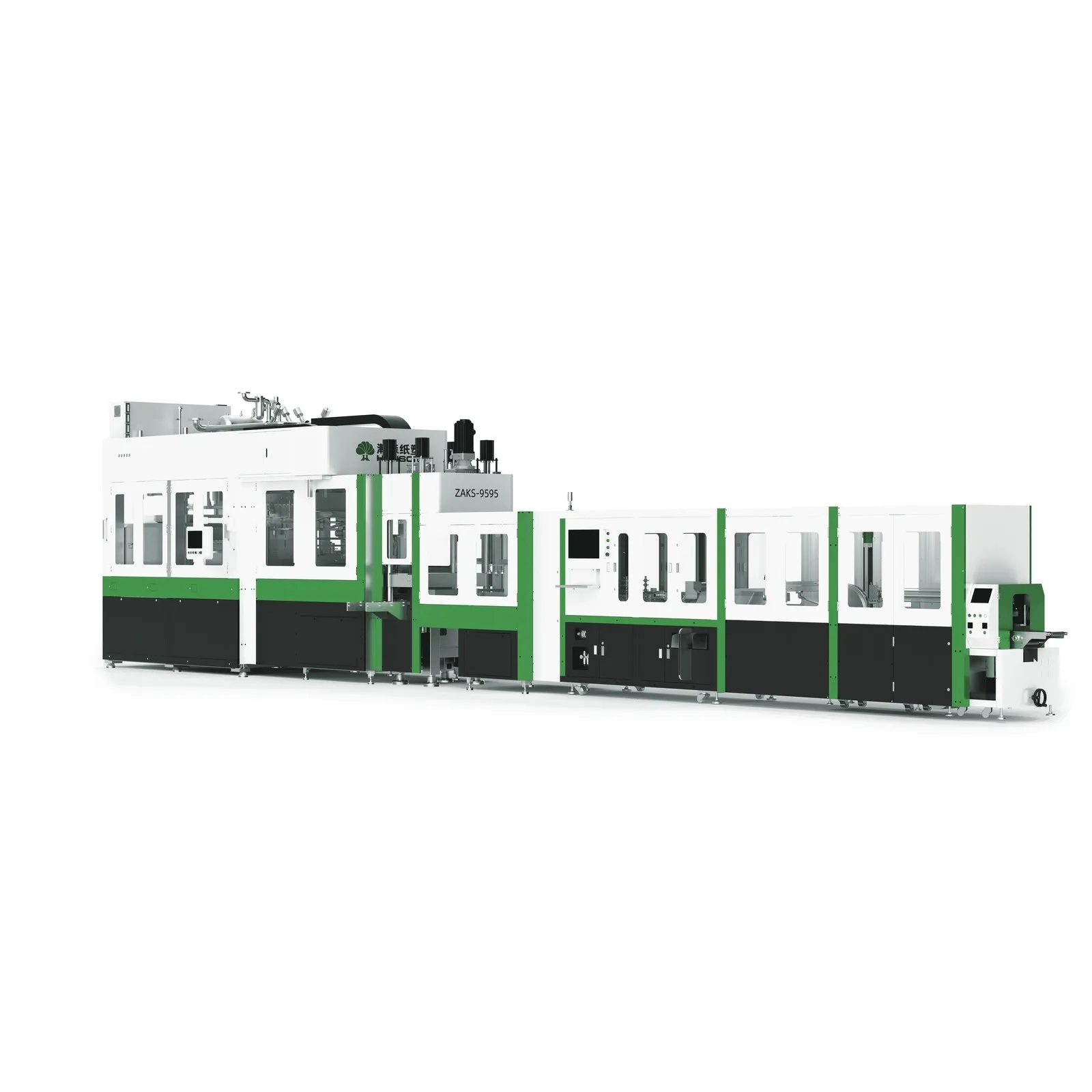
Features
Why Choose HANSON?
Our Own Mold Division, Design to Production
We run an independent mold division covering product development, mold design, manufacturing and testing. Because we build our own tooling, we control what decides your product range, how fast a new item reaches market, and how steadily you hold tolerances. We also optimize existing molds and retrofit equipment you already run, so a line that has lost its edge returns to spec without being replaced.
Complete Lines, Not Single Machines
Our portfolio covers tableware lines, industrial packaging equipment, cup lid lines and sampling lines, plus downstream automation for trimming, inspection, stacking and packing. Every station is engineered to the one after it, so the line reaches rated output instead of bottlenecking at the press or dryer. Start with one forming unit and expand into a full line as demand grows.
Turnkey Delivery With On-Site Support
We take a project from feasibility analysis and raw-material verification through layout, installation, commissioning and operator training. For turnkey projects we can place engineers on site and support ramp-up for up to six months — the period when most new plants either stabilize or stall. Ten service locations and 24/7 response keep that support running after warranty ends.
Proven at Scale, Certified for Regulated Markets
Our equipment runs in more than 20 markets, with roughly 150 units shipped a year and about half going to export customers across Europe, the Middle East, Southeast Asia and South America. Our forming equipment holds CE certification under the EU Machinery Directive, and 50 patents protect our structures, processes and automation systems. We serve listed companies, state-owned enterprises and leading packaging manufacturers.
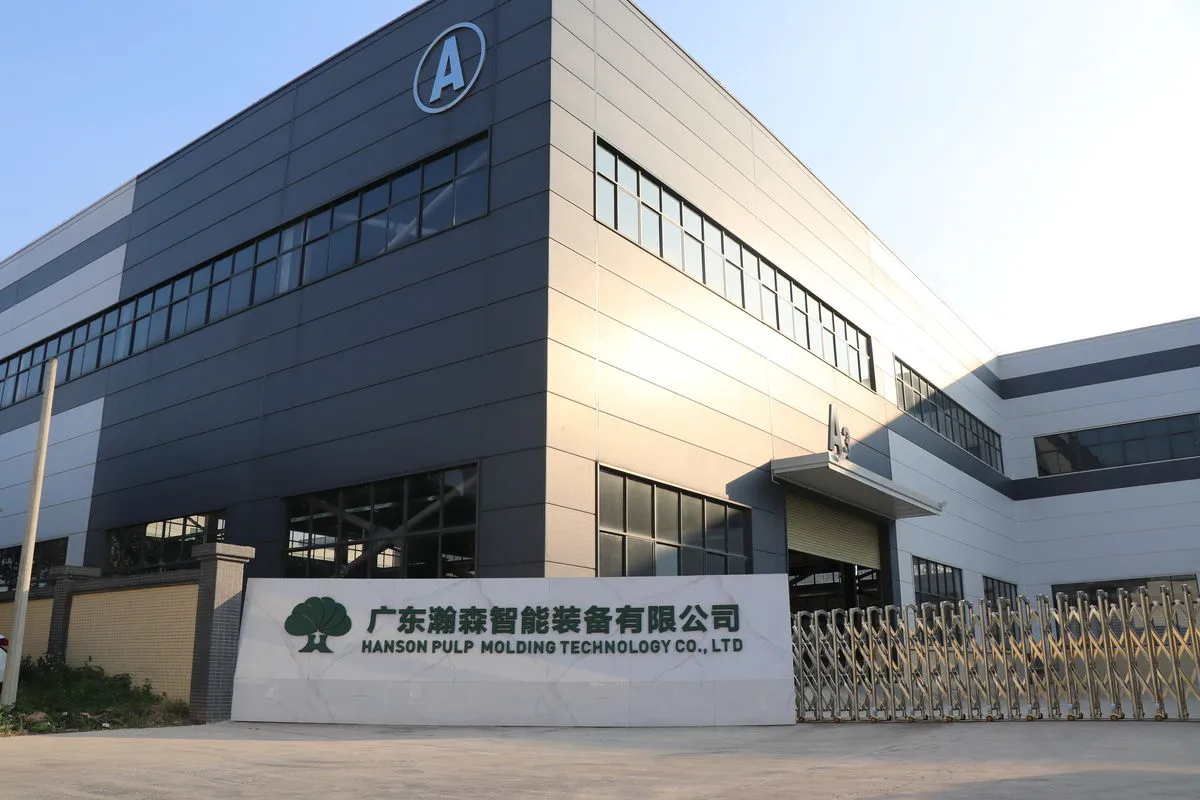
We Have The Best Solutions for Your Business
HANSON was founded in 2022 in Dongguan, Guangdong Province, China. Our 50,000 square meter facility employs more than 200 people, including a 50-engineer R&D team, and ships around 150 units a year to customers in more than 20 markets worldwide. We manufacture complete tableware production lines, premium industrial packaging equipment, plant-fiber cup lid lines and sampling lines, turning bagasse, bamboo fiber and recycled paper into tableware, egg trays, cup lids, cup carriers and protective packaging. What sets us apart is our independent mold division: with product development, mold design, manufacturing and testing all in house, we control the factor that decides how wide your product range goes and how reliably you hold tolerances. We deliver projects end to end, from feasibility analysis and factory layout to installation, commissioning and operator training, backed by 10 service locations and engineers who can stay on site through your ramp-up. Our equipment is CE certified and protected by 50 patents. Send us your product list and output target, and we will recommend the configuration that fits.
The short version
A molded fiber cup lid machine is a tolerance business. Rim geometry, wall density at the seal line and die cutting accuracy decide whether the lid seals. Vision inspection and automated packaging are not optional extras on a lid line; they are what keeps a high volume plant shipping without sorting by hand.
The Seal Is Everything on a Molded Fiber Cup Lid Machine
A lid works by pressing against the cup rim with enough force, distributed evenly around the circumference, to close the gap. That means three things have to be right: the cup rim diameter the lid is designed for, the lid's own inner geometry, and the flexibility of the fiber at the sealing ring. If any one of them is off, the lid either will not seat or seats with a gap that leaks.
Start by locking the cup specification. Paper cups from different suppliers vary in rim diameter and rim roll geometry even when they claim the same nominal size. A lid designed to a nominal dimension will fit some supplier's cups and leak on others. Measure the actual cups your customers use, across multiple production lots, and design the lid to the range rather than to a single sample.
The sealing ring itself needs density. Fiber that is pressed densely at the ring holds its shape and applies consistent pressure; fiber that is under-pressed relaxes over time and loses seal. This is why press temperature and dwell are quality critical parameters on a lid line, not throughput parameters to be trimmed when the schedule is tight.
| Seal variable | Failure if wrong | Control method |
| Lid inner diameter | Lid will not seat or sits loose | Gauge every cavity, every shift |
| Sealing ring density | Leaks under hot liquid | Press temperature and dwell recipe per mold |
| Rim flatness | Partial seal, drips at one point | Die cutting accuracy and mold parallelism |
| Wall thickness | Cracking when pressed onto rim | Fiber blend and forming consistency |
Stations in a Complete Cup Lid Line
A lid line is longer than a tableware line because lids need several finishing steps that plates do not. Forming and hot pressing come first, and the lid is pressed to near final dimension in the mold. Die cutting follows, trimming the flash and cutting any vent or straw hole to an exact position. Then inspection, and finally stacking and packaging.
Die cutting deserves particular attention. On a lid, the cut edge is a sealing surface, and a die that has worn or is misaligned produces a rim that seals on part of the circumference and leaks on the rest. Automated cutting with a hardened die and a defined replacement interval keeps the rim consistent; manual trimming does not survive high volume production.
Vent and straw holes add another tolerance. A hole in the wrong position blocks the drink opening of the cup; a hole that is undersized will not accept a straw. If your product includes these features, the tooling must cut them in the same operation as the rim trim so the relationship between hole and rim is fixed by the die rather than by handling.
Inspection and packaging close the line. Vision systems that check rim diameter, hole presence and surface defects catch drift before a carton ships, and automated stacking protects the rim from damage during handling. On a lid line running at very high piece rates, manual inspection cannot keep pace, and a plant that relies on it will ship defects.
Fiber and Process Choices for Cup Lids
Lids need a fiber blend that drains fast enough for short cycles but forms a dense, crack resistant sealing ring. Bagasse works well because its short fibers drain quickly and press densely, and it is bright enough to suit a consumer facing product. Bamboo gives higher strength and allows thinner walls, which helps if the lid has to be light, but it drains more slowly and needs a longer cycle.
Wet strength additive is essential for lids in a way it is not for plates. A lid sits on a hot drink and collects steam and condensation, and a lid that softens at the sealing ring loses its grip. Specify a dose appropriate to hot beverage service and verify it with a filled cup test held at serving temperature for a realistic period.
Coating decisions follow the market. Some buyers need a barrier coating for extended liquid contact, while others want an uncoated lid for compostability. This choice belongs in the design phase because it affects fiber preparation, pressing parameters and the compliance file, not a decision to make after tooling is cut.
Sizing a Molded Fiber Cup Lid Machine
Lid volumes are driven by cup volumes. Estimate the number of cups your target customers use annually, then work out how many lids they need through the year, accounting for the fact that lid use often exceeds cup use in some channels because lids are served on multiple sizes. Convert that into pieces per shift and compare against the sustained output of a candidate line at your lid diameter.
Lid diameter strongly affects cavity count and cycle time. A lid for a small coffee cup and a lid for a large soup bowl are different products with different tooling, and a machine quoted at a headline figure may deliver substantially less on the larger size. Ask for output figures per lid size rather than a single number.
Because lid lines include cutting and inspection stations, the whole line has to be balanced. A fast former feeding a slow cutter simply builds inventory. Work out the throughput of each station and confirm that the slowest one matches your target, because that station sets your real capacity.
Tooling Requirements for Lids
Lid tooling is a precision product. The forming mold controls the mat distribution at the sealing ring, the press mold controls density and flatness, and the cutting die controls the final rim. All three must be designed together, because a perfect forming mold paired with an inaccurate die still produces lids that leak.
Ask for dimensional data from a delivered lid mold. Inner diameter repeatability across cavities, rim flatness measurements and die cut concentricity tell you more than any specification sheet. A supplier who can show real data from a shipped tool understands what a lid line demands. The mold and tooling program explains how these precision tools are built and verified.
Plan a maintenance schedule around the die. Cutting edges wear, and a die that has drifted produces a rim that looks acceptable and leaks in service. Measure sample rims at fixed intervals and replace the die on a schedule rather than after complaints.
Compliance for Hot Drink Packaging
Cup lids contact hot liquids directly, so they face the strictest end of food contact regulation. European markets expect compliance with framework regulation requirements plus migration testing at the temperature the product will see in service, which for lids means testing hot rather than at ambient. North American buyers typically ask for documentation covering the base fiber, the additives and any coating.
If the lid carries a compostability claim, third party certification is required in most markets, and it must cover the coating system as well as the fiber. A coated lid that fails to disintegrate loses the claim entirely, so test the finished construction rather than the fiber alone.
Keep documentation of process parameters alongside certification. When a customer's quality team audits your plant, evidence that the process is stable underlies the certification's validity. Our project services team builds this record keeping into commissioning. Broader context on fiber lids appears on the industry news pages.
Training a Crew to Protect the Tolerance
A lid line is unforgiving of small process drifts, so operators must be trained to measure rather than to judge by eye. The checks that matter are lid inner diameter, rim flatness and sample fit onto the customer's actual cup. A fit test on a real cup with hot water is worth more than a stack of dimensional readings, and it should run at fixed intervals through every shift.
Teach the crew the early signs. A slightly heavier lid, a drain that runs a second slower, a press reading a few degrees low, or a cutter that sounds different: each precedes a sealing failure by hours. Catching a drift at the forming station costs a small adjustment; catching it after a carton ships costs a customer.
Record everything for the first months. Lid inner diameter by cavity, press temperature by shift, die cut date, sample fit results. Six months of that log turns any future problem into a comparison against a known baseline, and it becomes the evidence file for customer audits and certification renewals.
Final Thoughts
A molded fiber cup lid machine succeeds when the cup specification is locked first, the sealing ring is pressed densely, the die cuts accurately and the crew measures by the hour rather than by the day. Get those four things right and a lid line runs profitably at high volume. Miss any one and you will spend your time sorting rejects instead of shipping cartons.
Send us the cup rim dimensions you need to match and your expected annual volume, and we will propose a molded fiber cup lid machine configuration with cavity count, cycle time and a tooling plan.
Proposals include a dimensional control plan and a hot fill seal verification protocol.
Match a Lid to Your Cups
Featured Products
Collection about HANSON




User Reviews
What users say about HANSON
Frequently Asked Question
Do you have any question?
Because a lid that varies by a fraction of a millimeter will leak. Unlike an egg tray, where small variation is invisible, a lid either seals against the cup rim or it does not, so the machine has to hold that dimension on every part across every shift.
Forming, hot pressing for density and surface, die cutting to shape the rim, vision inspection to catch dimensional outliers, and packaging. Skipping inspection is common in low-cost builds and is usually the reason a line generates customer complaints.
Paper cups, soup bowls and takeaway containers, with the fit defined by the rim diameter and profile. Because rim standards vary between cup suppliers, buyers usually confirm the target cups and their rim dimensions before the lid mold is cut.
Control pulp consistency, press temperature and die condition as a set, and record them every shift. Lid quality drifts through those three variables long before it shows up in the finished product.