
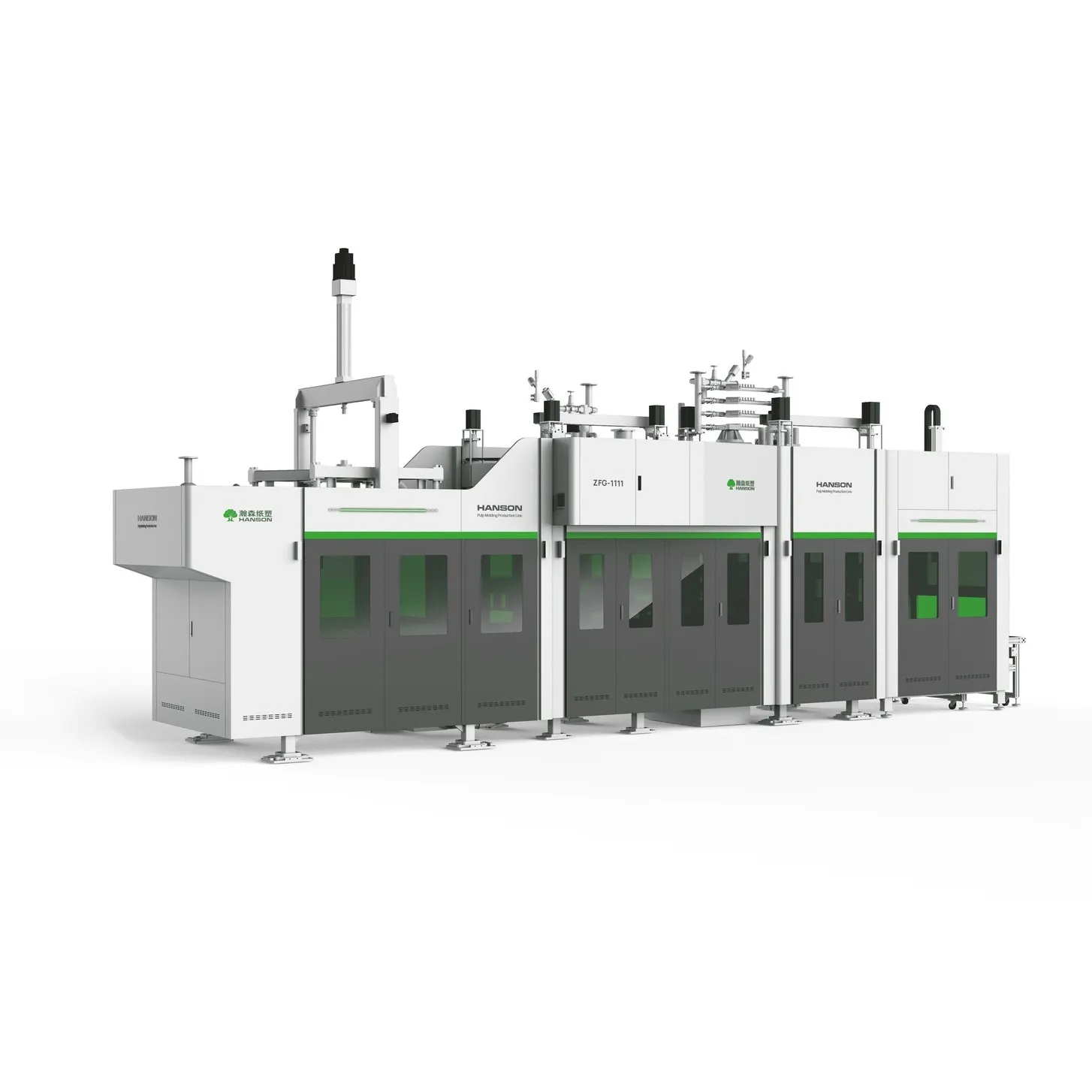
Features
Why Choose HANSON?
Our Own Mold Division, Design to Production
We run an independent mold division covering product development, mold design, manufacturing and testing. Because we build our own tooling, we control what decides your product range, how fast a new item reaches market, and how steadily you hold tolerances. We also optimize existing molds and retrofit equipment you already run, so a line that has lost its edge returns to spec without being replaced.
Complete Lines, Not Single Machines
Our portfolio covers tableware lines, industrial packaging equipment, cup lid lines and sampling lines, plus downstream automation for trimming, inspection, stacking and packing. Every station is engineered to the one after it, so the line reaches rated output instead of bottlenecking at the press or dryer. Start with one forming unit and expand into a full line as demand grows.
Turnkey Delivery With On-Site Support
We take a project from feasibility analysis and raw-material verification through layout, installation, commissioning and operator training. For turnkey projects we can place engineers on site and support ramp-up for up to six months — the period when most new plants either stabilize or stall. Ten service locations and 24/7 response keep that support running after warranty ends.
Proven at Scale, Certified for Regulated Markets
Our equipment runs in more than 20 markets, with roughly 150 units shipped a year and about half going to export customers across Europe, the Middle East, Southeast Asia and South America. Our forming equipment holds CE certification under the EU Machinery Directive, and 50 patents protect our structures, processes and automation systems. We serve listed companies, state-owned enterprises and leading packaging manufacturers.
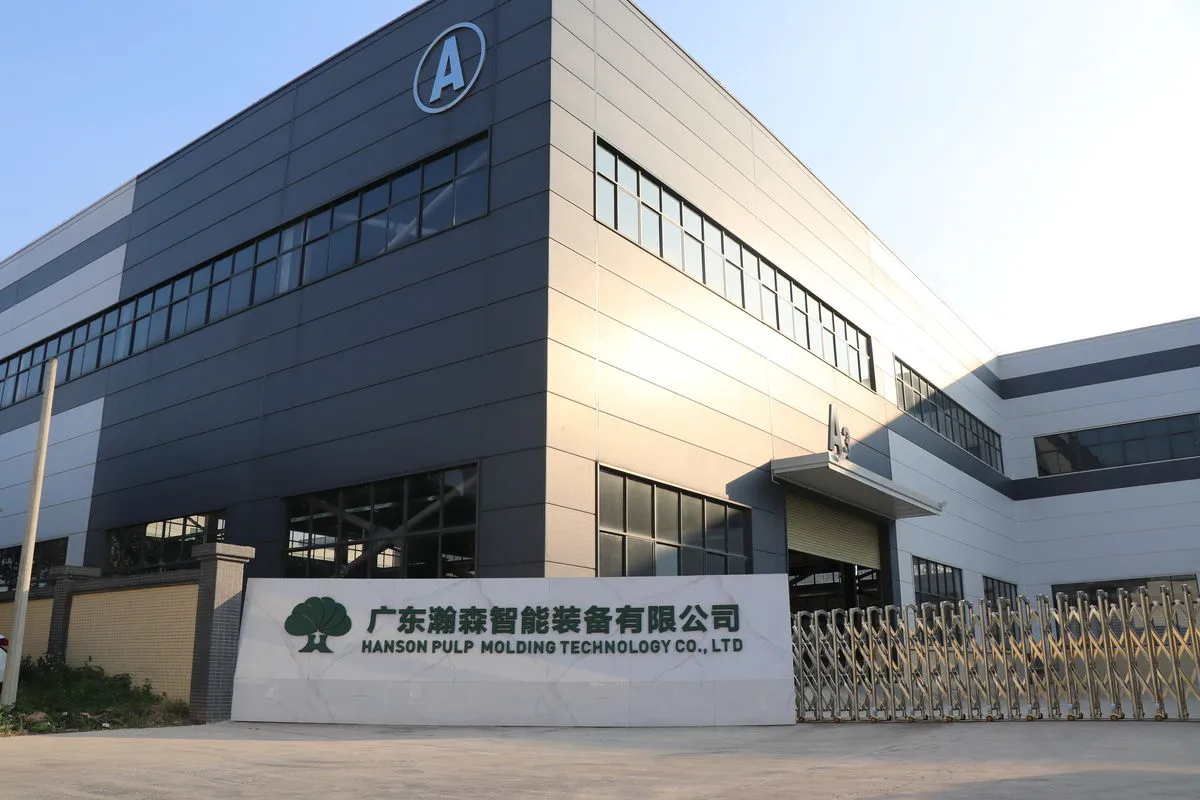
We Have The Best Solutions for Your Business
HANSON was founded in 2022 in Dongguan, Guangdong Province, China. Our 50,000 square meter facility employs more than 200 people, including a 50-engineer R&D team, and ships around 150 units a year to customers in more than 20 markets worldwide. We manufacture complete tableware production lines, premium industrial packaging equipment, plant-fiber cup lid lines and sampling lines, turning bagasse, bamboo fiber and recycled paper into tableware, egg trays, cup lids, cup carriers and protective packaging. What sets us apart is our independent mold division: with product development, mold design, manufacturing and testing all in house, we control the factor that decides how wide your product range goes and how reliably you hold tolerances. We deliver projects end to end, from feasibility analysis and factory layout to installation, commissioning and operator training, backed by 10 service locations and engineers who can stay on site through your ramp-up. Our equipment is CE certified and protected by 50 patents. Send us your product list and output target, and we will recommend the configuration that fits.
The short version
A bagasse tableware machine is a four stage system: pulping, forming, hot pressing and trimming. Output depends on cavity count and product depth, not on the brochure figure. Bagasse drains fast and holds stiffness, which is why it dominates food service tableware. Mold set depth decides your real product range.
How a Bagasse Tableware Machine Turns Fiber Into Plates
The process begins in the pulper, where baled or wet bagasse is broken down in water with a controlled dose of additives. The refiner then adjusts freeness, which is the measure of how quickly water drains through the fiber mat. Bagasse arrives at your plant already partly beaten by the sugar mill, so the refining load is lighter than what waste paper demands, but that advantage disappears if operators over-refine and cut the already short fibers into fines that wash straight through the forming mesh.
Forming comes next. The mold dips into the slurry tank, vacuum pulls water through the mesh and deposits a fiber layer on the mold surface. Because bagasse deposits quickly, the suction window is short and the vacuum profile has to be tuned carefully. A forming mold that drains unevenly produces one thick side and one thin side, and no amount of pressing later will hide it.
Hot pressing is where the product gets its character. The formed part moves to a heated mold that squeezes remaining water out and densifies the fiber walls. Temperature and dwell time determine surface smoothness, stiffness and how well the part resists hot food and sauce. Under-heated platens leave visible press marks on the naturally bright bagasse surface, which is a defect you cannot fix downstream.
Trimming finishes the job. A die cuts the rim to final shape and separates the part from the flash. On a bagasse tableware machine the trimming station also determines how clean the stacking edge is, and a ragged edge shows up immediately when a restaurant stacks plates in a dispenser.
Why Bagasse Is the Default Fiber for Molded Tableware
Three properties make bagasse the fiber most buyers specify. It is bright without bleaching, it holds stiffness at thin wall thickness, and it is available in enormous volume wherever sugar is refined. A bright furnish means less chemical load and a shorter, cheaper finishing path. Stiffness at thin walls means less material per piece, which reduces both fiber consumption and drying energy. Volume means supply stability, which matters more than price when you are committing to a multi-year contract with a retail chain.
| Fiber property | Effect on the bagasse tableware machine | What to control |
| Short fiber length | Fast drainage, short forming cycle | Avoid over-refining; monitor freeness daily |
| Natural brightness | Less bleaching and finishing work | Source control; keep fiber covered and dry |
| High stiffness | Thinner walls, lower material use | Press temperature and dwell consistency |
| Seasonal moisture | Varying slurry concentration | Moisture spec with supplier; closed loop water |
Sections of a Complete Bagasse Tableware Machine Line
Pulping and refining
The pulper, refiner and slurry tank set the ceiling for everything downstream. Size the pulper for your peak demand plus a margin, because running a pulper flat out during the busy season leaves you no room when a fiber delivery arrives wetter than specification.
Forming
Forming stations multiply output by running more molds in parallel. This is the section where buyers decide between a single head machine for a niche product and a multi head configuration for commodity tableware at volume.
Hot pressing and drying
The press defines surface quality and the dryer defines daily throughput. These two must be matched, because a fast dryer feeding a slow press simply builds work in progress that then sits and reabsorbs humidity.
Trimming and stacking
Trimming and automatic stacking reduce labor per shift and cut handling damage. For tableware headed to retail packaging, automated stacking is not a luxury; it is the difference between a sellable box and a pile of chipped rims.
Sizing a Bagasse Tableware Machine Against Your Order Book
The most expensive mistake in this industry is buying capacity before demand. A bagasse tableware machine is quoted with an output figure, and that figure comes from a specific product run at a specific cycle time. Deep bowls, compartment trays and ribbed clamshells all pull the cycle in different directions. If your product mix is heavier than the one used for the quote, your real output will sit well below the number on the offer sheet.
Work backwards instead. Start with annual demand, convert it into pieces per shift, add an allowance for mold changes and ramp-up, then compare that against what each candidate line sustains over a full shift rather than a demo run. Build your delivery commitments at a conservative share of that number. The gap between the sustained figure and the demo figure is where plants get into trouble during their own peak season.
Leave room for growth in the layout. Most buyers who succeed with a first line order a second within a few years, and the cheapest expansion is always the one you planned for: floor space, power capacity, water treatment headroom and pulper volume. Studying real plant layouts before civil work starts is far cheaper than moving a wall later.
Molds Decide Your Product Range
A bagasse tableware machine is only as flexible as its mold library. The machine frame stays the same whether you run round plates or three compartment trays, but the tooling determines drainage balance, pressing profile and stacking geometry. Buy molds in generations: prove three best sellers first, learn what your market actually reorders, then expand the library. This staged approach keeps cash under control and gives operators time to master changeovers before the range grows.
Review the tooling workshop and the design process before you sign. Ask how many trial presses a new mold gets before shipment and who owns the drawing. The engineering behind mold and tooling development is worth inspecting in person, because a mold problem discovered after arrival costs you weeks of production and a shipment of rework.
Food Contact Compliance You Must Plan For
Bagasse tableware is food contact material, so compliance is a product question that the machine must support. European markets expect materials to meet framework regulation requirements and standard migration test protocols. North American buyers increasingly ask for compostability certification before they will list a compostable claim. None of these certify the machine itself, but the machine must run a stable, documented process so your samples pass on the first submission rather than the third.
Ask any supplier for a compliance history: which customer plants passed which audits, and what process data accompanied the samples. A controller that logs batch parameters makes those submissions routine. Background on fiber tableware applications is available through the industry news pages and the technical blog.
Cost Structure Beyond the Machine Price
Buyers focus on the machine invoice, but the recurring cost sits elsewhere. Fiber, energy for drying and pressing, mold replacement, additives and labor per shift dominate lifetime spending. Drying is usually the largest energy item, which is why a well insulated dryer and a press that extracts water efficiently pay for themselves quietly over the first years of operation.
Mold life is the second surprise. A mold set that lasts through a long production campaign is cheaper than one that needs frequent replacement, even at a higher purchase price. Ask for the expected cycle count and the material specification of the forming mesh. When comparing offers, request a utility consumption table alongside the machine specification so you can model your running cost honestly.
Commissioning and Operator Training
A bagasse tableware machine reaches its rated performance only after the crew understands freeness control, vacuum tuning and press temperature management. Plan for a commissioning period measured in weeks, not days, and send your future line supervisor to the supplier for training before the machine ships. Plants that treat lead time as preparation time always start smoother than those that improvise under delivery pressure.
Set up a batch log from day one. Recording slurry concentration, freeness, vacuum profile, press temperature and rejection rate for every run turns troubleshooting from guesswork into comparison. Six months of good logs will teach you more about your own plant than any manual, and they become your evidence file when a customer audit arrives. Our project services team builds this logging discipline into the commissioning schedule.
How This Fits a Larger Tableware Plant
A single bagasse tableware machine is often the first step into a broader tableware business. As volume grows, buyers add forming heads, expand the dryer and eventually move toward an integrated line that handles plate and bowl production in one flow. Understanding where your first machine sits on that path prevents the classic mistake of buying a configuration that cannot be expanded without replacing the frame.
Ask the supplier to show you the growth path for the model you are considering: which stations can be duplicated, which need replacement, and what the utility demand looks like at each stage. A supplier who can draw that path clearly has built these plants before. Explore the broader equipment range through the tableware machinery collection to see how the configurations differ.
Final Thoughts
A bagasse tableware machine succeeds when three things line up: a stable fiber supply with a written moisture specification, a machine sized against your real product mix rather than a demo figure, and a tooling partner who will keep building molds as your range grows. Get those right and the rest is execution discipline. Get any one of them wrong and no amount of capacity will rescue the project.
Send us your product list, target markets and annual volume, and we will return a configuration proposal for a bagasse tableware machine with fiber consumption and utility figures attached.
Every proposal includes the pulping recipe, mold plan and commissioning schedule so you can compare suppliers on the same basis.
Request a Bagasse Line Configuration
Featured Products
Collection about HANSON




User Reviews
What users say about HANSON
Frequently Asked Question
Do you have any question?
Standard output covers plates, bowls, compartment trays, clamshells and takeaway containers. The exact range depends on your mold set rather than on the machine, so most buyers plan the mold package around the products their customers already order.
Bagasse is a by-product of sugar production, so it is available in large and consistent volumes at low cost, and it needs no extra agricultural land. Its relatively long fiber also gives good stiffness, which matters for plates and bowls that have to hold a loaded meal without flexing.
Yes. Because bagasse pulp carries a high water load after forming, the drying stage has to be sized to the throughput you want, not copied from a smaller line. Under-sized drying is the most common reason a new bagasse line fails to reach its rated output.
Bagasse fiber itself is suitable for food contact when the pulp is clean and the process is controlled. Buyers should ask the supplier for the material documentation and finished-product test reports their target market requires, and confirm the line can run the approved furnish without changes.