
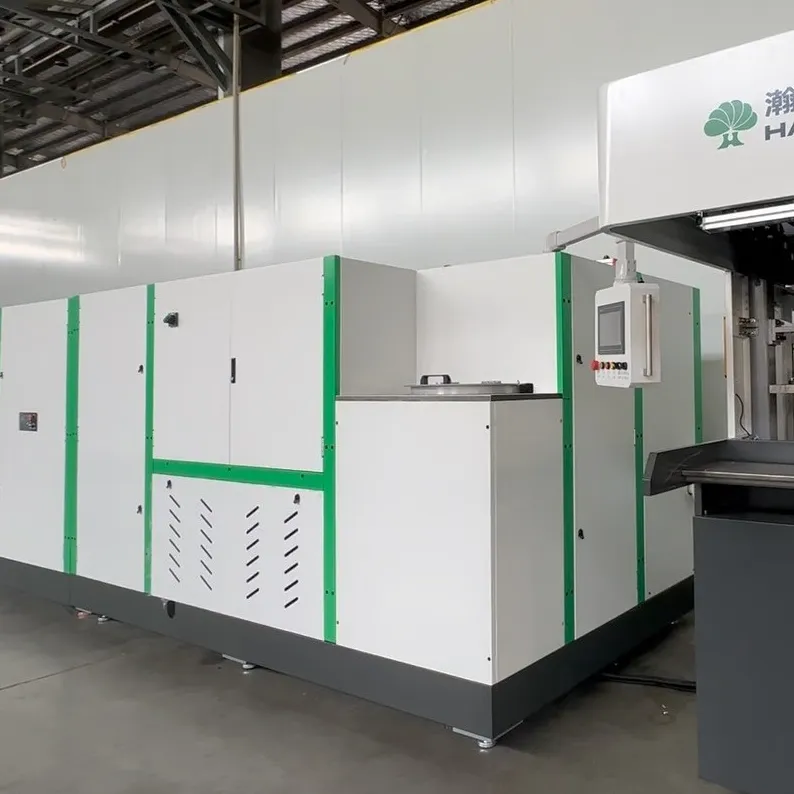
Features
Why Choose HANSON?
Our Own Mold Division, Design to Production
We run an independent mold division covering product development, mold design, manufacturing and testing. Because we build our own tooling, we control what decides your product range, how fast a new item reaches market, and how steadily you hold tolerances. We also optimize existing molds and retrofit equipment you already run, so a line that has lost its edge returns to spec without being replaced.
Complete Lines, Not Single Machines
Our portfolio covers tableware lines, industrial packaging equipment, cup lid lines and sampling lines, plus downstream automation for trimming, inspection, stacking and packing. Every station is engineered to the one after it, so the line reaches rated output instead of bottlenecking at the press or dryer. Start with one forming unit and expand into a full line as demand grows.
Turnkey Delivery With On-Site Support
We take a project from feasibility analysis and raw-material verification through layout, installation, commissioning and operator training. For turnkey projects we can place engineers on site and support ramp-up for up to six months — the period when most new plants either stabilize or stall. Ten service locations and 24/7 response keep that support running after warranty ends.
Proven at Scale, Certified for Regulated Markets
Our equipment runs in more than 20 markets, with roughly 150 units shipped a year and about half going to export customers across Europe, the Middle East, Southeast Asia and South America. Our forming equipment holds CE certification under the EU Machinery Directive, and 50 patents protect our structures, processes and automation systems. We serve listed companies, state-owned enterprises and leading packaging manufacturers.
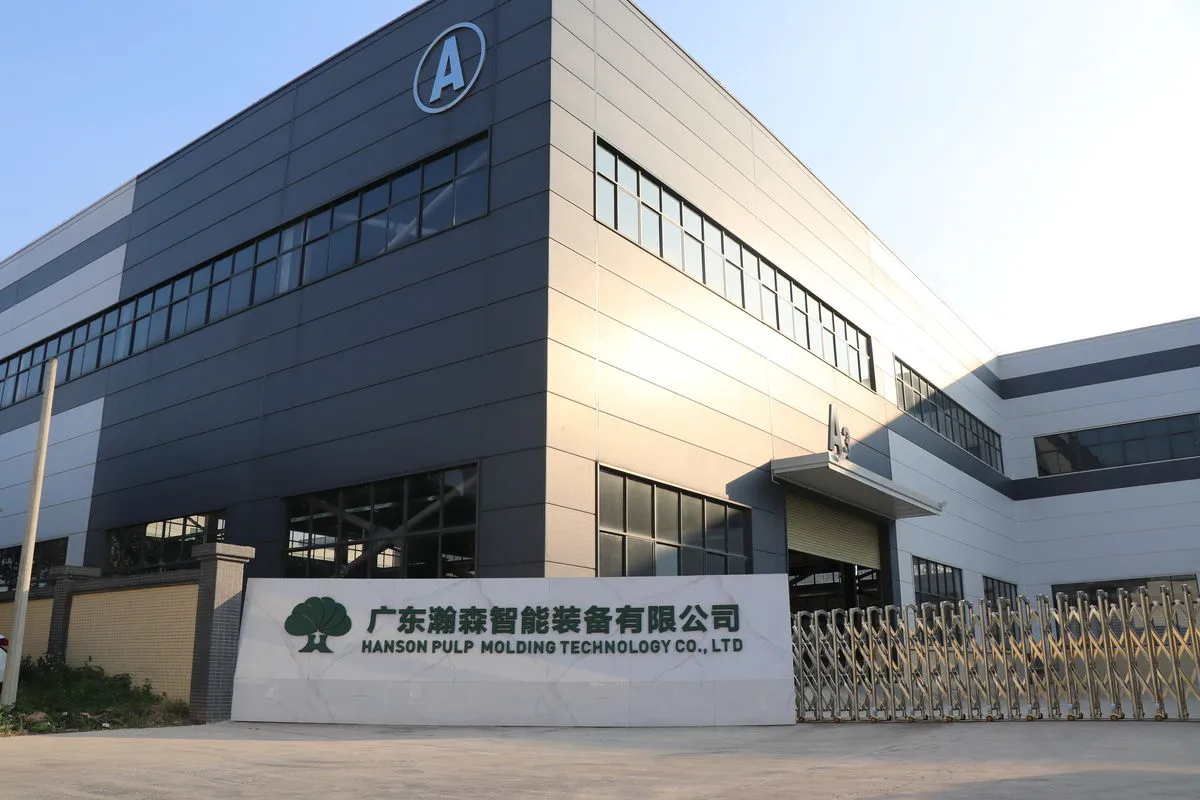
We Have The Best Solutions for Your Business
HANSON was founded in 2022 in Dongguan, Guangdong Province, China. Our 50,000 square meter facility employs more than 200 people, including a 50-engineer R&D team, and ships around 150 units a year to customers in more than 20 markets worldwide. We manufacture complete tableware production lines, premium industrial packaging equipment, plant-fiber cup lid lines and sampling lines, turning bagasse, bamboo fiber and recycled paper into tableware, egg trays, cup lids, cup carriers and protective packaging. What sets us apart is our independent mold division: with product development, mold design, manufacturing and testing all in house, we control the factor that decides how wide your product range goes and how reliably you hold tolerances. We deliver projects end to end, from feasibility analysis and factory layout to installation, commissioning and operator training, backed by 10 service locations and engineers who can stay on site through your ramp-up. Our equipment is CE certified and protected by 50 patents. Send us your product list and output target, and we will recommend the configuration that fits.
The short version
A pulp molding production line is a balanced chain in which the slowest station sets the output. Drying is usually the bottleneck. Layout, utility capacity and mold changeover speed determine real capacity as much as the forming cycle does. Design the line for the products you will run in year three, not just year one.
How a Pulp Molding Production Line Is Built Station by Station
A pulp molding production line begins with stock preparation. Bales are broken in a pulper with water and additives, then transferred to a refiner that adjusts fiber length and freeness, and finally held in a chest at controlled concentration. Automation here is usually limited to dosing and level control, but accuracy at this stage propagates through everything downstream, because a slurry that varies in concentration produces parts that vary in weight and dimension.
Forming follows. In a rotary arrangement, molds travel around a drum and dip into the slurry tank in sequence, building mats continuously rather than in batches. In a reciprocating arrangement the mold moves back and forth between the tank and the transfer point. Rotary arrangements generally achieve higher output per unit of floor space; reciprocating arrangements are often simpler to maintain and easier to reconfigure.
Hot pressing densifies the part and removes water mechanically. On a thick wall line the press is integrated directly after forming, while on a transfer line the part is partially dried before pressing. The press determines surface finish, stiffness and wall density, and it consumes a meaningful share of the line's thermal energy.
Drying removes the remaining moisture. Whether the dryer is a multi pass tunnel, a conveyor oven or a chamber system, it is usually the largest energy consumer and frequently the capacity constraint. Trimming and finishing stations follow, and on some lines they include printing, coating and vision inspection before automatic stacking and packing.
| Station | Typical bottleneck risk | Planning note |
| Pulping and refining | Low, unless fiber quality varies | Size for peak demand, not average |
| Forming | Medium; depends on product depth | Cavity count follows product range |
| Hot pressing | High on thick wall products | Match press dwell to product, not to former speed |
| Drying | Usually the true capacity limit | Size for the wettest, thickest product |
| Trimming and finishing | Labor dependent if manual | Automate where volume is high |
Line Balancing: The Calculation That Decides Everything
Line balance means every station can process what the station before it produces without accumulating work in progress. Calculate the throughput of each station for your specific product: pieces per hour at the forming stage, pieces per hour the press can cycle, pieces per hour the dryer can complete, pieces per hour trimming and packing can handle. The lowest number is your line capacity, regardless of any other figure.
Work in progress is the visible symptom of imbalance. If parts pile up between the press and the dryer, the dryer is the constraint. If they pile up before trimming, trimming is the constraint. Walking the line and finding where inventory accumulates tells you more about capacity than any specification sheet, and it is the first thing to check when output falls short of expectation.
Design for the product that stresses the line most. A line balanced around a shallow plate will fall short on a deep bowl that requires a longer press dwell and dryer residence time. If your product range is wide, model the line against the worst case in the range rather than the average, or accept that your capacity varies by product and plan sales accordingly.
Layout and Utility Planning
Layout follows process flow. Material should move forward through the line without backtracking, and service access should be available on both sides of every station. A layout that forces operators to walk around equipment to reach a control panel costs time on every shift and makes troubleshooting harder.
Utility planning is where cheap decisions become expensive. Power capacity, water supply, drainage, compressed air and ventilation all need headroom for expansion. Sizing electrical distribution for the starting configuration and then adding a second forming unit later usually means replacing switchgear and cable trays. Size for the expansion you expect, not the configuration you are buying.
Water treatment deserves early attention. A molded fiber line recirculates process water and discharges a portion, and the treatment capacity determines how much you can recirculate without quality problems. Closed loop operation reduces fresh water consumption and discharge volume, but it requires clarification and balancing equipment that has to be designed into the layout rather than added afterward.
Leave floor space for molds and tooling. A mold store, a maintenance area and space to stage a mold change all reduce changeover time. Plants that treat those areas as wasted floor space pay for it during every product change.
Changeover and Flexibility
Changeover time determines how many different products a line can economically run. A machine that takes a full shift to change a mold suits long production campaigns. A machine designed for fast changeover can serve several customers with different products in the same week, which is often the difference between winning and losing flexible packaging contracts.
Ask the supplier to describe a changeover step by step and to state the time it takes. The answer should cover mold removal, installation, alignment, process recipe recall and first article verification. If the answer includes an experienced operator's intuition rather than a documented procedure, your changeover time will vary with whoever is on shift.
Stored process recipes are a genuine efficiency feature. A line that recalls vacuum profile, press temperature and cycle time for each mold reduces first article trials from an hour to minutes, and it makes quality independent of which operator is working. When comparing machines, ask how many recipes can be stored and how they are recalled.
Automation and Staffing Across the Line
Staffing follows automation, and automation follows volume. On a high volume thin margin product such as an egg tray, automated transfer, stacking and packaging remove labor that would otherwise consume the entire margin. On a low volume specialized product, manual handling is more flexible and cheaper to run.
Plan the control room as part of the line. A line with centralized monitoring, alarm history and data logging needs fewer people walking the floor and diagnoses problems faster. Remote diagnostic capability lets the supplier review operating data without travel, which shortens troubleshooting from days to hours. Our project services team integrates this monitoring into commissioning.
Train across stations rather than in silos. Operators who understand the whole line make better decisions about when to adjust and when to call for help, and the plant gains flexibility in shift planning.
Commissioning and Ramp Up
Commissioning a production line means establishing a stable process at every station, then balancing them against each other. Expect the sequence to run through process trials at each station, first article verification for each mold, then progressive speed increases until the line balance point is reached. Rushing to full speed leaves quality problems embedded in every station.
Record every parameter and every first article measurement. The data becomes your baseline for maintenance, your evidence file for customer audits and your reference when a new mold is introduced. Plants that skip this step spend their first year solving the same problems twice. The factory overview shows how lines are assembled and tested before shipment, which is where much of this data originates.
Commissioning Sequence for a Pulp Molding Production Line
A pulp molding production line should be commissioned station by station, not all at once. Prepare the stock system first and confirm that slurry concentration and freeness hold steady across several hours of running. Then bring the forming station up on a single mold and produce parts until wall distribution is consistent across the mold face. Only then add the press and tune its recipe against parts from a stable forming process.
The dryer comes next, and it is where the schedule usually slips. Residence time has to be set for the wettest part the line will run, not for the part currently in production, or the first thick product will force a recalculation after installation. Set trimming and packing last, once parts arriving at those stations are consistently within tolerance.
Only after every station runs independently should speed be increased toward the balance point. Raising the former speed before the dryer is verified simply moves the bottleneck downstream and creates work in progress that then sits and reabsorbs moisture. Discipline at this stage saves months of confused troubleshooting later, and it is the single most reliable predictor of how quickly a pulp molding production line reaches stable output.
Final Thoughts
A pulp molding production line works when it is balanced. Calculate throughput at every station, find the constraint, and design the layout and utilities for the expansion you expect rather than the configuration you are buying today. Treat changeover speed and process documentation as capacity features, because on a line that runs several products they matter as much as the forming cycle.
Give us your product range and target output, and we will prepare a pulp molding production line layout with a station by station capacity balance and utility schedule.
Layouts include an expansion stage so you can plan capital in phases without rebuilding the utilities.
Request a Line Layout Proposal
Featured Products
Collection about HANSON




User Reviews
What users say about HANSON
Frequently Asked Question
Do you have any question?
The slowest station. A line is a system, so a fast former feeding an under-sized dryer produces a bottleneck rather than extra output. Line balancing is the calculation that should drive the whole configuration.
Enough to change product without a full rebuild. Quick mold change, adjustable press settings and a drying profile that can be tuned are what let one line serve several products across a year rather than committing you to a single item.
Mechanical completion, utility checks, dry runs, mold trials, process optimization on your fiber, operator training and a performance test against the agreed output. The performance test is the point at which the line is formally accepted.
Under-sized drying, unoptimized process settings, operator inexperience in the first months and product changes that were not planned for. Each is avoidable if it is considered at the specification stage rather than after installation.