
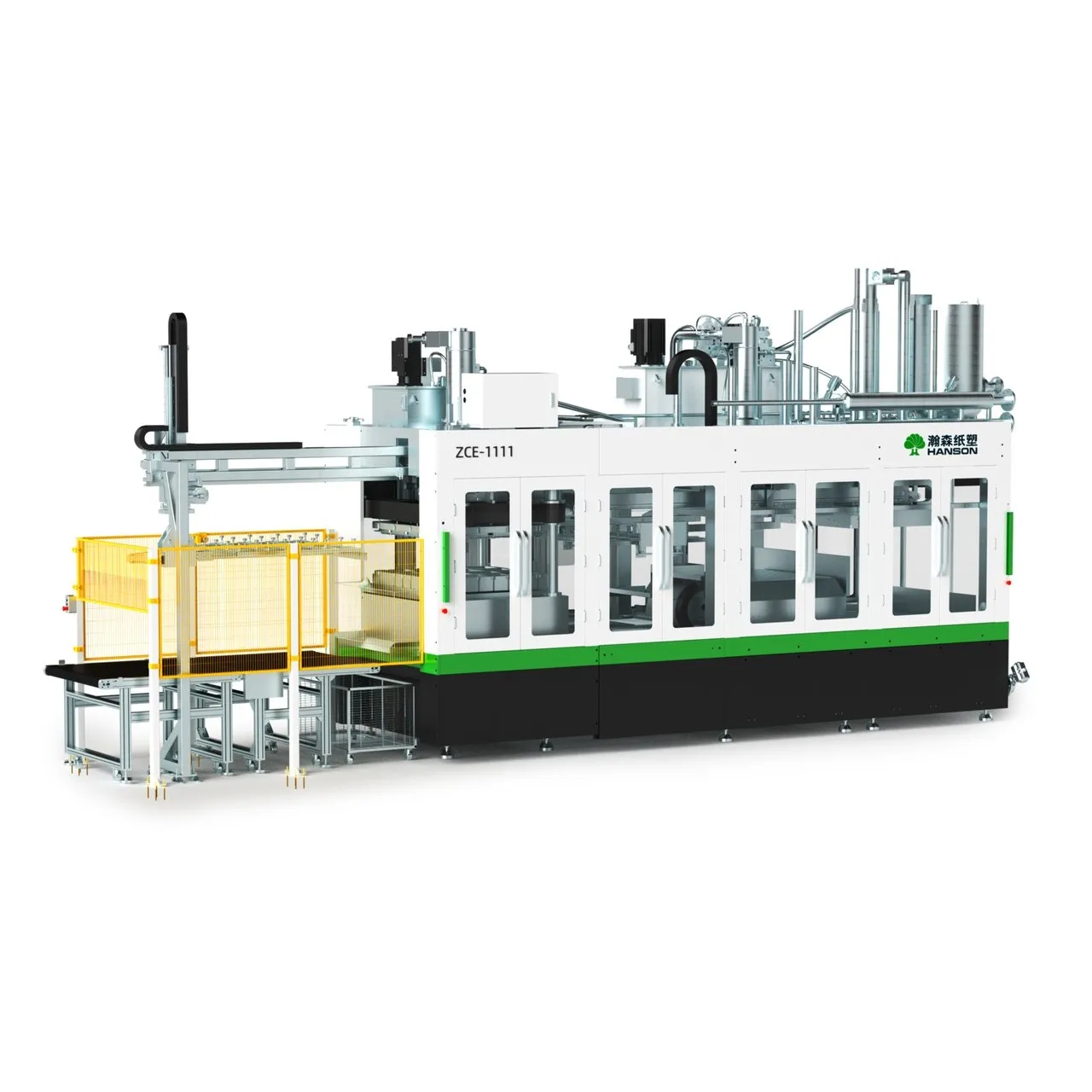
Features
Why Choose HANSON?
Our Own Mold Division, Design to Production
We run an independent mold division covering product development, mold design, manufacturing and testing. Because we build our own tooling, we control what decides your product range, how fast a new item reaches market, and how steadily you hold tolerances. We also optimize existing molds and retrofit equipment you already run, so a line that has lost its edge returns to spec without being replaced.
Complete Lines, Not Single Machines
Our portfolio covers tableware lines, industrial packaging equipment, cup lid lines and sampling lines, plus downstream automation for trimming, inspection, stacking and packing. Every station is engineered to the one after it, so the line reaches rated output instead of bottlenecking at the press or dryer. Start with one forming unit and expand into a full line as demand grows.
Turnkey Delivery With On-Site Support
We take a project from feasibility analysis and raw-material verification through layout, installation, commissioning and operator training. For turnkey projects we can place engineers on site and support ramp-up for up to six months — the period when most new plants either stabilize or stall. Ten service locations and 24/7 response keep that support running after warranty ends.
Proven at Scale, Certified for Regulated Markets
Our equipment runs in more than 20 markets, with roughly 150 units shipped a year and about half going to export customers across Europe, the Middle East, Southeast Asia and South America. Our forming equipment holds CE certification under the EU Machinery Directive, and 50 patents protect our structures, processes and automation systems. We serve listed companies, state-owned enterprises and leading packaging manufacturers.
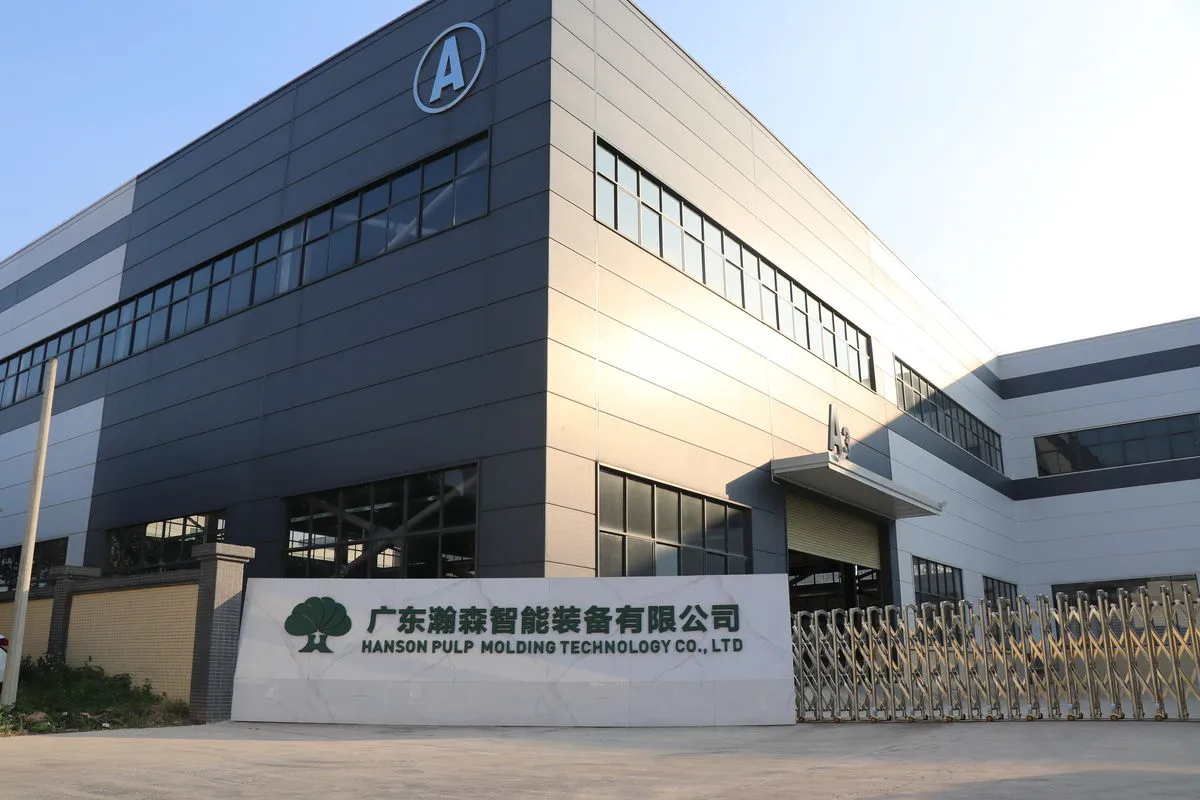
We Have The Best Solutions for Your Business
HANSON was founded in 2022 in Dongguan, Guangdong Province, China. Our 50,000 square meter facility employs more than 200 people, including a 50-engineer R&D team, and ships around 150 units a year to customers in more than 20 markets worldwide. We manufacture complete tableware production lines, premium industrial packaging equipment, plant-fiber cup lid lines and sampling lines, turning bagasse, bamboo fiber and recycled paper into tableware, egg trays, cup lids, cup carriers and protective packaging. What sets us apart is our independent mold division: with product development, mold design, manufacturing and testing all in house, we control the factor that decides how wide your product range goes and how reliably you hold tolerances. We deliver projects end to end, from feasibility analysis and factory layout to installation, commissioning and operator training, backed by 10 service locations and engineers who can stay on site through your ramp-up. Our equipment is CE certified and protected by 50 patents. Send us your product list and output target, and we will recommend the configuration that fits.
The short version
An egg tray machine produces thirty cell trays at very high volume and very low unit value, so fiber consumption and cycle time decide the margin. Shallow cells drain fast, which keeps cycles short. Stacking strength and cell depth are the two quality points buyers test before they place a repeat order.
Where Egg Trays Fit in the Poultry Operation
Egg trays are bulk packaging. They carry thirty eggs from the grading line to the cold room, into a shipping case, onto a pallet and eventually to a wholesaler or a breaking plant. Because they are rarely seen by a consumer, they carry no branding and no premium claim. That simple fact drives everything about the product: minimum material, minimum cost, enough strength to survive stacking and enough cell depth to prevent shell contact between adjacent eggs.
A tray differs from a retail carton in several important ways. There is no lid, so there is no hinge or closure to design. Cells are shallower and more closely spaced, which shortens drainage time and speeds the forming cycle. There is no printing step and no consumer facing surface requirement, so the press does not need a fine finish. All of this means a tray line can run faster and cheaper than a carton line producing the same thirty eggs, and it is why tray plants often serve several farms within a region.
Hatcheries use a related product with different requirements. Setting trays hold eggs through incubation and need to tolerate repeated washing and chemical sanitation, which places different demands on the fiber and the press. Understand which tray your customers actually use before specifying tooling, because a general purpose tray rarely satisfies both markets well.
Quality Points Buyers Test on Egg Trays
The first test is cell depth and consistency. An egg should sit in its cell without touching the base, and every cell in the tray should hold it the same way. If cell depth varies across the tray, eggs sit at different heights and the stack becomes uneven, which shows up as crushing in palletized loads.
The second test is stacking strength. Trays are loaded into cases, cases go onto pallets, and pallets are stacked in cold rooms. A tray that sags under load takes the whole pallet with it. Stacking strength comes from the tray post geometry, the wall thickness and how densely the fiber is pressed, and all three are tooling and process variables rather than fiber variables.
The third test is cell spacing. Eggs should not touch their neighbors, because contact transfers shock during handling and increases breakage. Spacing that is slightly too tight is a hidden defect; it passes a visual inspection and fails in the truck.
| Tray characteristic | Target | How it is verified |
| Cell depth | Egg rests above base, uniform across tray | Gauge every cell on sample trays from each cavity |
| Cell spacing | No shell to shell contact | Load a full tray with the largest grade eggs |
| Stack strength | Holds shape under full pallet load | Compression test on stacked cases |
| Edge quality | Clean trim, no loose fiber | Visual check and wipe test after trimming |
Fiber and the Cost per Thousand Trays
Waste paper is the standard furnish for egg trays and it will stay that way, because the product needs strength and drainage speed rather than appearance. Old corrugated containers give good strength. Mixed paper is cheaper but weaker, and a blend that leans too heavily on mixed grades will fail stacking tests in a warm cold room. Lock a blend ratio with your supplier and keep delivery samples so you can trace any drift.
Plant fibers such as bagasse produce a stronger and brighter tray that some buyers use for branded or organic egg lines, but on a bulk tray the material cost rarely justifies itself. Where plant fiber does pay is in markets with rules about recycled content in food contact applications, or where a distributor specifically requests a renewable material claim.
Additive choice is the quiet cost. Wet strength agent improves performance with condensation and washing, but every kilogram added is a recurring cost. Dose to the specification your customers actually require rather than to a general recommendation, and verify the dose by testing trays after a wash cycle rather than relying on the supplier's datasheet.
Sizing an Egg Tray Machine for Regional Demand
Tray plants usually serve a radius rather than a single customer, because trays are bulky and cheap to make but expensive to ship long distances. That geographic reality should shape sizing. Estimate the egg volume produced or handled within your economical delivery radius, convert it into trays per week, and work backward to machine capacity. A plant sized against a single farm's demand will sit idle; one sized against the regional total needs distribution agreements in place before it starts.
Seasonality matters in poultry too. Production rises with baking demand and falls in the quiet periods, and price pressure intensifies when supply is long. Build your capacity model around the peak months and plan how you will fill the troughs: additional distribution customers, hatchery tray orders, or a second product such as a fruit tray that runs on the same frame with different tooling.
Capacity on a tray line is usually quoted for a specific mold and product, so compare suppliers on the same basis. Ask for the sustained output over a full shift with your tray configuration, and discount it for realistic downtime before committing to delivery dates. Buyers who build sales promises on a demo figure spend their first year explaining delays.
Tooling and the Economics of Tray Molds
A thirty cell tray mold is a high cycle tool. It runs for years, undergoes thousands of press cycles per week and must keep every cell within a dimensional window. Cell depth variation across the mold face is the defect that matters most, because it creates uneven stacking that customers notice as crushed eggs rather than as a mold fault.
Ask for dimensional data from a previously delivered tray mold, not a specification. Cavity to cavity repeatability tells you how the supplier will perform on your tool. Also ask how the mesh is mounted and how it can be replaced, because a mesh change should be a scheduled maintenance task rather than a return to the factory. The mold and tooling program covers this design and verification work.
Buy tooling in generations for trays as well. Prove the standard thirty cell tray first, confirm the reorder pattern with real customers, then add regional variants or a fruit tray configuration. This keeps capital under control and lets operators master changeovers before the mold library grows.
Compliance for Bulk Egg Packaging
Egg trays contact food, so the material must satisfy food contact rules in the destination market. Recycled fiber receives particular attention because contaminants can carry through from the waste stream, so keep documentation on the recycled content and test the finished tray against the migration protocols your buyers specify. Do not assume a generic paper grade passes without testing.
Where trays are sold as compostable packaging, third party certification is normally required before the claim can be printed on a shipping document. The certification tests the finished product, but the machine must hold a stable process so the submitted samples represent production rather than a laboratory best effort.
Track regulatory shifts through the industry news pages, and look at the technical blog for application notes on molded fiber packaging.
Running the Plant at a Low Rejection Rate
On a product this cheap, rejection rate is the difference between a profitable contract and a loss making one. A plant rejecting five percent of its output loses five percent of fiber, energy and labor every shift with nothing to show for it. In most cases the cause is not equipment failure but drift: slurry concentration moving, vacuum falling off as filters load, or press temperature sagging late in a shift.
Commissioning should establish a measurement routine rather than just a working machine. Record tray weight, cell depth and press temperature at fixed intervals through every shift for the first weeks, then continue on a reduced schedule. The data tells you which parameter drifts first and how long you have before it produces rejects. Our project services team builds that routine into the commissioning plan.
Train operators to act on the early signals. A tray that feels slightly heavier, a drain that takes a second longer, a platen reading a few degrees low: each of these precedes a quality problem by hours, and catching them early costs nothing, while catching rejects at the end of the line costs fiber, energy and labor.
Final Thoughts
An egg tray machine pays back through volume and consistency. Size it against the regional demand you can actually distribute to, specify the fiber blend in writing, and treat the tray mold as the precision component it is. Then run the plant on measurement rather than instinct, because on a product with this thin a margin, the difference between good and mediocre operation is the entire profit.
Send us your tray configuration and the egg volumes you expect to handle, and we will return a proposal covering cavity count, cycle time and fiber consumption for an egg tray machine.
We include a dimensional control plan so your trays stack consistently from the first shift.
Get Tray Capacity Figures
Featured Products
Collection about HANSON




User Reviews
What users say about HANSON
Frequently Asked Question
Do you have any question?
Egg trays are the open thirty-egg format used for bulk transport and grading lines. Egg cartons are the closed consumer formats holding six, ten or twelve eggs. They are different molds, sometimes different machines, and they serve different points in the supply chain.
It sits directly after grading and before palletizing, so that eggs move straight from the grading line into trays and onto pallets without a manual repacking step. That placement is what makes tray production economically worthwhile at farm scale.
Stacking strength, cup fit and dimensional consistency. A tray that collapses under a full pallet load, or whose cups vary enough that eggs shift in transit, will be rejected regardless of how low the price is.
Consumption per tray depends mainly on tray weight and wall thickness, which in turn depend on the strength you need. Lighter trays save fiber but only if they still survive pallet stacking, so the two have to be designed together.