
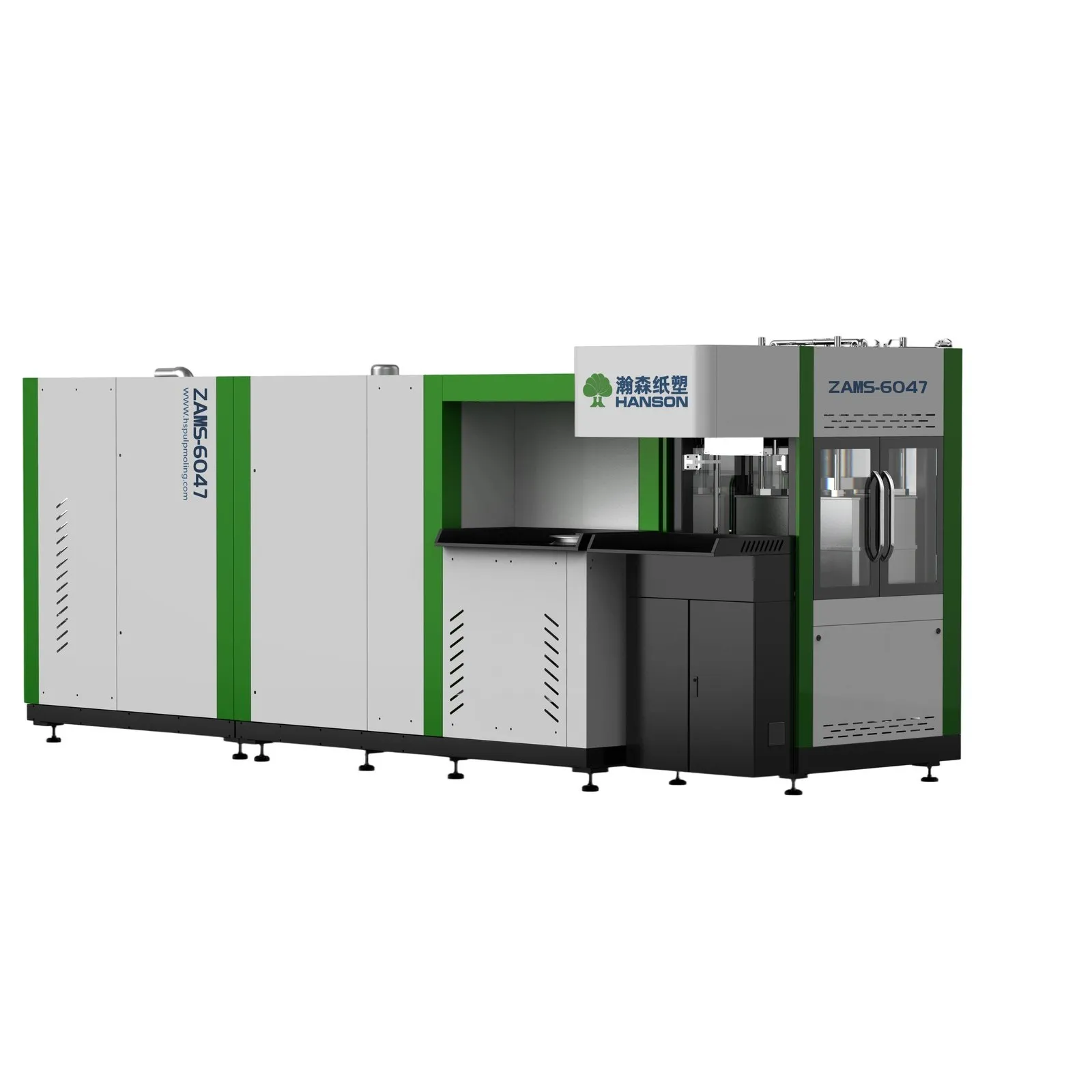
Features
Why Choose HANSON?
Our Own Mold Division, Design to Production
We run an independent mold division covering product development, mold design, manufacturing and testing. Because we build our own tooling, we control what decides your product range, how fast a new item reaches market, and how steadily you hold tolerances. We also optimize existing molds and retrofit equipment you already run, so a line that has lost its edge returns to spec without being replaced.
Complete Lines, Not Single Machines
Our portfolio covers tableware lines, industrial packaging equipment, cup lid lines and sampling lines, plus downstream automation for trimming, inspection, stacking and packing. Every station is engineered to the one after it, so the line reaches rated output instead of bottlenecking at the press or dryer. Start with one forming unit and expand into a full line as demand grows.
Turnkey Delivery With On-Site Support
We take a project from feasibility analysis and raw-material verification through layout, installation, commissioning and operator training. For turnkey projects we can place engineers on site and support ramp-up for up to six months — the period when most new plants either stabilize or stall. Ten service locations and 24/7 response keep that support running after warranty ends.
Proven at Scale, Certified for Regulated Markets
Our equipment runs in more than 20 markets, with roughly 150 units shipped a year and about half going to export customers across Europe, the Middle East, Southeast Asia and South America. Our forming equipment holds CE certification under the EU Machinery Directive, and 50 patents protect our structures, processes and automation systems. We serve listed companies, state-owned enterprises and leading packaging manufacturers.
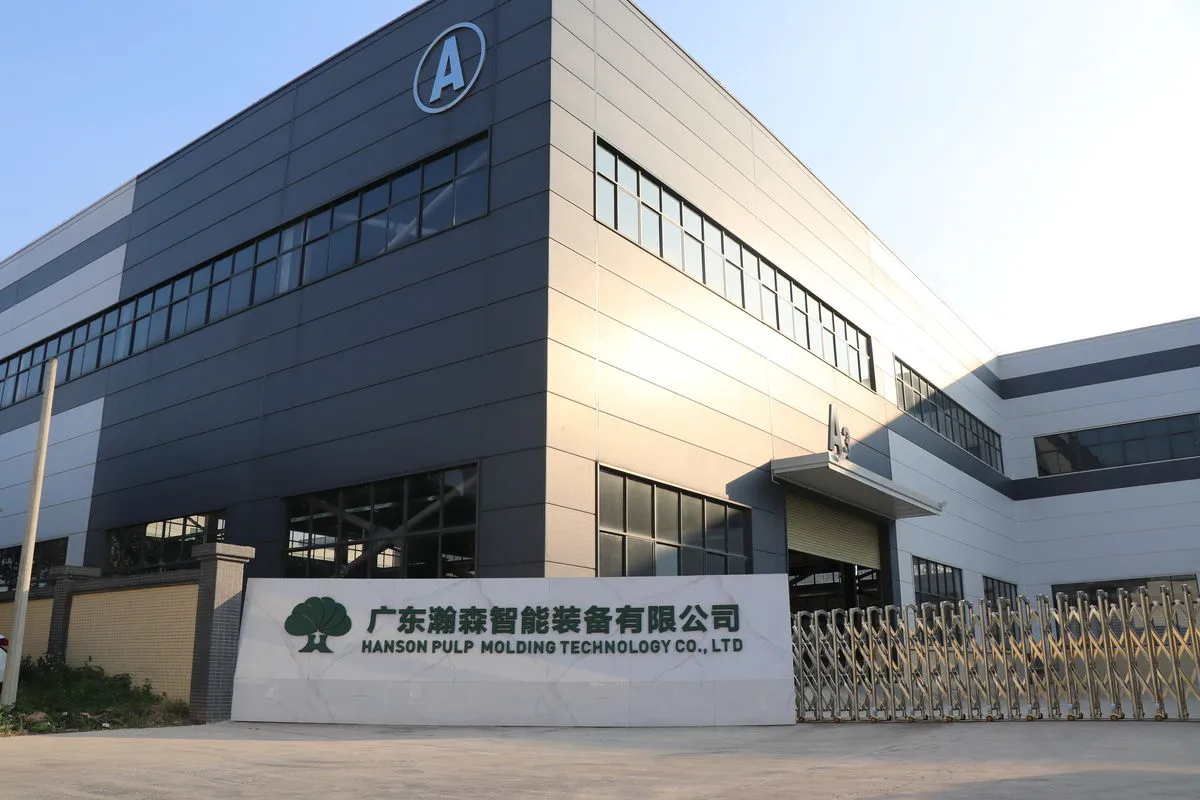
We Have The Best Solutions for Your Business
HANSON was founded in 2022 in Dongguan, Guangdong Province, China. Our 50,000 square meter facility employs more than 200 people, including a 50-engineer R&D team, and ships around 150 units a year to customers in more than 20 markets worldwide. We manufacture complete tableware production lines, premium industrial packaging equipment, plant-fiber cup lid lines and sampling lines, turning bagasse, bamboo fiber and recycled paper into tableware, egg trays, cup lids, cup carriers and protective packaging. What sets us apart is our independent mold division: with product development, mold design, manufacturing and testing all in house, we control the factor that decides how wide your product range goes and how reliably you hold tolerances. We deliver projects end to end, from feasibility analysis and factory layout to installation, commissioning and operator training, backed by 10 service locations and engineers who can stay on site through your ramp-up. Our equipment is CE certified and protected by 50 patents. Send us your product list and output target, and we will recommend the configuration that fits.
The short version
A pulp molding sample making machine produces prototype and small batch quantities so you can iterate on design before investing in production tooling. It is the fastest way to win customer approvals, validate mold geometry and confirm fiber performance. Small scale lines trade speed for flexibility, which is exactly the right trade at the development stage.
Why Sampling Decides Whether a Project Ever Ships
Every molded fiber product goes through an approval cycle with the end customer. A brand, a packaging engineer or a procurement team wants to hold the product, test it in their process and compare it against the incumbent. That approval cycle takes weeks or months, and it is where projects are won or quietly abandoned.
Without in house sampling, every iteration in that cycle depends on an external resource and takes weeks. With a sample making machine, an iteration takes a day. The difference compounds: a project that needs four design revisions finishes in a week rather than two months, and the customer experiences your company as responsive rather than slow.
Sampling also reduces production risk. A mold that has never produced a physical part hides design problems that only appear when fiber meets mesh. Trial tooling on a small line reveals drainage imbalance, weak ribs and fit problems before production tooling is cut, and correcting a prototype costs a fraction of correcting a hardened multi cavity tool.
| Development stage | What the sample machine provides | Risk removed |
| Concept | Fast physical parts for discussion | Designing to a drawing that cannot be molded |
| Fit and function | Iterations within days | Product does not fit the customer's assembly |
| Fiber selection | Small runs with different furnishes | Committing to a fiber that underperforms |
| Approval | Samples matched to production intent | Approval samples that production cannot reproduce |
What a Pulp Molding Sample Making Machine Can and Cannot Do
A sample making machine covers the same process steps as a production line, but at a scale designed for flexibility rather than throughput. It typically forms one or a few parts per cycle rather than many, uses a smaller pulper and press, and can be reconfigured quickly for a new mold. That flexibility is the whole point.
What it should not be asked to do is carry commercial production volume on a low margin product. Attempting that produces high unit costs, limits growth and wears out a machine designed for a different duty. Use it as a development and pilot tool, then move volume to production equipment once the design is proven.
There is a legitimate middle role: serving small customers whose order quantities do not justify production tooling. Specialty packaging, high value industrial inserts and custom cosmetic applications often run in modest volumes where a flexible small line is genuinely economical. If that is your business model, a sample machine is a production asset rather than a development tool.
Process Continuity Between Sample and Production
The most valuable property of a sample making machine is that its process mirrors production. When slurry preparation, forming, pressing and drying follow the same sequence and similar parameters as your production line, samples behave the way production parts will. When they do not, you win approvals with samples that production cannot reproduce, and the project fails at the worst possible moment.
Keep the parameters comparable. Record freeness, slurry concentration, vacuum profile, press temperature and dwell on the sample machine, then verify that the production machine can reach the same conditions. If a production press cannot achieve the density that produced an acceptable sample, the tooling design needs revisiting rather than the sample being repeated.
Fiber continuity matters as much as process continuity. Use the same fiber source and blend for samples as you intend to run in production. A sample made with a premium fiber that production will not use creates a quality promise you cannot keep, and customers notice the difference immediately when the first production batch arrives.
Mold Trials and Rapid Iteration
Prototype tooling is the biggest practical benefit. A single cavity trial mold costs a fraction of a multi cavity production tool and can be modified quickly. Running it on a sample machine lets you test drainage behavior, wall thickness distribution, stacking geometry and fit before committing to production tooling that would take weeks and significant cost to redo.
Design the iteration loop deliberately. Make a part, measure it, compare against the specification, adjust the mold, repeat. Each pass should test one change so you learn what caused the difference. Suppliers who run this loop well typically reach an acceptable part in three to five iterations; those who change several variables at once take far longer and learn less.
Involve the customer's packaging engineer early. Send a part from the second or third iteration rather than waiting for the final version, and ask for specific feedback on fit, feel and protection. Early feedback prevents the classic failure of passing every internal test and failing the customer's first review. The mold and tooling program covers how this development loop is structured.
Sizing and Configuring a Sample Making Machine
Size the machine to the largest part you expect to develop, not to the average. A sample line that cannot produce your biggest potential product limits the projects you can pursue. Ask what the maximum mold dimension is and whether the press can reach the density your products require.
Consider the pulping section carefully. Sampling often involves trying several furnishes, so a pulper that is easy to clean between runs saves hours on every fiber trial. Contamination between batches produces misleading results, and a machine that is difficult to clean discourages experimentation.
Check the utility requirements against your available services. A sample machine should not demand a new electrical supply or a dedicated boiler, or its cost of ownership rises sharply. Machines designed for development work usually have modest utility needs, which is part of what makes them practical to install in a technical center or a design office rather than on a factory floor.
Ask about process data capture. Being able to record and repeat parameters turns a sample machine from a toy into a development instrument. If the machine cannot log its settings, your iterations depend on operator memory rather than on data.
Positioning Sampling in Your Business
Companies use sample making machines in three ways. Manufacturers use them to develop products for their own production lines. Suppliers use them to demonstrate capability to prospective customers and win contracts. Service providers use them to offer design and prototyping as a revenue service to brands that do not own molding equipment.
Whichever role fits you, the commercial logic is the same: speed of iteration wins work. A company that can deliver a physical prototype within a week of a design brief is far more attractive than one that needs a month, and that speed is worth more than any price concession in a competitive tender.
Document your sampling capability and promote it. Buyers rarely ask whether a supplier can iterate quickly until they have been burned by one who could not. Making it visible, with clear turnaround expectations, becomes a genuine differentiator. Explore how sampling fits alongside production equipment through the project services overview.
Cost Logic Behind a Pulp Molding Sample Making Machine
The economics of a pulp molding sample making machine are straightforward once you stop comparing it to production equipment. It does not pay back through output; it pays back through avoided mistakes. A single production mold cut to a design that turns out to be unmoldable costs far more than a sample machine, and that scenario happens regularly to companies that develop products on drawings alone.
Count the iterations in a typical product development cycle. Four design revisions, each requiring a physical part for customer review, means four production interruptions if you rely on your main line, or four fast cycles if you own a sampling capability. Add the value of bidding for work you would otherwise decline because the turnaround was impossible, and the machine justifies itself within a small number of projects.
Operational cost is modest. Fiber consumption is measured in kilograms rather than tons, utilities are light enough for a technical center supply, and one trained technician can run the equipment alongside other duties. The maintenance burden is limited to meshes, seals and press surfaces, all of which are inexpensive and available as standard wear items. Purchased as a development asset rather than a production machine, a pulp molding sample making machine carries a cost profile much closer to laboratory equipment than to a factory line, which is precisely why so many technical centers now install one.
Final Thoughts
A pulp molding sample making machine pays for itself by making development fast. It turns a month long approval cycle into a week, reveals mold problems before production tooling is cut, and lets you test fiber options without disrupting production. Size it for your largest potential product, keep its process consistent with production, and treat the ability to iterate quickly as the commercial advantage it is.
Tell us the range of products you want to develop and the largest mold dimension you expect, and we will propose a pulp molding sample making machine configuration for your technical center.
Proposals include tooling trial plans and process data capture so sampling stays aligned with production.
Set Up Your Sampling Capability
Featured Products
Collection about HANSON




User Reviews
What users say about HANSON
Frequently Asked Question
Do you have any question?
Because most molded fiber projects are won or lost before the production machine is ordered. A customer approves a physical sample, not a drawing, and process problems surface during trials rather than on paper. Sampling de-risks the whole project.
It can reproduce the forming, pressing and drying behavior of production closely enough to validate geometry, wall thickness, surface and strength. It cannot replicate the cycle time or output of a full line, and it should not be used to estimate production rates.
Only if the process route is continuous between the two. If the sample is pressed and dried differently from how production will run, the sample will not predict production, and the customer will see different results at scale.
Normally with one or two forming stations, a small press and a compact dryer, sized for frequent mold changes rather than high output. Versatility matters more than throughput in this role.