
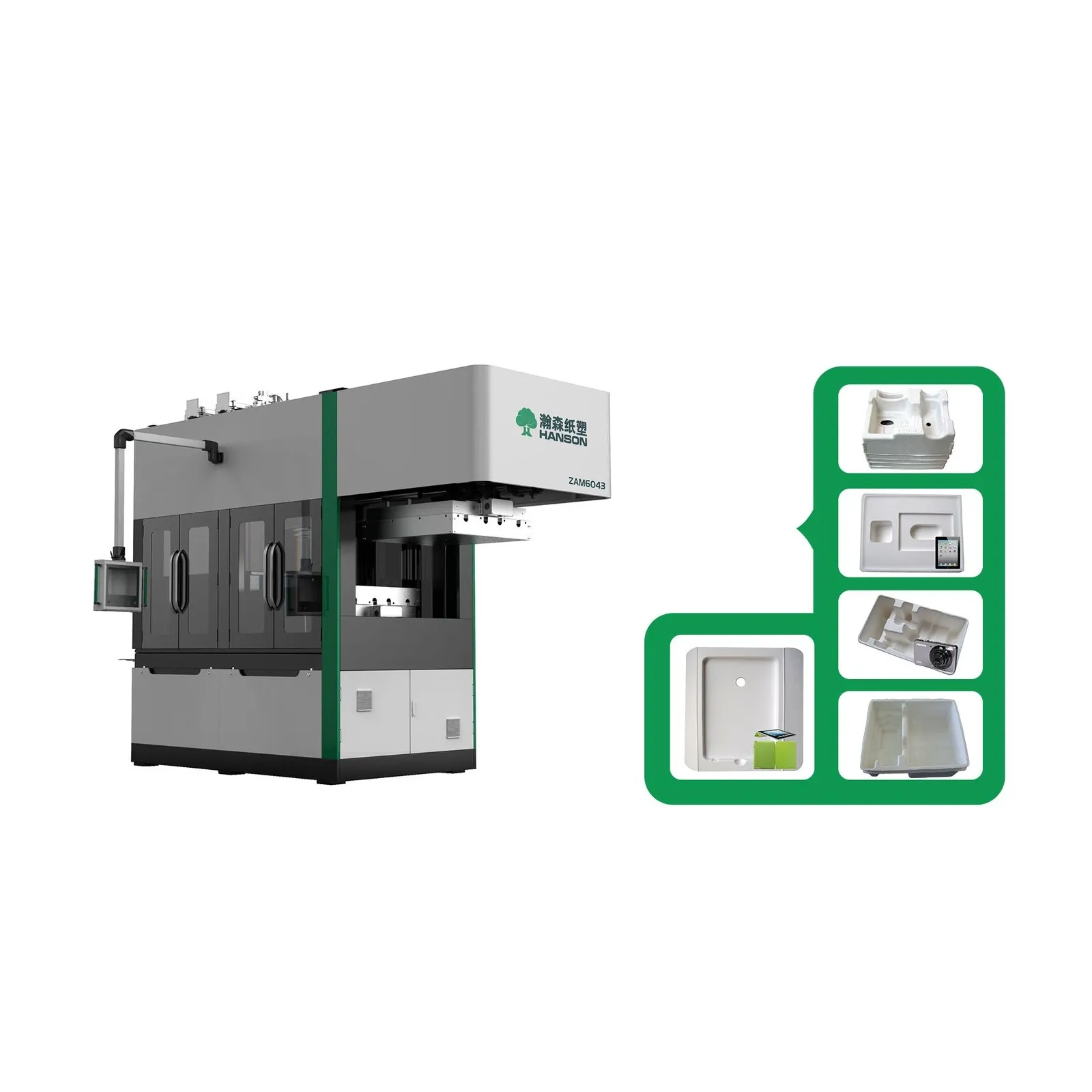
Features
Why Choose HANSON?
Our Own Mold Division, Design to Production
We run an independent mold division covering product development, mold design, manufacturing and testing. Because we build our own tooling, we control what decides your product range, how fast a new item reaches market, and how steadily you hold tolerances. We also optimize existing molds and retrofit equipment you already run, so a line that has lost its edge returns to spec without being replaced.
Complete Lines, Not Single Machines
Our portfolio covers tableware lines, industrial packaging equipment, cup lid lines and sampling lines, plus downstream automation for trimming, inspection, stacking and packing. Every station is engineered to the one after it, so the line reaches rated output instead of bottlenecking at the press or dryer. Start with one forming unit and expand into a full line as demand grows.
Turnkey Delivery With On-Site Support
We take a project from feasibility analysis and raw-material verification through layout, installation, commissioning and operator training. For turnkey projects we can place engineers on site and support ramp-up for up to six months — the period when most new plants either stabilize or stall. Ten service locations and 24/7 response keep that support running after warranty ends.
Proven at Scale, Certified for Regulated Markets
Our equipment runs in more than 20 markets, with roughly 150 units shipped a year and about half going to export customers across Europe, the Middle East, Southeast Asia and South America. Our forming equipment holds CE certification under the EU Machinery Directive, and 50 patents protect our structures, processes and automation systems. We serve listed companies, state-owned enterprises and leading packaging manufacturers.
We Have The Best Solutions for Your Business
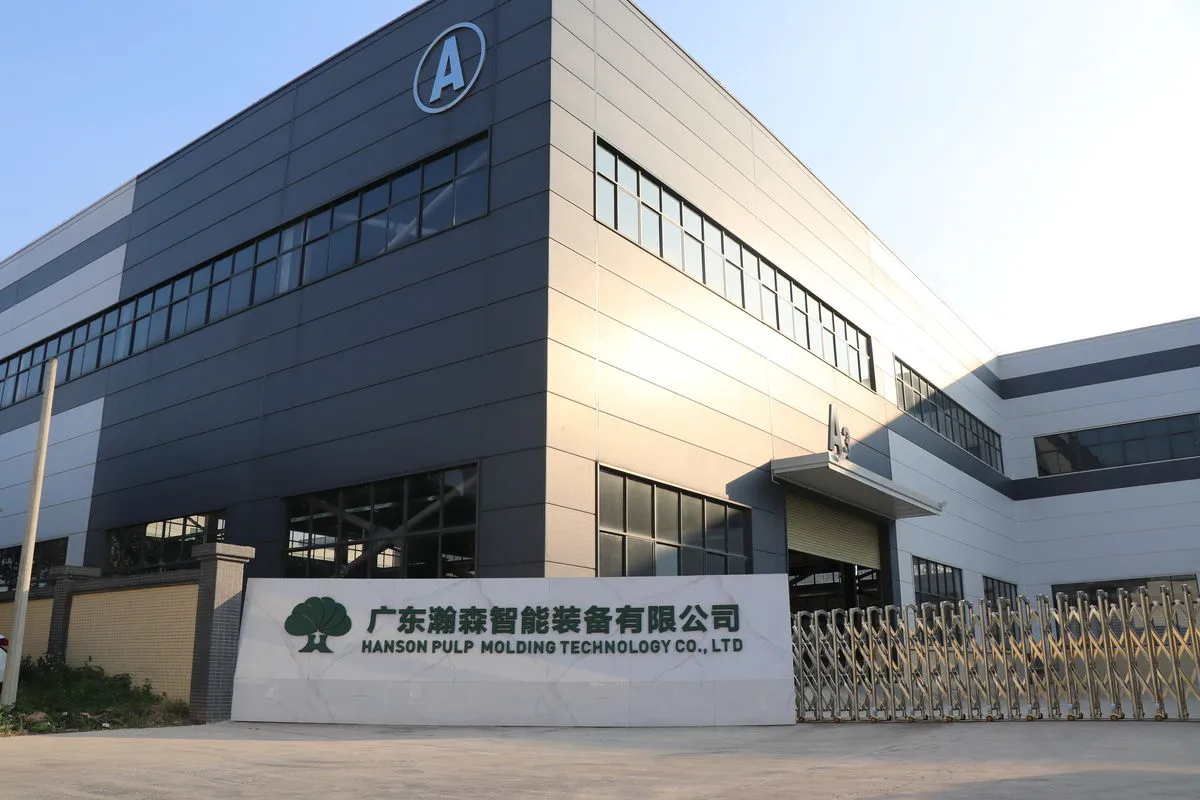
HANSON was founded in 2022 in Dongguan, Guangdong Province, China. Our 50,000 square meter facility employs more than 200 people, including a 50-engineer R&D team, and ships around 150 units a year to customers in more than 20 markets worldwide. We manufacture complete tableware production lines, premium industrial packaging equipment, plant-fiber cup lid lines and sampling lines, turning bagasse, bamboo fiber and recycled paper into tableware, egg trays, cup lids, cup carriers and protective packaging. What sets us apart is our independent mold division: with product development, mold design, manufacturing and testing all in house, we control the factor that decides how wide your product range goes and how reliably you hold tolerances. We deliver projects end to end, from feasibility analysis and factory layout to installation, commissioning and operator training, backed by 10 service locations and engineers who can stay on site through your ramp-up. Our equipment is CE certified and protected by 50 patents. Send us your product list and output target, and we will recommend the configuration that fits.
The short version
A pulp molding machine forms products from fiber slurry using molds, then presses and dries them into finished parts. The same platform produces very different products depending on tooling and process settings. Product geometry, fiber choice and mold design decide quality far more than the machine frame does.
How a Pulp Molding Machine Forms a Product
The process starts with fiber suspended in water. Waste paper, bagasse, bamboo or another plant fiber is broken down in a pulper, then refined until the fiber reaches the length and freeness your product needs. Freeness describes how quickly water drains through a fiber mat, and it is the single most important process variable in pulp molding because it controls how fast the mat builds on the mold and how the finished part presses.
Forming follows. A mold covered in a fine mesh is immersed in the slurry tank, vacuum is applied from behind the mesh, and fiber deposits on the surface while water passes through. The thickness of the deposit is controlled by the vacuum profile and the immersion time. Because the mold surface defines the outside of the product, the quality of the mold's drainage design determines whether the wall builds evenly or thickens on one side.
Pressing comes next. Still wet, the formed part is transferred to a heated mold that closes on it, squeezing water out mechanically and compacting the fiber. Because mechanical water removal costs far less energy than evaporation, pressing while wet is the standard route for products that need strength and a smooth surface. Temperature, pressure and dwell time together determine density, surface finish and stiffness.
Drying removes what the press leaves behind, and trimming cuts the part to final shape. Some products then receive printing, coating or inspection before packing. Each stage has its own optimal settings for a given product, which is why a mold change is never only a mechanical change but also a process change.
| Stage | What happens | Key variable |
| Pulping | Fiber broken down and dispersed in water | Slurry concentration |
| Refining | Fiber length and surface adjusted | Freeness |
| Forming | Fiber deposited on mesh mold under vacuum | Vacuum profile and immersion time |
| Pressing | Water squeezed out, fiber compacted | Temperature, pressure, dwell |
| Drying | Remaining moisture evaporated | Residence time and temperature |
| Trimming | Final shape cut, flash removed | Die condition and alignment |
What a Pulp Molding Machine Can Produce
The product range is wider than most newcomers expect, and it comes from tooling rather than from the machine. Egg trays and cartons are the traditional volume products, valued for protection at low cost. Tableware covers plates, bowls, compartment trays, clamshells and food containers, where stiffness and a food safe surface matter. Industrial packaging includes protective inserts for electronics, appliances and medical devices, where dimensional accuracy and load bearing capacity drive the design.
Cup lids and cup carriers sit in the tolerance sensitive end of the range. Agricultural trays for fruit and seedlings, cosmetic and skincare inserts, and 3C electronics packaging all run on the same platform with different tooling and process settings. The practical question for a buyer is not what the machine can make in theory, but which products you can sell and support with a mold library.
Understanding where your target product sits on the tolerance scale matters. A product like an egg tray forgives a millimeter of variation. A cup lid does not. If your business plan includes a tolerance critical product, the machine and tooling specification has to be built for it from the beginning rather than upgraded later.
Fiber Choices and What They Change
Waste paper is the most economical furnish and the most widely used. Old corrugated containers give good strength and drainage. Mixed paper is cheaper and weaker. Newspaper drains quickly but reduces strength. The blend ratio determines the behavior of the slurry, the strength of the finished part and the cost per thousand pieces, so it belongs in writing with your fiber supplier.
Bagasse is bright, short fibered and drains quickly, which makes it the standard choice for tableware where appearance matters. Bamboo has longer fibers and produces stronger, stiffer parts at thinner walls, at the cost of more refining energy and a slower forming cycle. Other plant fibers such as wheat straw and reed pulp serve specific markets, usually where local supply makes them economical.
Wet strength additives and coatings change performance with liquids. A plate needs modest wet strength to handle a hot dish; a cup lid needs more because it sits on a hot drink. Additive chemistry must match the destination market's food contact rules, so specify it with the compliance file in mind rather than defaulting to what the supplier stocks.
Machine Configurations
Machines differ mainly in how the forming section moves and how many molds run at once. A reciprocating machine moves the mold in a straight line between the slurry tank and the transfer point. A rotary machine carries molds around a drum, allowing continuous motion and typically higher output per unit of floor space. A multi head arrangement runs several molds in parallel to multiply output without increasing cycle speed.
The choice follows your product and your volume. Low volume specialty work suits a simple configuration with fast changeover. High volume commodity products suit rotary or multi head arrangements where the cycle is short and the product never changes. Plants that expect to run both should look at how quickly molds can be exchanged and how the process recipe is stored.
Automation level is a separate decision from forming configuration. Automated transfer, stacking and packaging reduce labor per shift, which matters most on thin margin products. On short production runs of specialized items, flexible manual handling can be more economical than automation that has to be reconfigured for every product.
Sizing and Buying Decisions
Sizing starts from demand, never from a machine specification. Write down your products, your annual volumes and your peak periods, then convert that into pieces per shift. Compare against the sustained output of a candidate configuration running your actual products, and treat the demo figure as an upper bound rather than a planning number.
Compile a running cost model alongside the capital cost. Fiber, drying energy, molds, additives and labor per thousand pieces decide whether the plant is profitable, and drying energy in particular is easy to underestimate. Ask for a utility consumption table with the offer so you can model honestly.
Evaluate the supplier as carefully as the machine. Tooling capability, commissioning support, spare parts and remote diagnostics determine the plant's performance long after the invoice is paid. Ask for references from plants running your product type and speak to them about commissioning rather than about the equipment. The factory overview and the mold and tooling program show what to look for.
Commissioning and the First Year
The first year decides whether the project works. Commissioning takes weeks rather than days because the crew has to learn freeness control, vacuum tuning and press recipes for every mold. Plan customer commitments around that learning period instead of promising deliveries from the first good shift.
Set up a measurement routine from the first day. Record parameters and first article dimensions for every product, and keep the samples. When a quality problem appears months later, the comparison resolves it quickly. Train operators to recognize drift early, because a slightly heavier part or a marginally cooler platen precedes a quality failure by hours. Our project services team builds these routines into commissioning.
Maintenance Practice on a Pulp Molding Machine
Maintenance on a pulp molding machine follows the wear pattern of the process rather than a generic schedule. Forming meshes are the first items to need attention, because fiber and fines gradually block the openings and slow drainage. A mesh that drains slowly produces uneven walls, and the symptom appears long before the mesh fails visibly. Inspect on a fixed interval and replace on measurement rather than on appearance.
Vacuum components come second. Filters load, seals harden and lines accumulate deposits, and the effect is a gradual loss of suction that operators compensate for by extending cycle time rather than investigating. Recording vacuum readings at the start of each shift turns that slow decline into a visible trend. Press surfaces and platens also need periodic checking for deposit buildup and temperature uniformity, since an uneven platen produces surface defects that are difficult to trace later.
Keep a spare parts inventory sized to your risk. Meshes, seals, vacuum components and trimming dies should sit on the shelf rather than in a supplier's warehouse, because a machine stopped for a wear item costs far more in lost production than the part costs to stock. A pulp molding machine that is maintained on measurement and supported by local spares reaches stable output for years rather than months, and the maintenance record itself becomes valuable evidence during customer audits.
Final Thoughts
A pulp molding machine is a flexible platform whose output depends on tooling, fiber and process control. Buy it against the products you can sell, specify the fiber blend in writing, and choose a supplier who will still be supporting the plant when you expand. The machine frame is the least interesting part of the decision, and buyers who understand that usually build plants that last.
Tell us what you plan to produce and in what volumes, and we will recommend a pulp molding machine configuration with tooling, utility demand and running cost estimates.
We include a commissioning schedule and operator training plan with every proposal.
Start Your Machine Specification
Featured Products
Collection about HANSON




User Reviews
What users say about HANSON
Frequently Asked Question
Do you have any question?
Fiber is suspended in water, drawn onto a shaped screen by vacuum, then transferred to a heated press where it is densified and dried. The screen determines the geometry and the press determines the density, surface and strength.
Egg trays and cartons, tableware such as plates and bowls, cup carriers and cup lids, industrial protective inserts and agricultural trays. All of these use the same core process, and changing product means changing molds and process settings.
Recycled newsprint, mixed waste paper, old corrugated containers, bagasse and bamboo pulp are all common. Fiber choice affects strength, surface finish, drying load and cost per unit, and it should be fixed before the line is configured.
From your product mix and required output per shift, not from the headline capacity of the forming unit. A machine that hits its rated figure on egg trays may deliver far less on a thick walled industrial insert, because cycle time is product driven.