
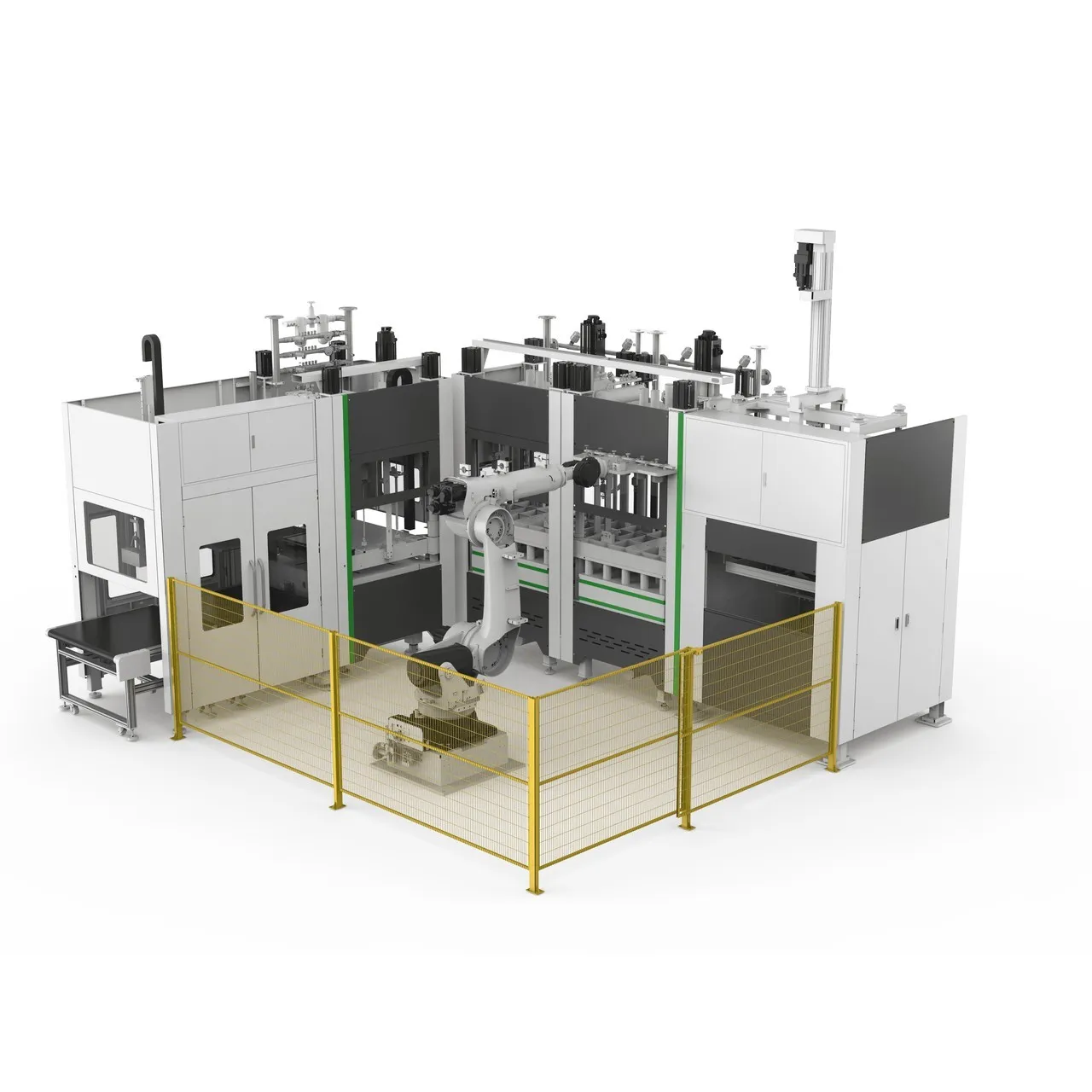
Features
Why Choose HANSON?
Our Own Mold Division, Design to Production
We run an independent mold division covering product development, mold design, manufacturing and testing. Because we build our own tooling, we control what decides your product range, how fast a new item reaches market, and how steadily you hold tolerances. We also optimize existing molds and retrofit equipment you already run, so a line that has lost its edge returns to spec without being replaced.
Complete Lines, Not Single Machines
Our portfolio covers tableware lines, industrial packaging equipment, cup lid lines and sampling lines, plus downstream automation for trimming, inspection, stacking and packing. Every station is engineered to the one after it, so the line reaches rated output instead of bottlenecking at the press or dryer. Start with one forming unit and expand into a full line as demand grows.
Turnkey Delivery With On-Site Support
We take a project from feasibility analysis and raw-material verification through layout, installation, commissioning and operator training. For turnkey projects we can place engineers on site and support ramp-up for up to six months — the period when most new plants either stabilize or stall. Ten service locations and 24/7 response keep that support running after warranty ends.
Proven at Scale, Certified for Regulated Markets
Our equipment runs in more than 20 markets, with roughly 150 units shipped a year and about half going to export customers across Europe, the Middle East, Southeast Asia and South America. Our forming equipment holds CE certification under the EU Machinery Directive, and 50 patents protect our structures, processes and automation systems. We serve listed companies, state-owned enterprises and leading packaging manufacturers.
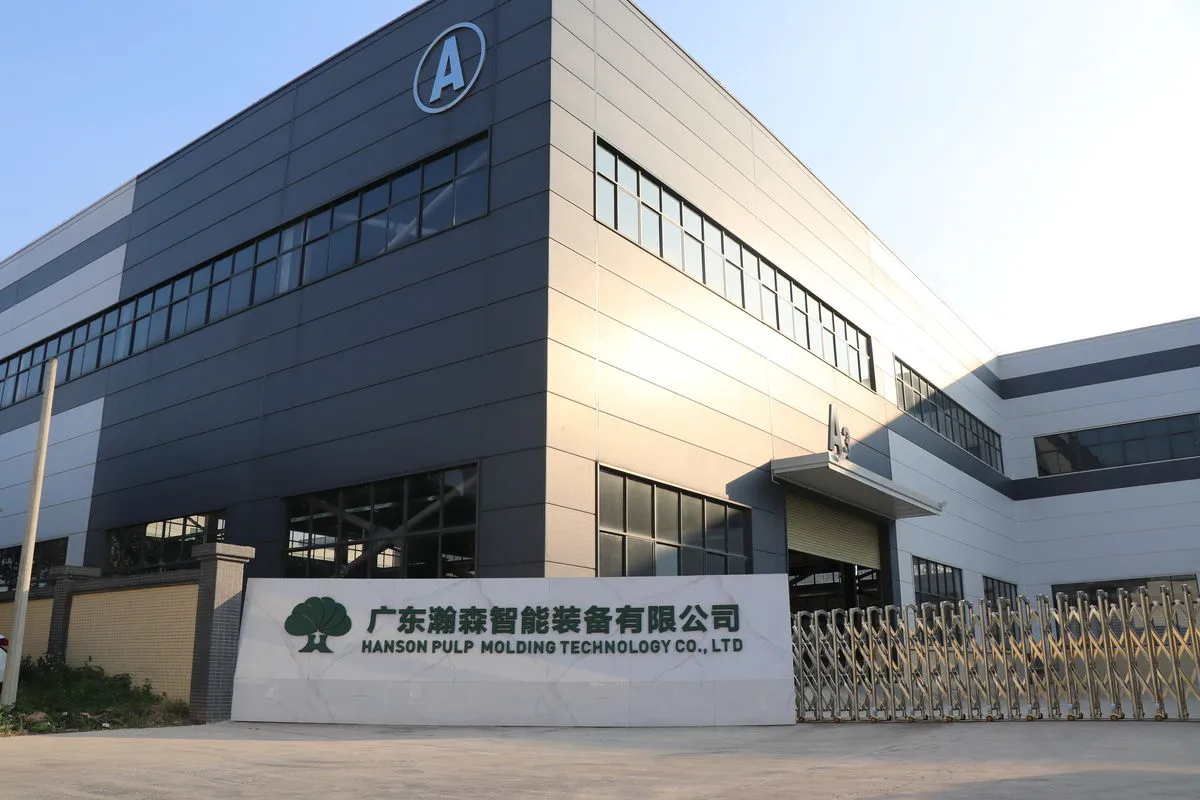
We Have The Best Solutions for Your Business
HANSON was founded in 2022 in Dongguan, Guangdong Province, China. Our 50,000 square meter facility employs more than 200 people, including a 50-engineer R&D team, and ships around 150 units a year to customers in more than 20 markets worldwide. We manufacture complete tableware production lines, premium industrial packaging equipment, plant-fiber cup lid lines and sampling lines, turning bagasse, bamboo fiber and recycled paper into tableware, egg trays, cup lids, cup carriers and protective packaging. What sets us apart is our independent mold division: with product development, mold design, manufacturing and testing all in house, we control the factor that decides how wide your product range goes and how reliably you hold tolerances. We deliver projects end to end, from feasibility analysis and factory layout to installation, commissioning and operator training, backed by 10 service locations and engineers who can stay on site through your ramp-up. Our equipment is CE certified and protected by 50 patents. Send us your product list and output target, and we will recommend the configuration that fits.
The short version
Bamboo fiber is longer and stronger than bagasse, so walls can be thinner and parts hold up better in transit. It needs more refining energy and more careful freeness control. A bamboo tableware machine rewards buyers who lock a fiber supply agreement before ordering equipment.
How a Bamboo Tableware Machine Differs From Other Fiber Lines
The machine architecture is similar across plant fibers, but the settings are not the same, and the difference starts in pulping. Bamboo pulp arrives with longer fibers than bagasse, which means the refiner has more work to do to reach the target freeness. That extra refining energy is worth it, because long fibers create a denser, tougher mat on the forming mold. The result is a part that resists bending and holds its shape when hot food is placed on it.
Drainage is slower with bamboo. Short fiber furnishes dewater almost instantly on the mold, while bamboo needs a longer suction window and a more gradual vacuum ramp. Operators coming from a bagasse line often try to speed the forming cycle up to match their old numbers, and the result is a wet, heavy part that cracks in pressing. The bamboo tableware machine has to be run at its own rhythm.
Hot pressing also changes. Bamboo fiber reaches high stiffness when pressed correctly, and that stiffness is one of the strongest selling points of the finished product, but it demands consistent platen temperature across the whole mold face. A temperature gradient that would be invisible on bagasse will produce one hard edge and one soft edge on bamboo.
| Process stage | Bamboo behavior | Adjustment on the line |
| Refining | Longer fiber, more energy needed | Higher refining load, freeness logged every shift |
| Forming | Slower drainage than bagasse | Gradual vacuum ramp, longer suction window |
| Hot pressing | High stiffness when fully dried | Even platen temperature, verified with a surface probe |
| Drying | Denser walls hold more water | Slightly longer dryer residence time |
Sourcing Bamboo Fiber for a Bamboo Tableware Machine
Bamboo pulp is sold as bleached or unbleached board in bales, and as raw bamboo chips that you pulp on site. Baled pulp is the practical choice for most new plants because it arrives at a known freeness and quality, which removes one large variable from your first year of production. Chips sourced locally can lower material cost substantially, but they require more pulping capacity, more chemical control and more operator skill.
Whatever route you take, put a moisture and cleanliness specification in the purchase contract. Bamboo pulp that arrives damp or contaminated with sand will raise your rejection rate, clog the refiner and shorten mesh life. Insist on a certificate of analysis per batch and keep samples from each delivery, so that when quality drifts you can trace it to a specific lot rather than guessing.
Storage matters more than buyers expect. Bamboo pulp absorbs humidity from the air, and a bale that has been sitting in a damp corner behaves differently from a freshly opened one. Keep the store dry, rotate stock on a first in, first out basis, and open bales only when they are about to be used.
Product Range on Bamboo Lines
Bamboo handles a wide tableware range well: round and square plates, shallow and deep bowls, compartment trays, food containers and clamshells. The fiber's strength makes it a particularly good match for items with thin rims and for products that will be stacked in dispenser columns, where rim strength decides how many pieces a customer can load without deformation.
Deep drawn items remain the hardest test. A bowl with a high draw ratio needs a mold with balanced drainage and a pressing profile that removes water from the base without cracking the rim. Plan your first mold purchases around your three best selling shapes, then expand once you have real reorder data. A bamboo tableware machine with a small, proven mold library outperforms one with a large library that never gets used.
Tooling depth is what separates a supplier from a vendor. Look at the workshop and the design process directly, and ask who owns the drawings and how many trial presses each new mold receives. The mold and tooling program is worth a visit before you commit.
Sizing a Bamboo Tableware Machine for Your Market
Capacity planning begins with demand, not with equipment. Convert your annual forecast into pieces per shift, add an allowance for mold changes and seasonal peaks, and then compare that requirement against the sustained output of each candidate line. Bamboo's slower drainage means the forming cycle is typically longer than an equivalent bagasse run, so a machine rated at a headline figure for bagasse will not automatically deliver the same number on bamboo. Always ask for the output figure for your specific fiber and product.
Build the business case at a conservative share of the sustained figure. Downtime for mold cleaning, knife changes and slurry adjustment consumes a very real part of every shift, and honest suppliers will tell you what their customers actually achieve rather than quoting a demo run. The plants that deliver reliably are the ones whose sales commitments were written against minus-realistic availability, not against a brochure.
Reserve expansion space from the start. Bamboo tableware tends to sell into premium channels where volume grows in steps as retail contracts are won, and the cheapest way to add capacity is the floor space, power and pulper volume you left available in the original layout.
Compliance and Market Positioning for Bamboo Tableware
Bamboo tableware is food contact material, so the compliance file your buyers ask for depends on their market. European customers typically want evidence that the material meets framework regulation requirements and passes standard migration testing. North American buyers often request compostability certification before allowing a compostable claim on packaging. These certifications test the finished product rather than the machine, but a stable, documented process is what makes the samples pass early instead of after several resubmissions.
Bamboo also carries a marketing advantage that bagasse does not always match. Bamboo regenerates quickly, and consumers in several markets already associate it with renewable material. That story supports a higher price point in retail, provided the claim is backed by certification rather than marketing language. Keep the documentation clean and the claim modest, and the premium holds.
For background on fiber trends across markets, the industry news pages track regulatory shifts, and the technical blog covers material comparisons in more depth.
Running Costs and Where They Hide
The purchase invoice is the visible cost; the running cost decides whether the plant is profitable. Fiber is the largest recurring line item, followed by drying energy, then molds, additives and labor. Bamboo's higher strength means you can sometimes reduce wall thickness, which cuts fiber and drying cost per piece, so the material's higher purchase price does not automatically mean a higher unit cost. Run the numbers per thousand pieces rather than per ton of fiber.
Refining energy is the item that surprises buyers. Bamboo needs more of it than bagasse, and the total shows up on the power bill rather than on any quotation sheet. Ask for a utility consumption table alongside the machine specification, and model your running cost with the fiber you actually intend to use rather than a generic assumption.
Mold life is the second hidden cost. A forming mold that holds its mesh and drainage geometry through a long campaign beats a cheaper mold that needs replacing every few months. Ask for expected cycle counts and the mesh material specification before you compare prices.
Commissioning a Bamboo Line Without Losing a Season
Bamboo lines need a commissioning period measured in weeks. The crew must learn freeness control, vacuum tuning and press temperature management for this specific fiber, and rushing that learning curve produces a month of rejected product. Send your future line supervisor to the supplier for training before the machine ships, and plan your first customer deliveries for after the stabilization period rather than during it.
Start a batch log on day one and never stop. Slurry concentration, freeness, vacuum profile, press temperature and rejection rate recorded for every run turn troubleshooting into comparison instead of guesswork, and they become your audit evidence when a customer requests process documentation. Our project services team builds this discipline into the commissioning schedule as standard.
Final Thoughts
A bamboo tableware machine rewards planning more than any other fiber choice, because the fiber is slower to drain, hungrier for refining energy and stronger in the finished part. Lock your supply agreement before ordering equipment, ask for output figures quoted against bamboo rather than bagasse, and buy molds from the same engineering team that builds the line. Do those three things and the premium positioning bamboo offers becomes real profit rather than a brochure claim.
Tell us your product shapes, target markets and expected annual volume, and we will prepare a bamboo tableware machine proposal with refining load, utility demand and mold schedule.
We quote bamboo configurations separately from bagasse so you can compare the two on identical assumptions.
Get a Bamboo Line Sizing ReviewFeatured Products
Collection about HANSON




User Reviews
What users say about HANSON
Frequently Asked Question
Do you have any question?
The main difference is in the process settings, not the machine concept. Bamboo pulp drains and consolidates differently, so forming vacuum, pressing pressure and drying profile have to be adjusted to reach the same wall density and surface finish.
Bamboo fiber for molding is typically supplied as pulp from dedicated plantations or from processing residues. Because bamboo matures quickly, the supply is renewable on a short cycle, which is one of the reasons it carries a strong sustainability story in premium markets.
Bamboo fiber performs well on plates, bowls and trays where stiffness and a warm natural tone add value. Buyers targeting premium food service, retail gift sets or branded hospitality lines usually get more from bamboo than buyers competing purely on price per unit.
Raw material cost tends to be higher than bagasse or mixed waste paper, and the process window is narrower, so the unit cost is usually above a standard recycled fiber line. The offset is positioning: bamboo tableware often sells at a premium that covers the difference.