
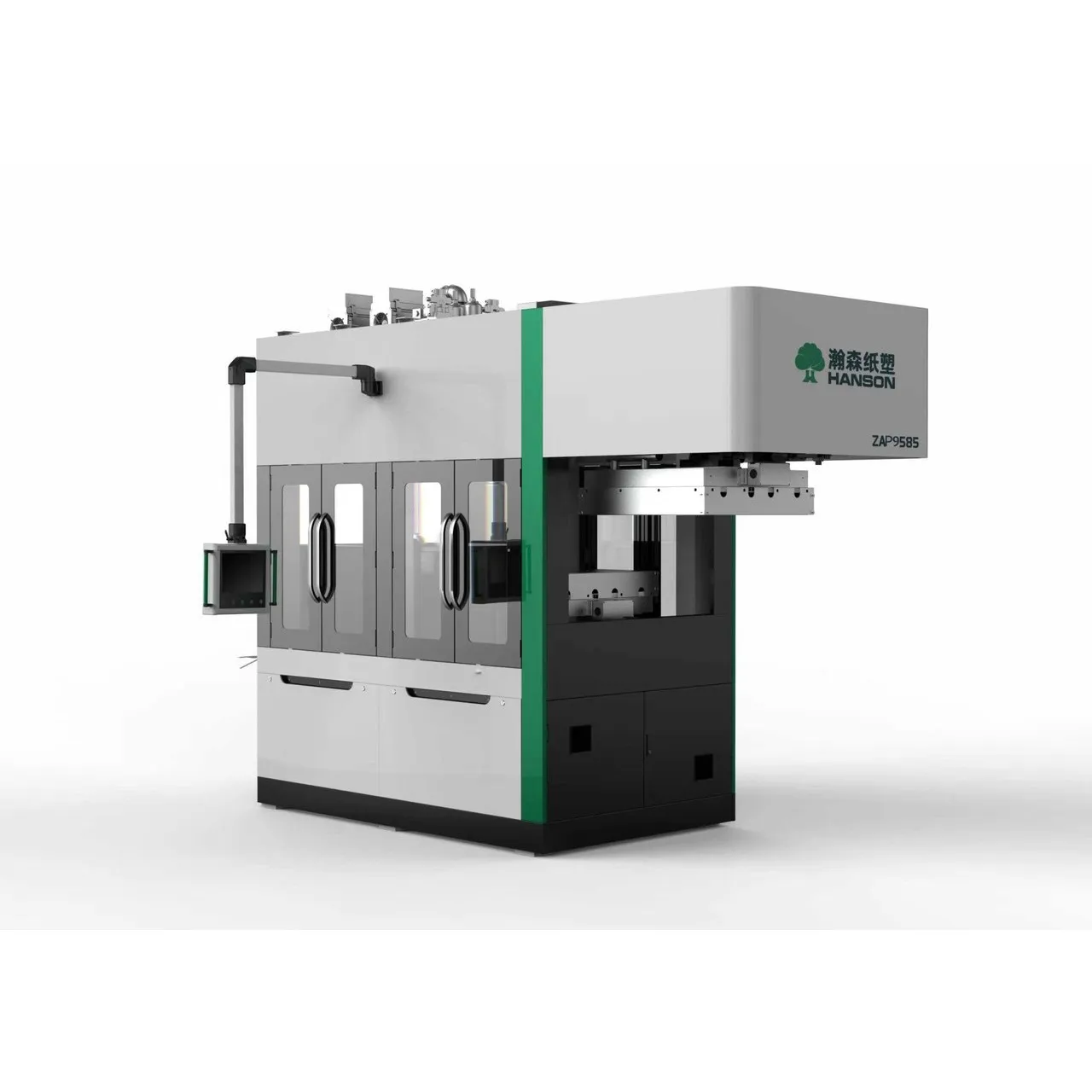
Features
Why Choose HANSON?
Our Own Mold Division, Design to Production
We run an independent mold division covering product development, mold design, manufacturing and testing. Because we build our own tooling, we control what decides your product range, how fast a new item reaches market, and how steadily you hold tolerances. We also optimize existing molds and retrofit equipment you already run, so a line that has lost its edge returns to spec without being replaced.
Complete Lines, Not Single Machines
Our portfolio covers tableware lines, industrial packaging equipment, cup lid lines and sampling lines, plus downstream automation for trimming, inspection, stacking and packing. Every station is engineered to the one after it, so the line reaches rated output instead of bottlenecking at the press or dryer. Start with one forming unit and expand into a full line as demand grows.
Turnkey Delivery With On-Site Support
We take a project from feasibility analysis and raw-material verification through layout, installation, commissioning and operator training. For turnkey projects we can place engineers on site and support ramp-up for up to six months — the period when most new plants either stabilize or stall. Ten service locations and 24/7 response keep that support running after warranty ends.
Proven at Scale, Certified for Regulated Markets
Our equipment runs in more than 20 markets, with roughly 150 units shipped a year and about half going to export customers across Europe, the Middle East, Southeast Asia and South America. Our forming equipment holds CE certification under the EU Machinery Directive, and 50 patents protect our structures, processes and automation systems. We serve listed companies, state-owned enterprises and leading packaging manufacturers.
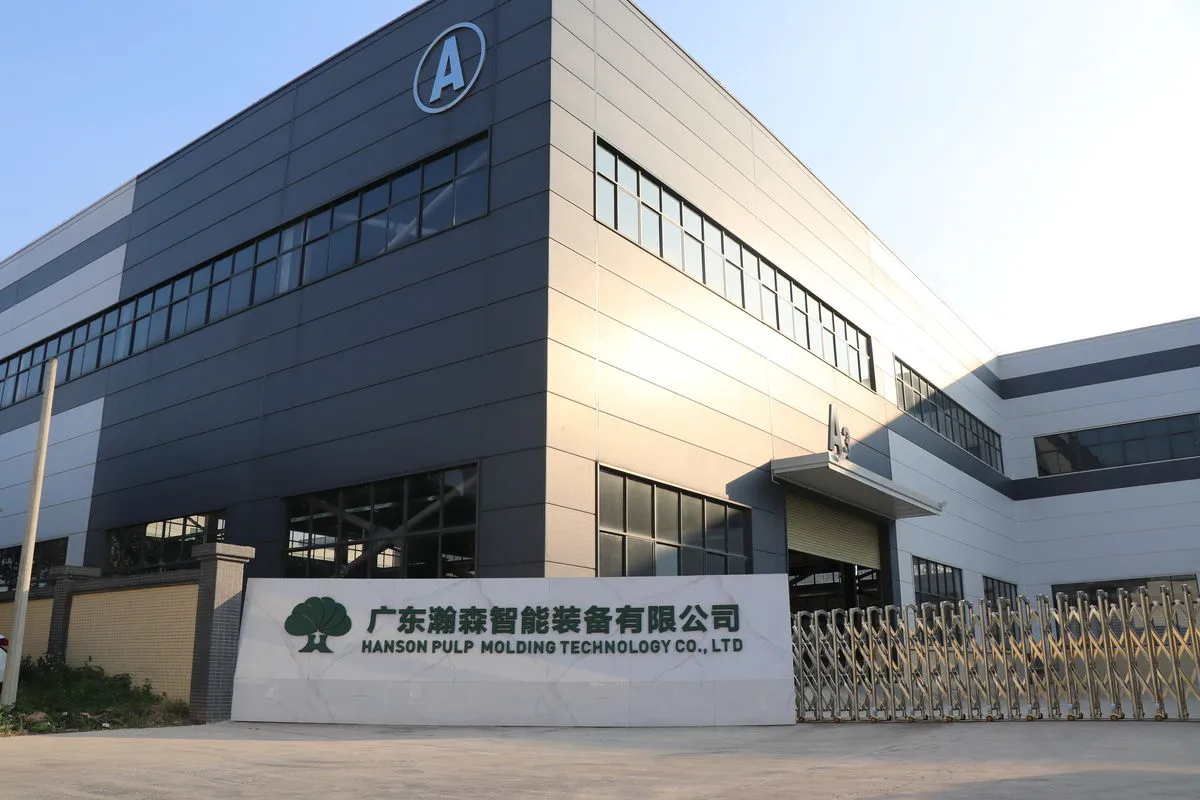
We Have The Best Solutions for Your Business
HANSON was founded in 2022 in Dongguan, Guangdong Province, China. Our 50,000 square meter facility employs more than 200 people, including a 50-engineer R&D team, and ships around 150 units a year to customers in more than 20 markets worldwide. We manufacture complete tableware production lines, premium industrial packaging equipment, plant-fiber cup lid lines and sampling lines, turning bagasse, bamboo fiber and recycled paper into tableware, egg trays, cup lids, cup carriers and protective packaging. What sets us apart is our independent mold division: with product development, mold design, manufacturing and testing all in house, we control the factor that decides how wide your product range goes and how reliably you hold tolerances. We deliver projects end to end, from feasibility analysis and factory layout to installation, commissioning and operator training, backed by 10 service locations and engineers who can stay on site through your ramp-up. Our equipment is CE certified and protected by 50 patents. Send us your product list and output target, and we will recommend the configuration that fits.
The short version
Pulp molding equipment is not one machine but a set of stations: pulping, forming, pressing, drying, trimming and any finishing step. The forming station and the press determine product quality; the dryer usually determines capacity. Buy equipment in a configuration you can expand rather than a single fixed unit.
The Stations That Make Up Pulp Molding Equipment
Pulping equipment prepares the furnish. A pulper breaks bales or loose fiber into a slurry, a refiner adjusts fiber length and freeness, and a chest holds the prepared stock at a controlled concentration. On a small line the pulper and chest may be combined; on a large line they are separate vessels with automated dosing. The capacity of this section sets the ceiling for everything downstream, and buying a pulper that barely meets average demand leaves no room for a peak week.
Forming equipment deposits fiber onto a mold. The mold dips into the slurry, vacuum draws water through the mesh, and a mat of fiber builds on the surface. Forming stations can be arranged as a single head for low volume work, a rotary configuration for continuous production, or a multi head arrangement running several molds in parallel. On a reciprocating machine the mold moves in a straight line; on a rotary machine it travels around a drum. Each arrangement has different changeover characteristics and different cycle behavior.
Pressing equipment finishes the shape and sets the density. Hot pressing removes remaining water, compacts the fiber and produces surface quality. Some processes press in a heated mold immediately after forming; others dry first and press later. The choice affects surface finish, energy consumption and the achievable wall thickness, so it should be made against your product rather than against a generic preference.
Drying equipment removes the water the press cannot. Drying is usually the largest energy consumer in the plant and often the capacity bottleneck, because a fast former feeding a slow dryer simply builds work in progress that then reabsorbs humidity while it waits. Trimming equipment cuts the part to final shape and separates flash, and finishing equipment covers any printing, coating, inspection or stacking step your product needs.
| Station | What it determines | Common sizing mistake |
| Pulping and refining | Fiber quality and plant ceiling | Sized for average demand, no peak headroom |
| Forming | Wall uniformity and cycle time | Cavity count chosen before product range is known |
| Hot pressing | Surface, density and stiffness | Press capacity mismatched to dryer throughput |
| Drying | Real daily output | Treated as a utility rather than a capacity limit |
| Trimming and finishing | Edge quality and labor cost | Manual handling on a high volume product |
Process Routes: Matching Equipment to Product
The three common process routes each suit a different product family. The thick wall route presses the part in a heated mold while it is still wet, producing a dense, strong part with a smooth surface, which suits tableware and industrial inserts. The transfer route forms and partially dries the part before pressing, which allows faster cycles on thin walled products and works well for egg trays and cartons. The free drying route forms the part and dries it in an oven before any pressing step, which suits products where a softer texture is acceptable.
Choose by product, not by preference. A plant that runs tableware and egg trays on the same machine will find that one route serves one product better than the other, and trying to compromise usually means running both below their potential. If your business plan includes two very different product families, model the cost of two configurations against the benefit of one flexible one.
Energy consumption follows the route. Pressing while wet removes water mechanically and costs less energy than evaporating it in a dryer, so routes that press early generally use less energy per piece. That advantage has to be balanced against cycle time, because a wet press takes longer than a transfer press on the same product.
Configuring Pulp Molding Equipment for Your Scale
First time buyers should specify around the product they can sell, not the capacity they can imagine. Write down the three products you expect to ship in the first year, the annual volume for each, and the largest and thickest part among them. Then ask suppliers to quote a configuration that handles that range at a sustained rate, including changeovers between products.
Expanding plants should specify around the bottleneck rather than the headline. If your existing dryer limits throughput, adding forming capacity achieves nothing. Analyse each existing station's real capacity, find the constraint, and buy equipment that relieves it. This is usually cheaper than a new line and always cheaper than a line that sits idle.
Both groups should insist on expansion capacity in the utilities. Floor space, power supply, water treatment headroom and pulper volume are cheap to provide at construction and expensive to add later. Ask the supplier to show the utility demand at your starting configuration and at a doubled configuration, then size the building services for the larger number.
Automation Level and Labor Cost
Automation decisions should follow labor cost and product consistency requirements in your market, not a general preference for advanced machinery. On a thin margin product like an egg tray, labor per thousand pieces decides the contract, so automated stacking and transfer justify themselves quickly where wages are high. On a specialized industrial insert produced in small batches, flexible manual handling may be more economical than automation designed for volume.
Control systems matter as much as mechanical automation. A line with logging, recipe storage and alarm history lets you diagnose problems from data instead of from memory, and it makes customer audits and certification straightforward. When comparing offers, ask what the control system records and how recipes are stored and recalled. A machine that requires an experienced operator to remember settings for every mold is a machine that stops when that operator leaves.
Remote support capability is worth checking. Equipment that allows the supplier to review operating data remotely shortens troubleshooting dramatically, and it converts a week of exchanged emails into an hour of diagnosis.
Evaluating a Pulp Molding Equipment Supplier
The equipment is only part of what you buy. Tooling capability, commissioning support and spare parts availability determine what the plant looks like two years after installation. A supplier without an in house mold shop will subcontract tooling, which slows every design change and makes problem solving harder.
Ask for three references from plants running similar products, and speak to them about commissioning, not about the machine. How long did stabilization take, how responsive was support during the first months, and how quickly were spare parts delivered. Those answers tell you more than a specification sheet. The factory overview and the mold and tooling program are useful references when comparing suppliers on capability rather than price.
Confirm what training is included and where it happens. Sending your line supervisor to the supplier before shipment is the single highest value item you can negotiate, because the person who understands the machine best should be the person running it, not a visiting technician who leaves after a week.
Commissioning and Ramp Up
Commissioning is a learning period, not a handover event. Expect several weeks between first good parts and stable production, and plan your customer commitments around that timeline. The learning curve covers freeness control, vacuum tuning, press recipes and the changeover sequence for each mold.
Start measurement routines from day one. Record the parameters for every mold the plant runs, and keep first article samples for each product with the dimensional measurements that accompanied them. When a problem appears six months later, comparing against a known good sample resolves it in hours instead of days. Our project services team structures commissioning around this data rather than around a checklist.
Plan the ramp against real demand. Running the machine at design speed before the crew has mastered it produces rejects and erodes confidence. Bring speed up gradually, hold quality first, and let the schedule follow the process rather than pushing the process to meet the schedule.
Final Thoughts
Pulp molding equipment should be specified against a defined product range, a realistic volume and a plan for growth. The forming station and press determine quality, the dryer determines capacity, and the supplier's tooling and commissioning support determine what the plant looks like in two years. Buy the configuration that fits the business you can actually build, and leave room in the utilities for the one you hope to build later.
Describe your product range, annual volumes and available floor space, and we will prepare a pulp molding equipment configuration with station by station capacity figures.
We quote both a starting configuration and an expansion path so you can plan capital in stages.
Get an Equipment Configuration
Featured Products
Collection about HANSON




User Reviews
What users say about HANSON
Frequently Asked Question
Do you have any question?
Pulping and refining, forming, hot pressing, drying, trimming or die cutting, and packing. Each station has to be sized to the one downstream of it, because the slowest station sets the capacity of the whole system.
A single forming unit suits a niche product or a pilot operation where drying and finishing can be handled separately. A complete line integrates all stages and is the right choice when you need consistent output and predictable labor per unit.
Match automation to your labor cost and your quality requirement. In higher labor cost markets, automation at forming, pressing and inspection pays back quickly; in others, semi-automatic configurations deliver the same quality with lower capital outlay.
Whether they have run your product type before, whether they build their own molds, what commissioning support they include, and how they handle spare parts after warranty. The equipment itself is often similar; the support behind it is not.