
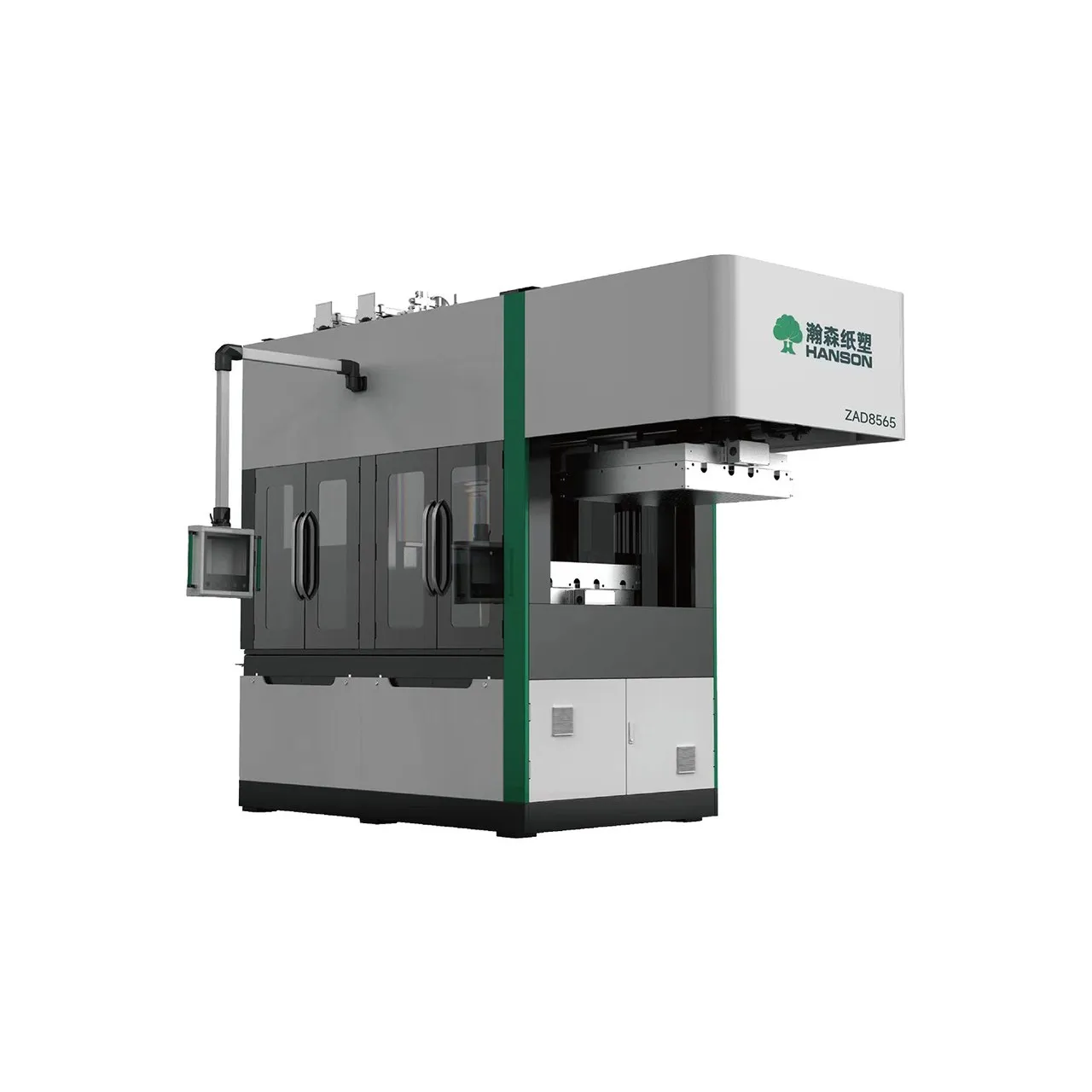
Features
Why Choose HANSON?
Our Own Mold Division, Design to Production
We run an independent mold division covering product development, mold design, manufacturing and testing. Because we build our own tooling, we control what decides your product range, how fast a new item reaches market, and how steadily you hold tolerances. We also optimize existing molds and retrofit equipment you already run, so a line that has lost its edge returns to spec without being replaced.
Complete Lines, Not Single Machines
Our portfolio covers tableware lines, industrial packaging equipment, cup lid lines and sampling lines, plus downstream automation for trimming, inspection, stacking and packing. Every station is engineered to the one after it, so the line reaches rated output instead of bottlenecking at the press or dryer. Start with one forming unit and expand into a full line as demand grows.
Turnkey Delivery With On-Site Support
We take a project from feasibility analysis and raw-material verification through layout, installation, commissioning and operator training. For turnkey projects we can place engineers on site and support ramp-up for up to six months — the period when most new plants either stabilize or stall. Ten service locations and 24/7 response keep that support running after warranty ends.
Proven at Scale, Certified for Regulated Markets
Our equipment runs in more than 20 markets, with roughly 150 units shipped a year and about half going to export customers across Europe, the Middle East, Southeast Asia and South America. Our forming equipment holds CE certification under the EU Machinery Directive, and 50 patents protect our structures, processes and automation systems. We serve listed companies, state-owned enterprises and leading packaging manufacturers.
We Have The Best Solutions for Your Business
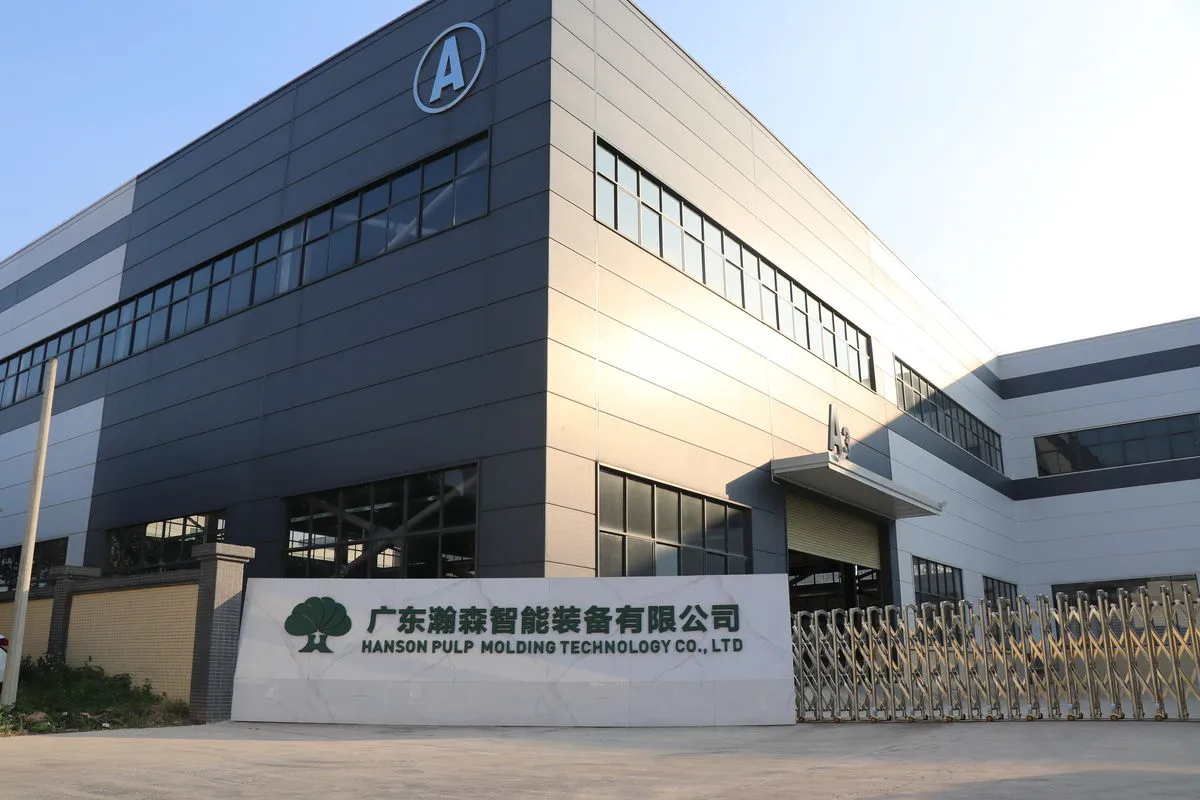
HANSON was founded in 2022 in Dongguan, Guangdong Province, China. Our 50,000 square meter facility employs more than 200 people, including a 50-engineer R&D team, and ships around 150 units a year to customers in more than 20 markets worldwide. We manufacture complete tableware production lines, premium industrial packaging equipment, plant-fiber cup lid lines and sampling lines, turning bagasse, bamboo fiber and recycled paper into tableware, egg trays, cup lids, cup carriers and protective packaging. What sets us apart is our independent mold division: with product development, mold design, manufacturing and testing all in house, we control the factor that decides how wide your product range goes and how reliably you hold tolerances. We deliver projects end to end, from feasibility analysis and factory layout to installation, commissioning and operator training, backed by 10 service locations and engineers who can stay on site through your ramp-up. Our equipment is CE certified and protected by 50 patents. Send us your product list and output target, and we will recommend the configuration that fits.
The short version
An industrial packaging pulp molding machine makes protective inserts, not consumer tableware. Dimensional accuracy, wall thickness control and the ability to mold deep pockets decide whether the insert protects the product. Every insert is engineered against a drop test specification, and tooling design carries most of the risk in the project.
How Industrial Packaging Differs From Tableware
Tableware is judged on appearance, feel and food contact compliance. Industrial packaging is judged on protection and fit. A plate with a slightly uneven rim is still a plate. An insert with a cavity that is half a millimeter too tight will not accept the product on an assembly line running hundreds of units an hour, and the customer will reject the entire delivery.
Walls are thicker on industrial parts because they carry compression loads. A protective insert supports the product through the corners and ribs rather than across the face, and the design has to route load from the product into the shipping case. That load path is a mechanical engineering problem, and it determines where material goes and where it does not.
Product runs are shorter and changeovers more frequent. A tableware plant may run one plate shape for months. An industrial packaging plant may produce five different inserts in a week for five different customers, each with its own mold and its own tolerances. Flexible tooling changeover and fast process setup are worth more here than peak cycle speed.
| Dimension | Tableware lines | Industrial packaging lines |
| Primary requirement | Appearance and food contact | Protection and dimensional fit |
| Wall thickness | Thin, material saving | Thicker where load is carried |
| Run length | Long, single product | Short, many products |
| Validation | Food contact testing | Drop, vibration and compression testing |
Engineering an Insert That Actually Protects
Protective design starts from the product and the hazard, not from the mold. Define the product's mass, its fragile features and the drop height the package must survive. Then design the load path: which faces carry compression, where the ribs run, and how much crush distance the fiber provides before the product contacts the case. Molded fiber protects by absorbing energy through controlled deformation, and a design that does not allow for that deformation transfers shock straight to the product.
Ribs and corner posts do the structural work. A flat insert face looks clean in a drawing and collapses under load. Ribs running perpendicular to the expected impact direction convert a thin wall into a stiff panel, and adequately sized corner posts take the compression load from stacking. Ask your tooling supplier to show the rib layout for a similar product they have delivered.
Clearance to the product surface matters as much as structure. The cavity should locate the product without gripping it, because a fiber surface in constant contact with a polished component can mark it. Specify the clearance in the drawing and verify it on first article samples with the real product, not a proxy.
Process Control on an Industrial Packaging Pulp Molding Machine
Thick walled parts drain more slowly than tableware, and the difference in drainage time between a 2 millimeter wall and a 4 millimeter wall is not linear. The forming stage must be tuned so the mat builds evenly and the vacuum does not pull fiber preferentially toward the mesh. Uneven mat density is the root cause of most dimensional problems in industrial inserts, and it shows up as a cavity that is tight on one side and loose on the other.
Pressing determines both density and final dimension. Industrial inserts are pressed harder than tableware because density is what creates crush resistance, but over-pressing creates internal stresses that show up as warping days later. The window between enough and too much is narrower than most new operators expect, which is why a documented press recipe per mold matters.
Drying completes the process and is often the capacity bottleneck. Thick sections hold water longer, and a part that leaves the dryer with a damp core will continue to change dimension in storage. On industrial work where a half millimeter matters, verify moisture content rather than relying on dryer residence time.
Fiber Selection for Protective Packaging
Recycled paper fiber is the workhorse of industrial packaging and it performs well, provided the blend is controlled. Long fiber content improves tear resistance and crush performance, so old corrugated containers are a better base than mixed paper for parts that must survive severe drops. Newspaper fiber improves drainage but weakens the part, so use it as a minor component.
Plant fibers such as bagasse and bamboo give higher strength at lower density, which can reduce part weight and material use on load bearing inserts. They also support a renewable material story that matters when your customer is an electronics brand with public sustainability commitments. The tradeoff is fiber cost and a slower cycle, and whether that pays depends on how much your customer values the claim.
Additives for industrial parts focus on water resistance and dimensional stability rather than food contact compliance, though the same migration rules apply if the insert contacts a food product. Specify additive chemistry with the destination market in mind rather than defaulting to whatever the supplier stocks.
Sizing and Configuring the Line
Capacity planning on an industrial line starts with the number of different parts you will run, not with a single output figure. If you produce five inserts for five customers, your effective capacity is reduced by changeover time between each run. Model the realistic schedule: how many hours of actual forming time you get per week after changeovers, cleaning and maintenance, then apply that to the cycle time of your smallest part.
Tooling changeover speed is therefore a specification worth negotiating. Ask how long a mold change takes, what tooling is needed, and whether the machine allows preheating an idle mold while the previous one finishes. Plants that cut changeover time in half effectively gain capacity without buying anything.
Verify the machine can handle your largest and thickest part, not just the average. A line specified around a small insert may struggle with a deep pocket or a heavy wall, and the buyer discovers the limit after installation. Share your full product range with the supplier before the offer is written, including the part you expect to add in two years.
Tooling and Validation Workflow
Industrial tooling follows an engineering workflow: design, prototype, first article, drop test, revision, production. Skipping the prototype stage is the most expensive shortcut in this business. A single trial mold that costs a fraction of production tooling will reveal fit problems, rib weakness and drainage imbalance before you commit to a multi cavity production tool.
Validation should mirror the real shipping environment. Drop tests from the specified height on the specified faces, compression tests under the stacking load the pallet will see, and vibration testing where the customer's distribution route involves long road transport. Documenting these tests creates the evidence file your customer's packaging engineer will ask for, and it protects both parties if a damage claim arises.
The mold and tooling program walks through how these tools are developed and verified. For the broader equipment context, the industrial packaging machinery collection shows the range of forming platforms available.
Serving Customers Who Are Replacing Foam
Most industrial packaging projects today are driven by a customer who has to remove expanded foam or rigid plastic from a product line. That customer usually has an existing packaging design, an assembly line that expects a certain presentation, and a deadline set by regulation. Understanding their constraint is more valuable than any machine feature, because the transition has to work on their line from day one.
Expect to produce first article samples for their packaging engineering team and to iterate. Fibre inserts rarely match a foam part exactly in feel and tolerance on the first attempt, and the customer will compare unpacking experience as well as protection. Plan two design cycles into your project schedule rather than promising a single pass.
Once the design is locked, volume tends to follow. An electronics or appliance manufacturer that qualifies a fiber insert typically rolls it across a product family, which is why winning the first application matters far more than the first order value. Our project services team supports this design and qualification process from first article through production ramp.
Final Thoughts
An industrial packaging pulp molding machine is an engineering investment more than a production purchase. The value comes from dimensional accuracy, thick wall capability and flexible changeover, and the risk sits in tooling design. Prototype before you commit, validate against the real shipping environment, and build the customer's transition timeline into your own schedule. Do that and foam replacement work becomes a long term contract rather than a one off order.
Share your product dimensions, weight and drop test requirement, and we will propose an insert configuration and machine sizing for an industrial packaging pulp molding machine.
We include a tooling development plan with prototype and validation stages built in.
Submit Your Packaging Brief
Featured Products
Collection about HANSON




User Reviews
What users say about HANSON
Frequently Asked Question
Do you have any question?
Industrial parts are thicker, larger and held to tighter dimensional tolerances, and the buyer usually validates them with drop and vibration testing. That shifts the emphasis from surface finish and unit cost toward repeatability and documented performance.
Blends of recycled fiber are common, sometimes with additives to improve moisture resistance or cushioning. The correct furnish is the one that passes the customer's protection tests at the lowest cost, and it is normally fixed during mold trials rather than assumed.
Through the same test sequence the end customer uses: drop testing at the specified height, vibration testing for the transit mode, and compression testing for stacking. Passing those tests on a sample is the point at which a project becomes real.
Regulation in several major markets is restricting foam and single-use plastic packaging, and brand owners want packaging they can describe as recyclable in a single stream. Molded fiber satisfies both pressures while meeting the protection requirements that paperboard alone cannot.